This new article will show you everything you need to know about how to stop understimating yourself.
You get asked to lead a project at work. Pride? Not exactly. What you feel first is a quick, familiar flinch, the sense that somebody must have meant a different person.
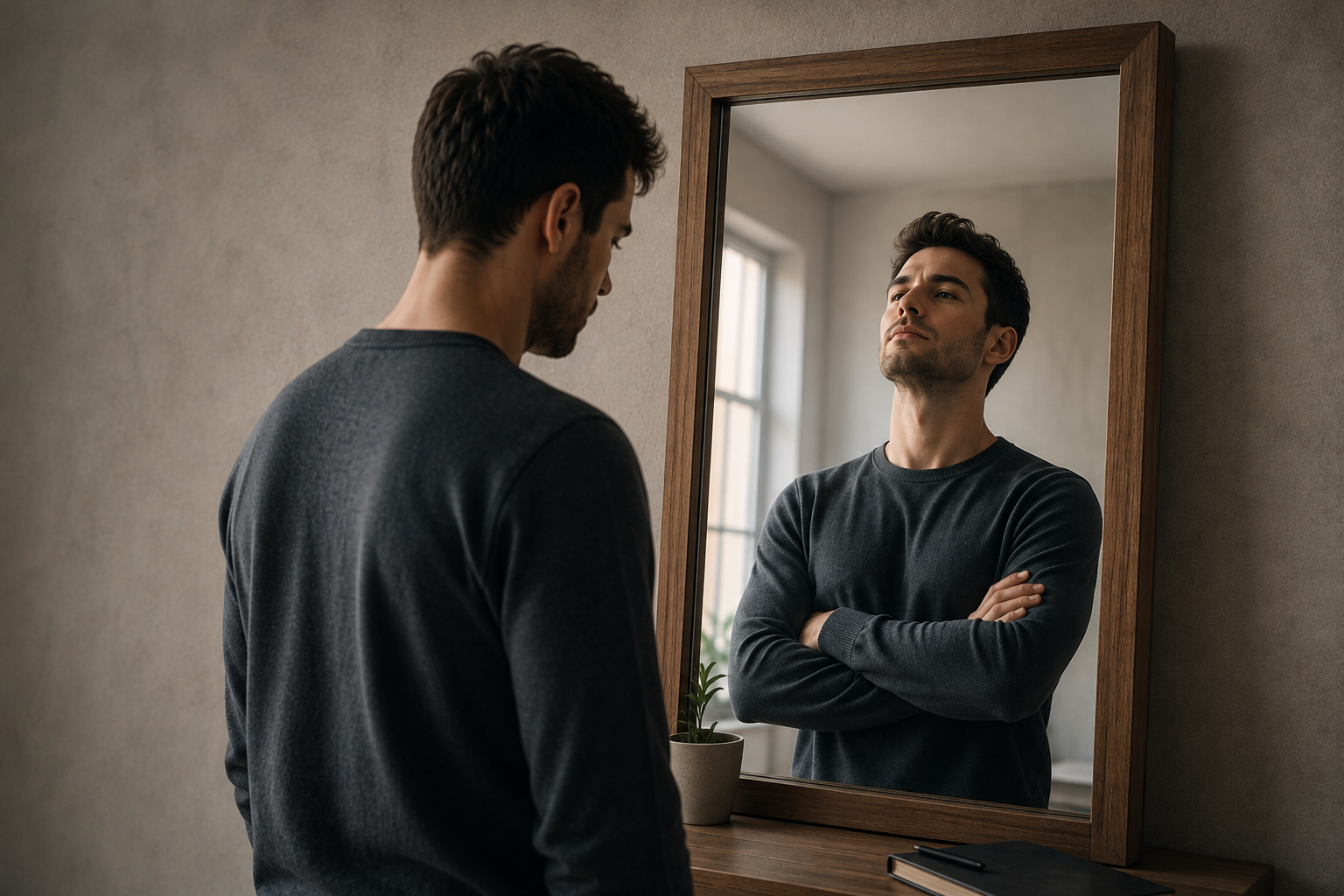
If that flinch sounds familiar, you’re in good company. Underestimating yourself is one of the most common habits among capable people, and it hides well because it passes for humility. It isn’t humility. Humility says “I still have plenty to learn.” Underestimating says “I probably can’t do this,” and it says so before you’ve tried anything.
The damage is rarely dramatic. You skip the audition, let a colleague present your idea, and decide against the 10K, then spend a week wondering how it would have gone. None of these choices looks like a big deal when you make it, but they pile up, and after a few years you’re living a much smaller life than the one you were qualified for.
The habit does respond to practice, though. What follows are twelve approaches, each tied to research that holds up and each ending with a step small enough to take today. Nobody sensible tries all twelve at once, so pick two or three.
1. Check the evidence before you believe the doubt
Doubt shows up sounding like a fact. “I’ll fumble the presentation” feels like a forecast, when it’s usually a mood in a lab coat. Cognitive behavioral therapy built an entire method around this gap: you treat a thought as a claim and go looking for proof, instead of obeying it on sight.
Say the thought is “They’ll realize I don’t belong on this team.” Evidence for: you’re the newest person in the room. Evidence against: they hired you after several rounds of interviews, and your last two projects shipped without a single correction. Written down, the claim looks a lot shakier than it did in your head.
There’s also a reason to suspect your sense of “average” is set too high. In their 1999 experiments, Justin Kruger and David Dunning found that people who scored in the top quarter on tests of skills like logic and grammar placed themselves around the 70th to 75th percentile, although their real standing was closer to the 87th. (That figure comes from a 2008 follow-up by Joyce Ehrlinger and colleagues.) Skilled people often assume that what comes easily to them comes easily to everyone. The effect has been challenged on statistical grounds since, so treat it as a nudge rather than a law.
Give it a go: write your loudest doubt at the top of a page, then draw two columns, one for facts that back it up and one for facts that don’t. Opinions don’t count as facts here, and neither do feelings at 2 a.m. If you want more ideas for reshaping thought patterns, our list of 19 ways to think positively every day is a good companion.
2. Talk to yourself the way you’d talk to someone else
Does it matter whether you tell yourself “I can do this” or “you can do this”? Apparently so. Ethan Kross and colleagues published seven studies in 2014 (585 people in total) on exactly this: the words we use when we talk to ourselves. Participants who prepared for a stressful moment using their own name or “you” instead of “I” were rated as performing better by objective observers, both when making a first impression and when giving a speech. They also described the upcoming stress as more of a challenge and less of a threat.
Why would a pronoun matter? The researchers point to distance: “I can’t do this” puts you inside the panic, while “Maya, you’ve handled worse” puts you in the chair of an adviser, and advisers tend to be fairer than defendants. If using your own name feels silly, plain “you” counts too.
Harsh inner commentary is a bigger subject, and our guide on how to stop hating yourself goes further into it.
Next time, do this: before something that makes your stomach drop, silently say your own name followed by one plain instruction. “Maya, start with the first slide.” Boring works.
3. Keep a record of what you’ve actually done
Pauline Clance and Suzanne Imes described the problem back in 1978. They had worked with high-achieving women who held a stubborn belief that they weren’t really bright, despite their degrees and promotions. The achievements simply never registered as evidence.
Evidence doesn’t stick by itself. You have to store it somewhere you can find it, and the form matters. Albert Bandura’s 1977 paper on self-efficacy named four sources of belief in your own ability: performance accomplishments, watching others succeed, encouragement from other people, and your physical state. Adjectives like “reliable” or “creative” are a thin version of the first one. Events are better. “Led the Q3 handover and nobody had to redo anything” beats “I’m organized” every time.
Add the small promises you kept, too. Keeping a promise to yourself is a quiet way to build trust in your own word.
Open a note on your phone right now, call it “Receipts”, and add one entry before you close this tab.
4. Write about what you value
Lists of strengths have their place. Writing about your values is a different exercise, and there’s brain-imaging work behind it. In 2016, Christopher Cascio and colleagues scanned 67 sedentary adults. Those who had done a self-affirmation exercise showed more activity in regions tied to self-related thinking and to valuing things when they reflected on future-oriented core values. Stronger activity then predicted bigger drops in sitting time during a separate activity program.
It was one study with a modest sample, and a brain scan doesn’t prove a changed life. Even so, I’d argue the practical idea is sound. Confidence anchored in what matters to you has more traction than confidence borrowed from a slogan. It also points forward.
Questions about what matters most can run deep, and our guide to finding the meaning of life is there if you want to dig.
Start small: pick one value, such as curiosity or loyalty, and spend five minutes writing about the last time you acted on it. Then sketch next month’s version.
5. Go easy on yourself after a stumble
The usual objection goes like this: be kind to yourself and you’ll stop trying. Juliana Breines and Serena Chen put that to the test in 2012, across four experiments. In one, students who had just struggled with a difficult test and then received a self-compassionate message spent more time studying for the next one than students given a self-esteem boost. Accepting the failure made people more willing to work on it.
That fits what harsh self-criticism does in practice. It turns a mistake into a verdict, and people tend to avoid verdicts. A piece of information is much easier to act on.
Noticing what you feel in the moment is half of this skill, which is one reason our piece on improving emotional intelligence pairs well with it.
A quick experiment: after your next small failure, write down two sentences you’d say to a friend in the same spot. Then read them back as if they were addressed to you.
6. Retire the comparison game
Leon Festinger proposed in 1954 that people work out how good they are by looking at others. That’s fine when the others are real and nearby. It goes wrong when your comparison group is the internet.
Erin Vogel and colleagues (2014) found that people who used Facebook most often had lower self-esteem, and that exposure to upward comparisons helped explain the link. In a second experiment, participants who viewed a profile packed with upward-comparison cues, such as a busy social life and healthy habits, reported lower self-esteem than those who viewed a profile with downward cues. One look was enough.
You know your own drafts and deleted messages. Of everyone else, you see only the published version. That match is rigged. Our longer guide on how to stop comparing yourself to others has sixteen more tactics.
Your move: the next time you catch yourself measuring, name one thing the other person is good at and one thing you’re good at. Then go back to your own work.
7. Trim the scroll
What happens if you just use social media less? Melissa Hunt and her team at the University of Pennsylvania answered that with an experiment in 2018, rather than a survey. They randomly assigned undergraduates to cap Facebook, Instagram and Snapchat at about 30 minutes a day for three weeks, or to carry on as usual. The group that cut back reported significantly lower depression and loneliness at the end. Both groups also felt slightly less anxious and less afraid of missing out, which hints that simply paying attention to your habits helps a little.
The study measured mood, not confidence, and the participants were students. Hunt herself pointed to reduced social comparison as a likely reason, though, and that’s exactly the mechanism from the previous section. If the endless feed is where your time disappears, our guide on how to stop doomscrolling offers a way out.
Open your phone’s screen-time report today, put a daily cap on the one app that leaves you feeling worst, and give it three weeks, the same stretch the Penn study used. Whatever time you win back can go to something that leaves a record in your Receipts note.
8. Treat mistakes as information
Picture two people who send the same client email with the same typo. One thinks, “I’ll proofread more carefully next time.” The other thinks, “I’m sloppy, and everyone can tell.” Identical error, completely different next move.
Jason Moser and colleagues at Michigan State University looked at what separates the two. In 2011 they recorded brain activity in 25 undergraduates doing a task built to provoke errors. People who believed intelligence grows with effort showed a stronger brain signal linked to noticing and attending to mistakes, and they were more accurate right after an error. Small sample, so don’t build a worldview on it.
If you underestimate yourself, you’ve probably filed mistakes under the second heading for years. Moving them to the first is a learnable skill. Part of it is taking responsibility for your actions without punishing yourself for them.
Test it this week: after any mistake, however minor, write one answer to a single question. What will I do differently next time? The question “why am I like this?” is banned.
9. Collect proof in small doses
Your doubts only lose their grip when something happens that contradicts them. Albert Bandura argued in 1977 that persisting at activities that feel threatening but are actually fairly safe produces experiences of mastery, and that those experiences raise self-belief while lowering avoidance. It’s the logic behind exposure therapy, and it works at a smaller scale too.
The trick is the dose. Jumping from “never speaks in meetings” to “keynote speaker” is a recipe for a bad experience. That’s precisely what the doubt predicted. A better ladder starts low: ask one question in a meeting this week, then share a rough draft next week. Each rung is small enough to survive. It’s also real enough to count.
If starting is where you stall, our strategies to beat procrastination were written for that moment.
Here’s a simple way in: pick something one notch beyond comfortable, where the cost of flopping is small. Offer an idea in a team chat, or sign up for a 5K. Put a date on it before you go to bed tonight.
10. Ask the people who watch you work
In the original Kruger and Dunning experiments, top scorers who got to see how other people had performed adjusted their own estimates upward. What helped was a better yardstick.
You can borrow that effect without a psychology lab. Colleagues and friends see parts of you that you can’t, and they tend to notice the things that come easily to you, because those are the things you’ve stopped noticing. Asking feels exposed. Ask anyway. Good questions get better answers, which is why asking thoughtful questions is worth practicing: “What do you rely on me for?” gets you far more than “Am I any good?” And when the answer comes, resist the reflex to wave it away. Say thank you, and write it down.
Message two people you trust today and ask what they’d come to you for. Paste their answers into your Receipts note.
11. Calm your body before you argue with your mind
Self-doubt has a physical side: a tight chest and a racing pulse. Reasoning with your thoughts is harder in that state.
A 2023 randomized trial led by Melis Yilmaz Balban at Stanford compared three five-minute daily breathing exercises with five minutes of mindfulness meditation over a month. Everything improved mood, but the exhale-focused exercise, called cyclic sighing, did best, beating meditation on mood and on lowering breathing rate. Meditation has its own record. A 2014 review by Madhav Goyal and colleagues pooled 47 trials with 3,515 participants and found small to moderate improvements in anxiety, depression and pain from mindfulness programs, though no evidence that they beat other active treatments such as exercise.
These studies tracked mood and stress, not self-belief, so the reasonable inference is a modest one: a calmer body gives you a fairer shot at thinking clearly. Nerves also spike when outcomes feel unknown, and our piece on dealing with uncertainty in life covers that side.
Before your next big moment, breathe in through your nose, then let the exhale run longer than the inhale. Keep going for about a minute.
12. Look after the basics: movement and sleep
You won’t think your way into confidence on four hours of sleep. That’s my view, and the research backs the boring stuff. A 2023 umbrella review led by Ben Singh pulled together 97 reviews covering 1,039 trials and 128,119 participants. It found medium-sized improvements in depression, anxiety and psychological distress from physical activity, with programs of 12 weeks or less working best. Those are symptoms rather than self-belief, and most of the evidence concerned mild to moderate depression. But low mood and self-doubt are close neighbors.
Sleep has its own benchmark. In 2015, a panel of 15 experts convened by the American Academy of Sleep Medicine and the Sleep Research Society, with Nathaniel Watson as moderator, concluded that healthy adults should regularly get seven or more hours. The panel set no upper limit, so the seven-to-nine range you often see is a rule of thumb rather than a ceiling. For more on building routines that last, see our list of good habits to have in life.
Start small: take a ten-minute walk after lunch and move your bedtime fifteen minutes earlier. Hold both for a week before you add anything else.
When you slip back into old habits
You will. Probably this week.
At some point you’ll catch yourself turning down an opportunity, or replaying a conversation and concluding you’re not up to it. That doesn’t cancel your progress. It’s an older habit showing up, and it has years of head start on the new one.
The Breines and Chen finding applies here as well: self-compassion after a failure kept people working on it. So skip the trial. Name what happened in one sentence, such as “The old voice showed up before the interview,” and then do the smallest step from this list. Open the Receipts note, or say your name and an instruction, or take one slow exhale. Pick whichever takes under two minutes.
Then look at the trigger. Slips tend to cluster around particular situations: being tired, scrolling late at night, facing a new kind of challenge, spending time with someone who makes you feel small. Spotting your own pattern is more useful than promising never to slip again. On the rough days, our guide to getting over a bad day lays out fourteen intentional steps.
One more thing. If the doubt comes with weeks of low mood, constant anxiety or trouble getting through the day, take it to a doctor or therapist. Self-help has limits, and there’s no medal for going it alone.
Pick one and start today
Ending this habit takes better evidence about what you can do, plus a few small experiments to collect it. No new personality required.
So choose one idea from this article. Not the best one, the one you’d really do tomorrow. Do it, then tell a friend which one you picked, because saying it out loud makes it harder to quietly drop. When you want more where this came from, the Self Improvement section has plenty.