
If you want to know how to stop living on autopilot, you’re in the right place.
You get to Friday and can’t say where the week went. The commute happened. Lunch happened, probably at your desk. Somebody told you something that mattered to them on Tuesday, and you nodded along while drafting an email in your head.
That’s autopilot.
It’s also completely normal. Your brain automates whatever it can, because running routines in the background frees up attention for harder problems. The trouble starts when the automation creeps into the parts of life you actually wanted to be there for: dinner with your kids, a walk on a good evening, the conversation you’ll wish you’d remembered.
You won’t need a silent retreat to fix this. What helps is a handful of small, specific moves that pull your attention back into the room, and the research behind several of them is better than you might expect. Below are 12. Each one comes with the evidence (including where that evidence is thin) and one thing to do this week.
Pick two to start. Not twelve.
1. Catch the moment your mind leaves the room
The first skill is noticing. You can’t come back to the present if you never register that you left.
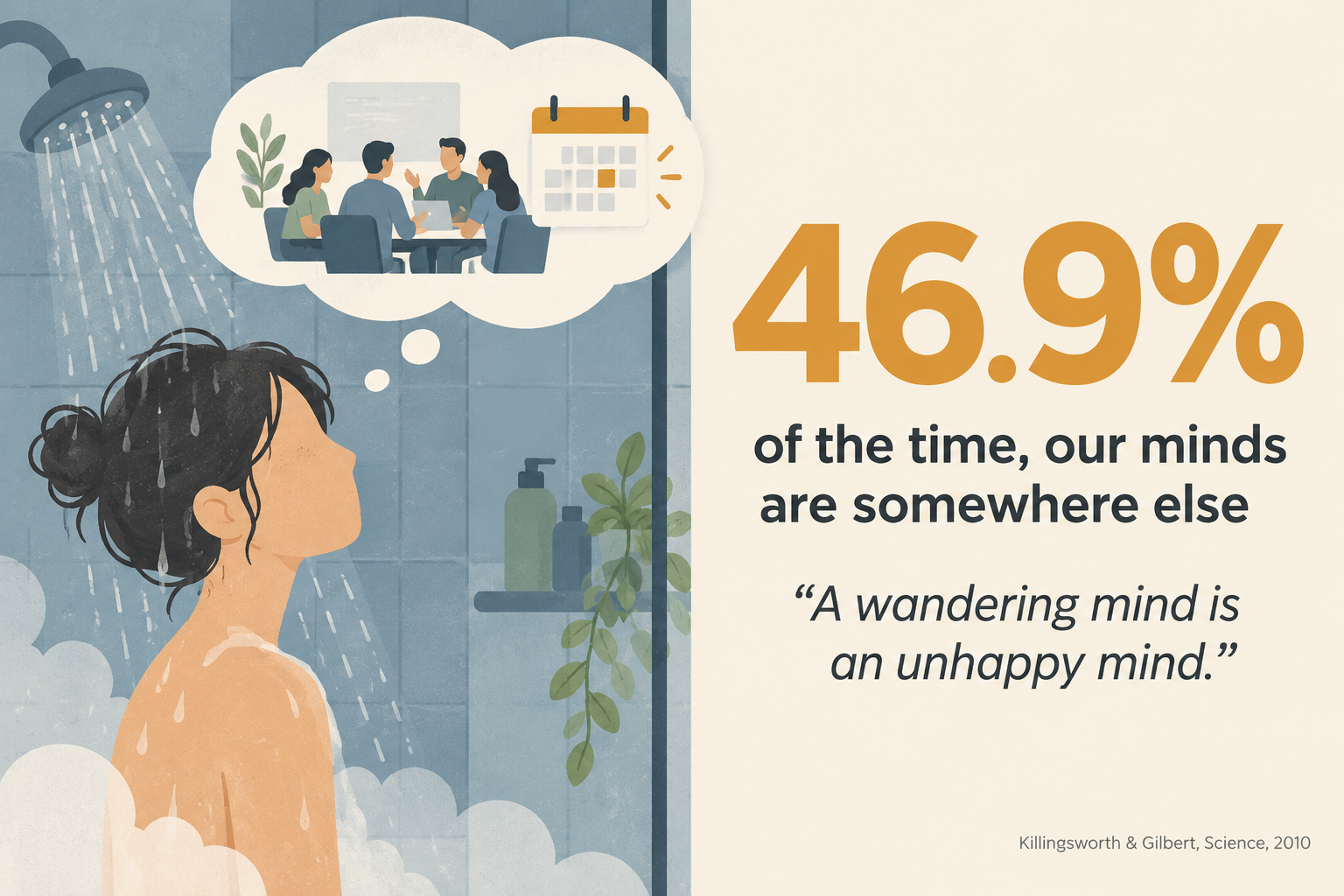
How often do we leave? In a study published in Science in 2010, Harvard psychologists Matthew Killingsworth and Daniel Gilbert built an iPhone app that pinged 2,250 adults at random moments and asked what they were doing, what they were thinking about, and how they felt. Across roughly 250,000 responses, people’s minds were somewhere other than the task 46.9% of the time. The figure stayed at or above 30% for every activity they logged except sex. People also reported feeling less happy while their minds were wandering, and time-lag analyses suggested the wandering tended to come before the dip in mood, which is why the authors concluded that “a wandering mind is an unhappy mind.”
Two caveats. The sample was people who owned an iPhone in 2010 and chose to download a happiness app, and the design can suggest a direction of cause without proving it. The study is old, too, but it’s still the benchmark later research measures itself against.
Picture this: you’re in the shower, already halfway through tomorrow’s meeting. Nothing is wrong with that. The point is to catch it.
Start small: pick one cue that happens many times a day, like touching a door handle or hearing the kettle click off, and use it as a check-in. Where is my mind right now? Don’t fix anything. Just notice. If the place it keeps going is the same worry on repeat, our guide on how to stop ruminating thoughts goes deeper.
2. Change one small thing in a routine you never think about
Here’s the mechanism behind autopilot, step by step.
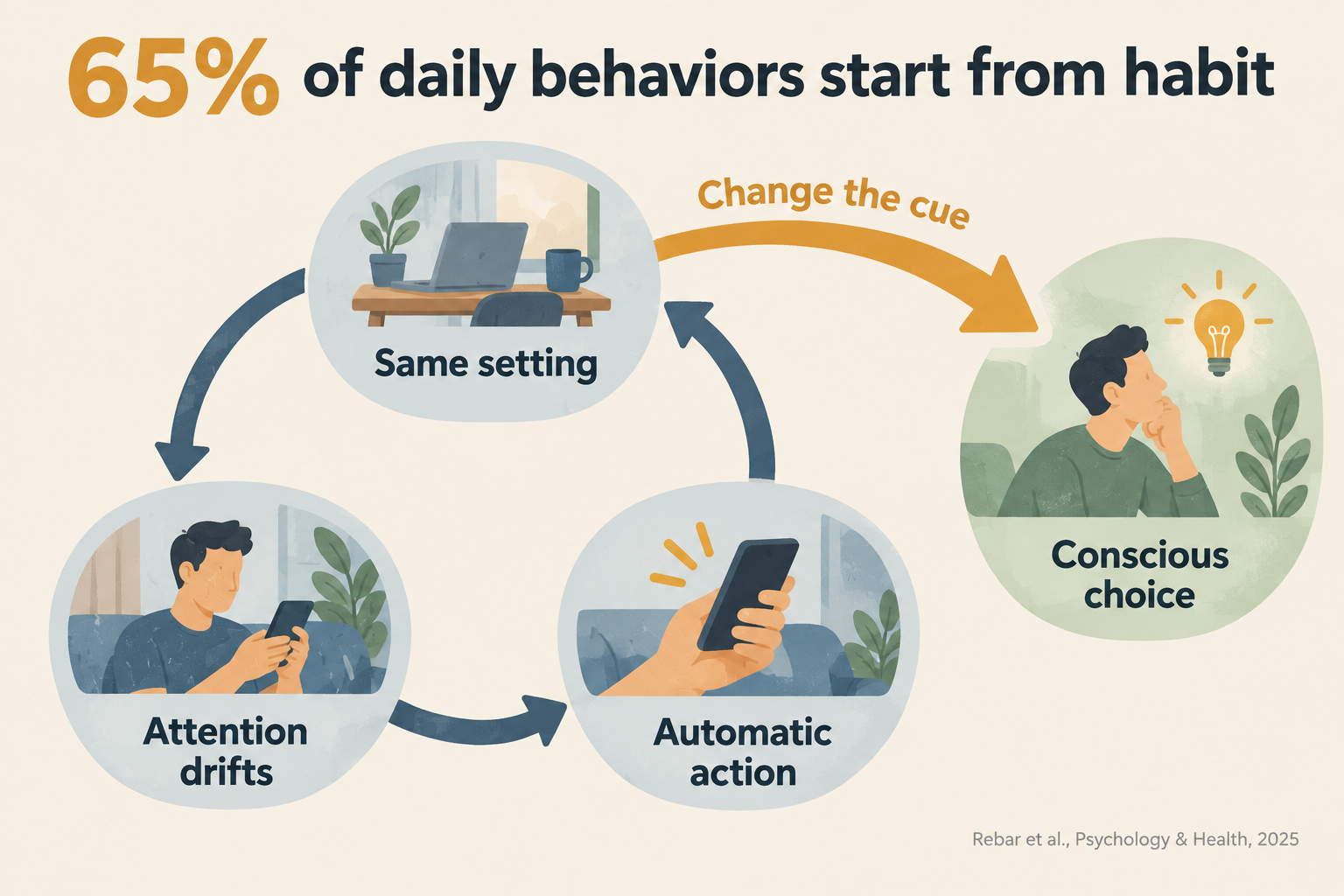
You repeat an action in the same setting. Your brain learns to link the two. After enough repetitions, the setting itself starts the action, before you’ve made any decision. Because the action no longer needs your attention, your attention goes elsewhere. That’s how you end up at the bottom of the stairs with no memory of walking down them.
How much of the day runs this way? A September 2025 study in Psychology & Health, led by Amanda Rebar at the University of South Carolina with colleagues at the University of Surrey and Central Queensland University, sent 105 adults in the UK and Australia six random phone prompts a day for a week. At each prompt, people described what they were doing and whether habit or a conscious decision had started it. Sixty-five percent of behaviors were habit-initiated. That’s well above the roughly 43% figure USC psychologist Wendy Wood has long cited from her earlier diary research.
The same logic runs in reverse. If a cue fires the routine, changing the cue forces the action back through conscious choice, and for a moment you’re awake to it. The researchers recommend exactly this, disrupting triggers, for breaking unwanted habits. A caution, though: their study measured how habitual life is. It didn’t test whether shuffling your routines makes you feel more present. That part is a reasonable inference from the mechanism, not a tested result.
Test it this week: move one thing. Sit in a different chair at dinner, or take another route to the shop. Then notice the small jolt of having to think. And keep the autopilot for the routines that deserve it; our list of good habits to have in life is a decent place to decide which ones those are.
3. Give your phone’s internet a break
This one has the strongest experiment on the list behind it.
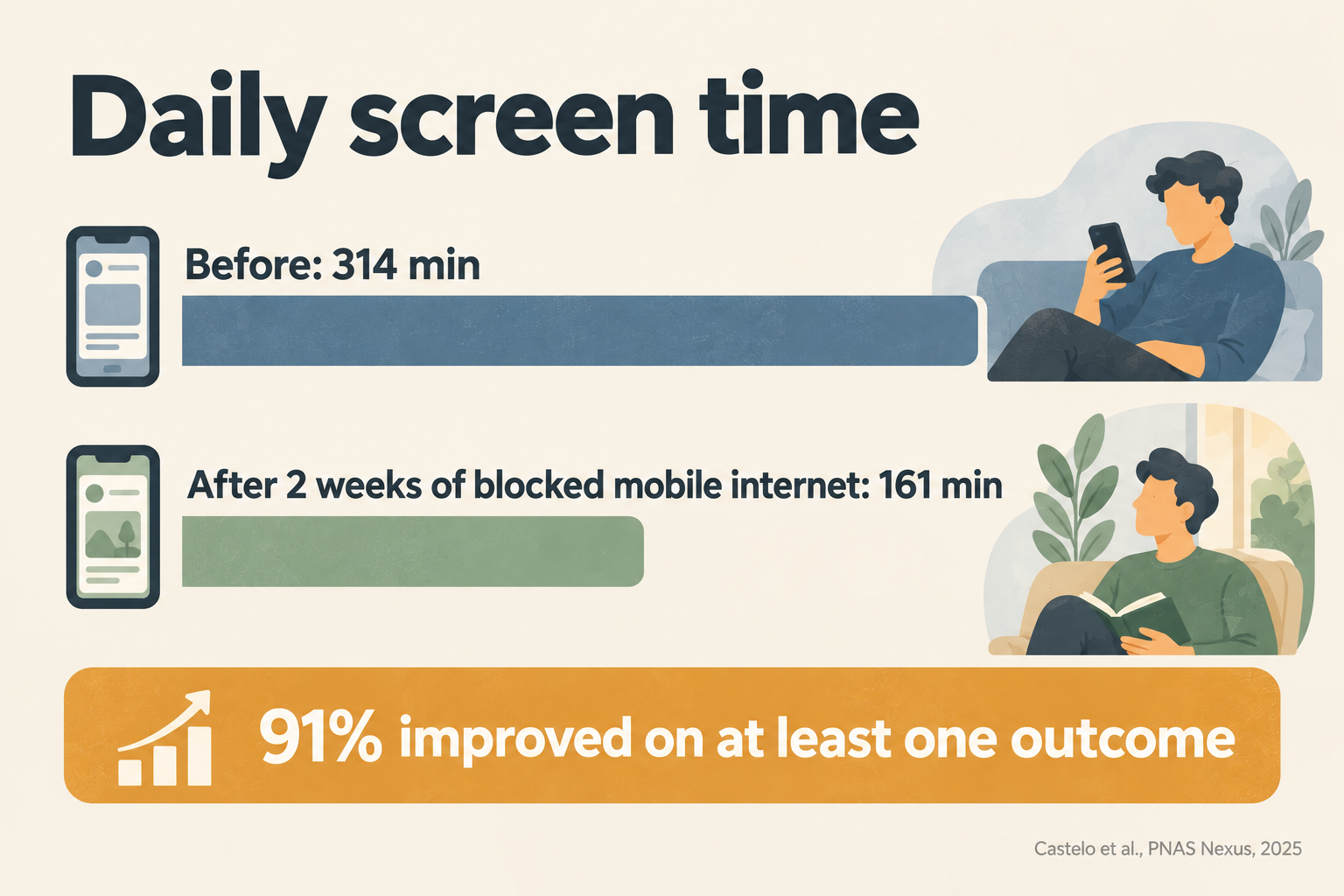
In a preregistered randomized trial published in February 2025, Noah Castelo (University of Alberta), Kostadin Kushlev (Georgetown), Adrian Ward (UT Austin), Michael Esterman and Peter Reiner asked 467 American and Canadian iPhone users, average age 32, to install an app that blocked mobile internet for two weeks. Calls and texts still worked. So did laptops and desktops. Half the group blocked first; the other half waited two weeks and then blocked.
Results from the 2025 PNAS Nexus trial led by Noah Castelo were striking. Daily screen time in the first group fell from 314 minutes to 161. Overall, 91% of participants improved on at least one of three measures: mental health, well-being or sustained attention. The gain in attention was about the size of 10 years of age-related decline, and the improvement in depression symptoms was larger than the average effect of antidepressants in meta-analyses, though the authors warn their sample and intervention were very different from clinical trials. People spent the freed-up time socializing face to face, exercising and being outdoors.
Now the honest part. Sticking to it was hard: only 119 of the 467 kept the block on for at least 10 of the 14 days. Participants knew the study was about phones, which can inflate self-reported benefits. Still, even people who broke the rules improved somewhat.
Here’s a simple way in: block mobile browsing and social apps for one fixed window each day, say 7 to 9 p.m., and leave calls and texts on. If you want a fuller reset, our guide to digital minimalism walks through the bigger version.
4. Do one thing at a time, and guard it
Single-tasking sounds obvious until you look at what a normal workday does to it.
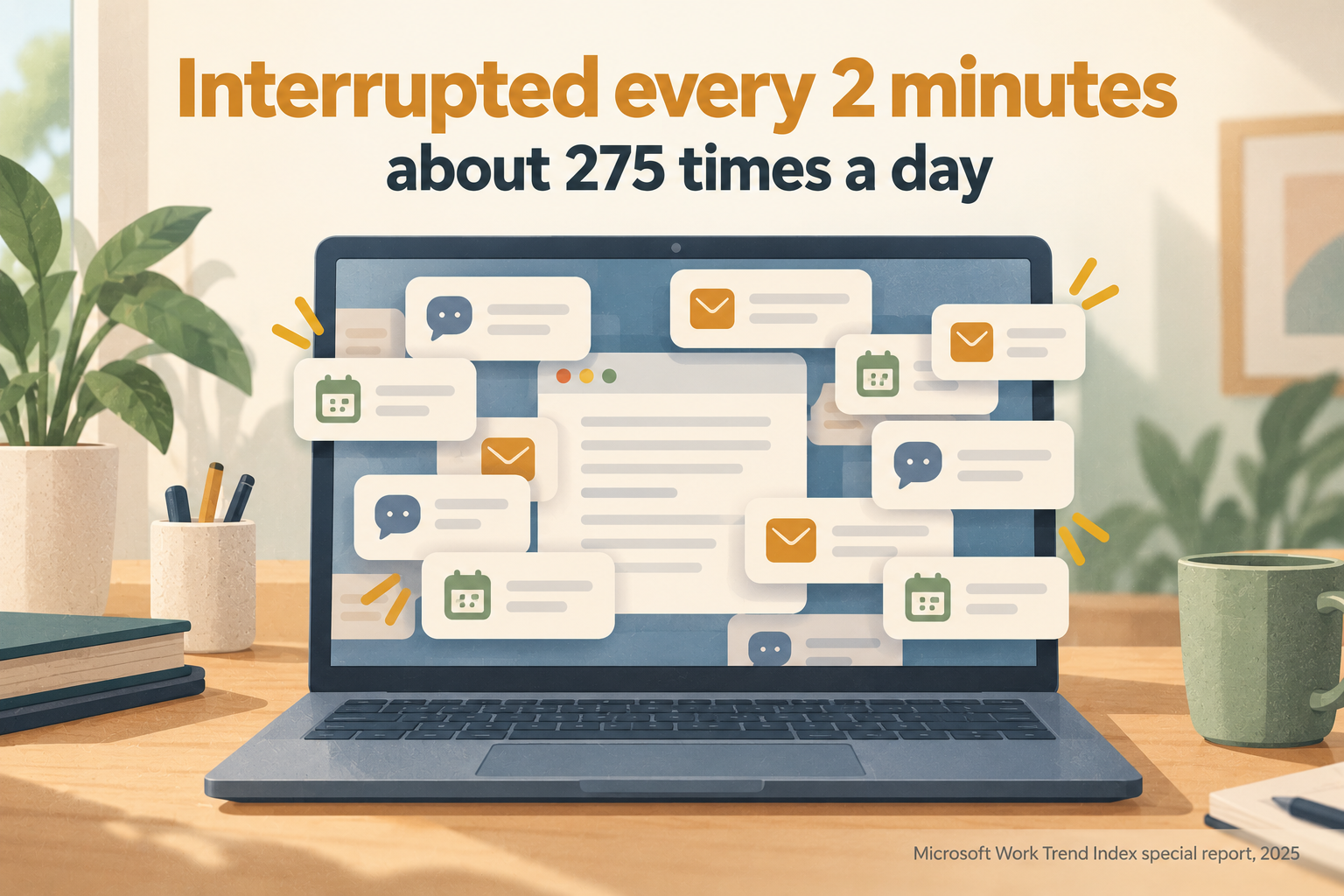
Microsoft’s Work Trend Index special report, “Breaking down the infinite workday,” published in June 2025, analyzed aggregated, anonymized Microsoft 365 activity from tens of thousands of workers. Its headline figure: during core working hours, the average worker was interrupted by a meeting, email or chat notification every two minutes, about 275 times a day. That data comes from heavy digital-tool users, so it describes office knowledge work more than life in general. Even so, it’s hard to be present for anything in two-minute slices.
Gloria Mark, professor emerita of informatics at UC Irvine, has measured this for two decades. In a 2024 University of California interview, she said that in her early-2000s studies people stayed on one screen for about two and a half minutes on average, and that by 2020 the figure had dropped to 47 seconds. She also pointed out that about half of our interruptions are self-inflicted: nobody pings us, we just go and check. Her advice is less “try harder” and more “design your day”: learn when your attention naturally peaks, and plan breaks before you’re running on fumes.
Your move: tomorrow, pick one task, close every other tab and app, and silence notifications until you notice your focus fading. Then take a real break. If you like the feeling of being fully absorbed, our piece on how to enter the flow state shows how to get there more often.
5. Train your attention in small daily doses
Mindfulness gets oversold. It also works, within limits that are worth knowing.
The newest evidence: a systematic review and meta-analysis by Anisha Rajan, Mahendra Kumar and Pranav Raj P, published in npj Mental Health Research in February 2026, pooled studies of mindfulness-based programs in adults without a clinical diagnosis, all of which measured stress with the same standard questionnaire. After the programs, perceived stress was lower by a moderate margin (a standardized mean difference of −0.53).
Shorter doses deserve more modest expectations. An earlier meta-analysis by Maya Schumer, Emily Lindsay and David Creswell (Journal of Consulting and Clinical Psychology, 2018), covering 65 randomized trials of brief mindfulness training, found only a small effect on negative mood, and the effect shrank further once the authors adjusted for unpublished null results. So five minutes a day is a starting point, not a cure.
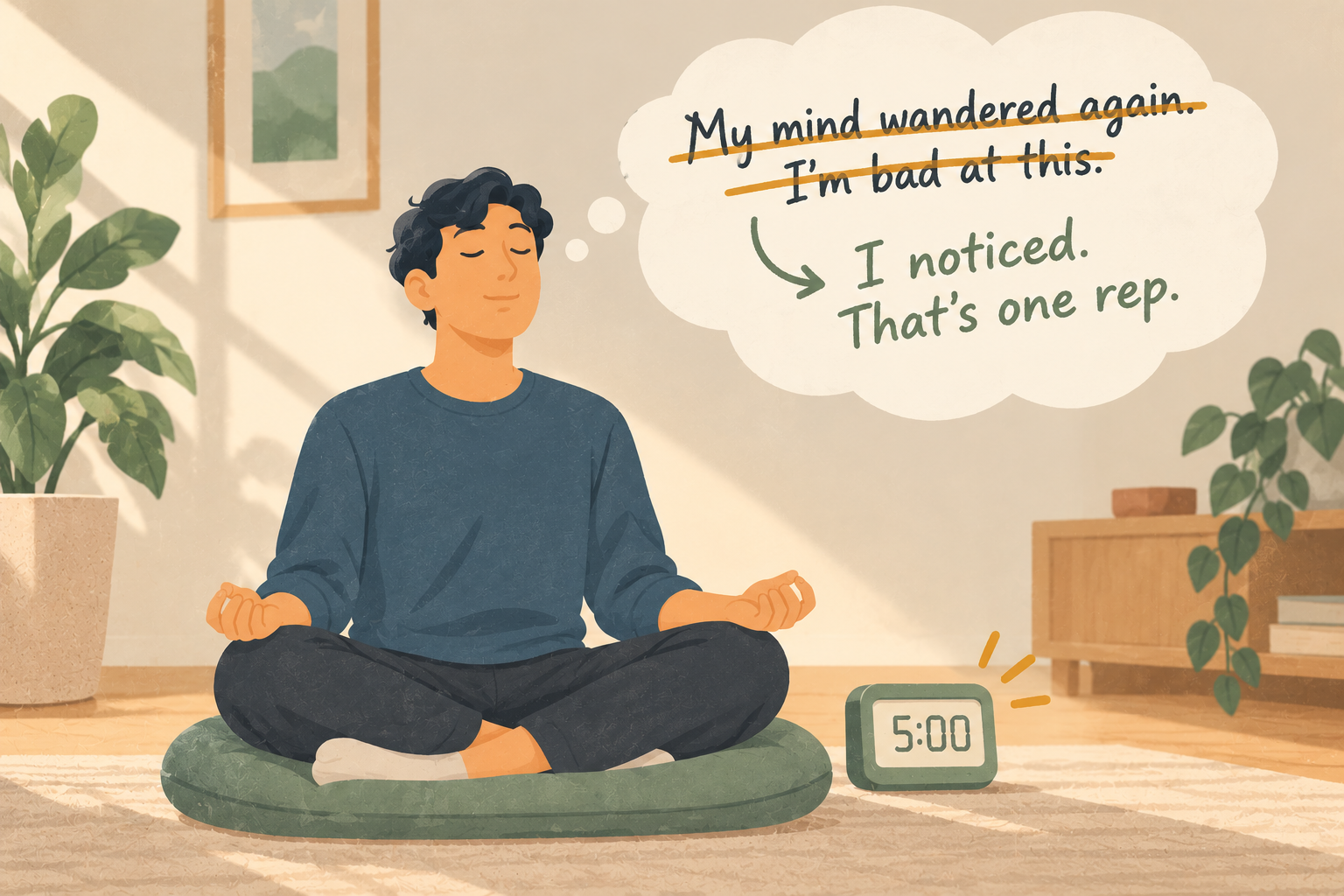
Why bother, then? Because the practice is a direct rehearsal of the skill this article is about: notice that attention has drifted, then bring it back without a lecture. Every time you catch yourself, that’s one repetition. Set a five-minute timer at the same time each day, follow your breath, and count the catches rather than the minutes of perfect focus. You’ll also get better at spotting what you’re feeling in the moment, which is the backbone of emotional intelligence.
6. Look up when someone’s talking to you
Most of us don’t think we ignore people for our phones. The tracking data disagrees.
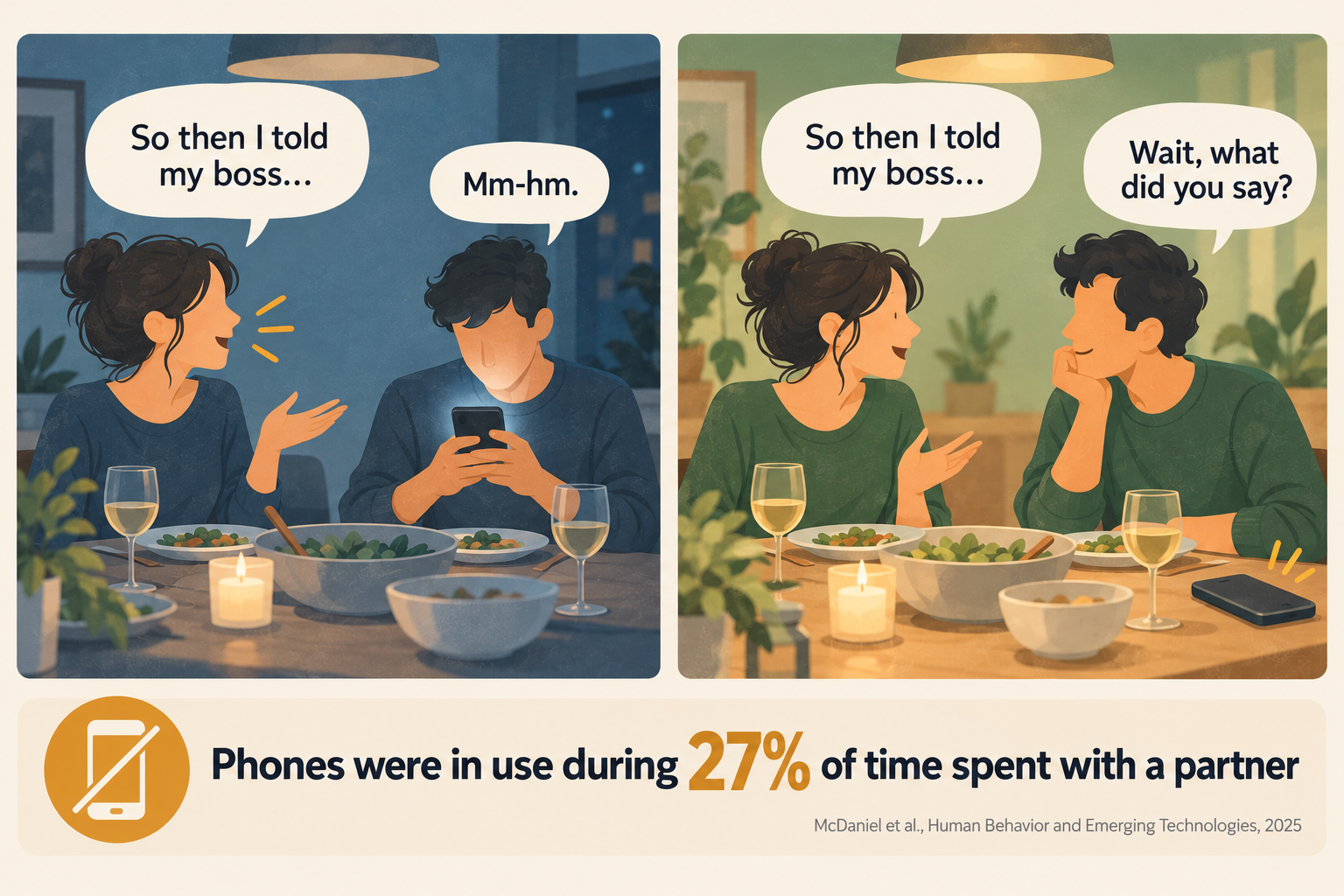
In a 2025 study in Human Behavior and Emerging Technologies, Brandon McDaniel, Sabrina Uva, Victor Cornet and Michelle Drouin measured smartphone use objectively for eight days in 247 adults, who also kept nightly diaries of when they were with their partner. Phones were in use during 27% of the time people spent around their partner, and 86% of participants used their phone around their partner every single day. Phone use during that shared time, not total daily phone use, predicted lower relationship satisfaction and lower co-parenting quality, though the effects were only significant for women. It’s a correlational study, so it can’t say the phone caused the drop.
There’s a large-scale real-world case that points the same way. From January 1, 2024, the Netherlands kept phones and other devices out of classrooms. A survey of 317 secondary schools, commissioned by the Dutch government and reported by Reuters in July 2025, found that three in four schools saw better concentration, nearly two-thirds saw a better social climate, and about a third saw better academic results. These are school reports rather than measured outcomes, and they describe teenagers, not couples. But the direction matches.
Next time, do this: when someone starts talking to you, put the phone face down and out of reach before they finish their first sentence. Then ask one follow-up question. Our guides on how to have good conversation and how to make eye contact without staring cover what to do with the attention you just freed up.
7. Spend 15 minutes somewhere green
You don’t need a forest. A park bench might do.
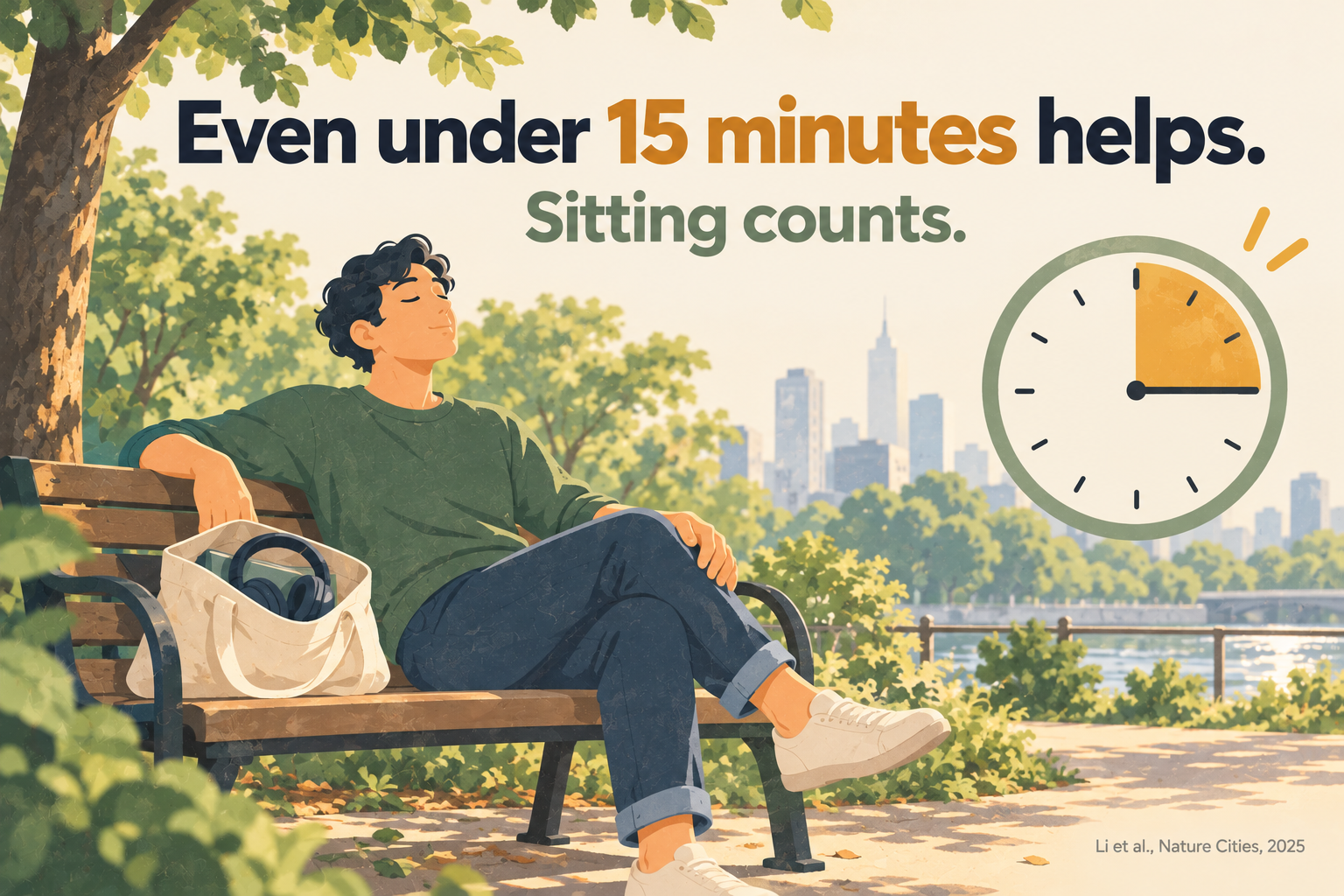
A 2025 Nature Cities analysis from Stanford’s Natural Capital Project, led by Yingjie Li with colleagues including Roy Remme of Leiden University, pooled 78 field experiments with close to 5,900 participants, all either randomized trials or before-and-after studies of time in urban nature. Every type of urban greenery helped. Even contact shorter than 15 minutes produced measurable mental health benefits, and sessions longer than 45 minutes produced bigger ones. Urban forests did best for depression and anxiety. One result stands out: sitting still in green space reduced negative outcomes such as depression more than being active there.
Limits apply. Before-and-after designs are weaker than randomized ones, and effects were larger in Asian countries, so the size of the benefit won’t be the same everywhere.
Why does it fit here? Green space gives your attention somewhere interesting to land that doesn’t ask anything of you. That’s a gentle exit from the loop in your head.
Give it a go: find the nearest patch of green you can reach on foot, sit there for 15 minutes, and leave the headphones in your bag. Sitting counts. According to that analysis, it might even count for more.
8. Let yourself wait without filling it
The queue, the bus stop, the two minutes while the pasta boils. These used to be small pockets of unstructured thinking. Now they’re scroll time.
Kou Murayama, a psychologist at the University of Tübingen, made this point in a 2022 statement from the American Psychological Association: killing time has become extremely easy, so on the bus we reach for the phone because we expect our own thoughts to be dull. By avoiding thinking altogether, he argued, people may miss its benefits, including problem-solving, creativity and a sense of meaning. He also added a fair warning: not all thinking is pleasant, and some people get caught in loops of negative thought.
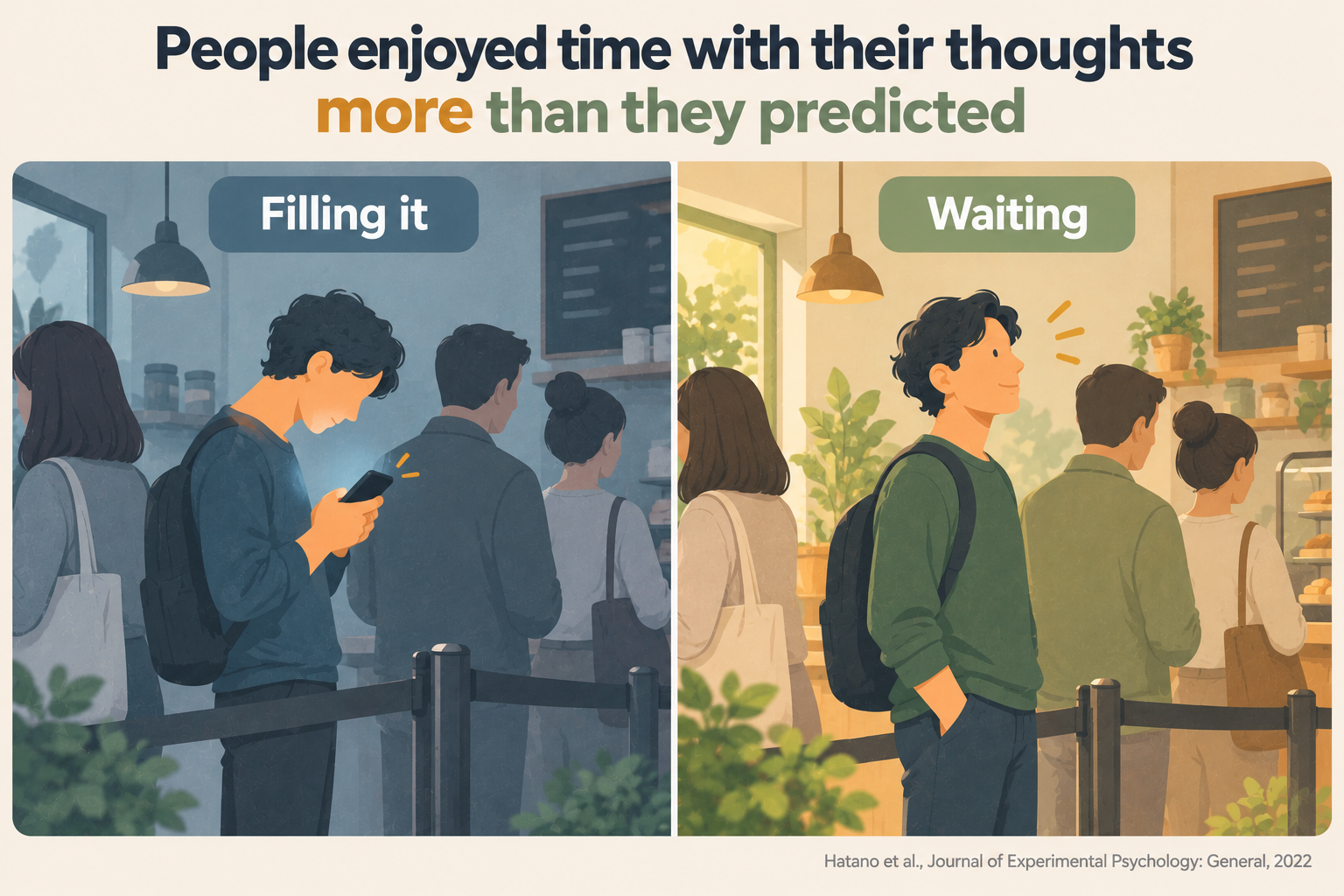
His team’s research backs up the first half. In six experiments published in the Journal of Experimental Psychology: General in 2022, Aya Hatano, Cansu Ogulmus, Hiroaki Shigemasu and Murayama asked 259 university students in Japan and the UK to sit alone with their thoughts for between 3 and 20 minutes, no phone allowed. Every time, people enjoyed it more than they had predicted. Yet when offered a choice, they still preferred checking online news, even though the two activities turned out about equally enjoyable. The enjoyment was moderate, around 3 to 4 on a 7-point scale, and the sample was students only.
A quick experiment: next time you’re waiting for something, leave the phone in your pocket and see what your mind does with two minutes. If it heads somewhere you’d rather it didn’t, item 1 still applies. And if sitting with yourself feels hard in general, how to enjoy being alone is worth a read.
9. Audit one ordinary day
Autopilot is mostly about defaults. The easiest way to see yours is to write them down.
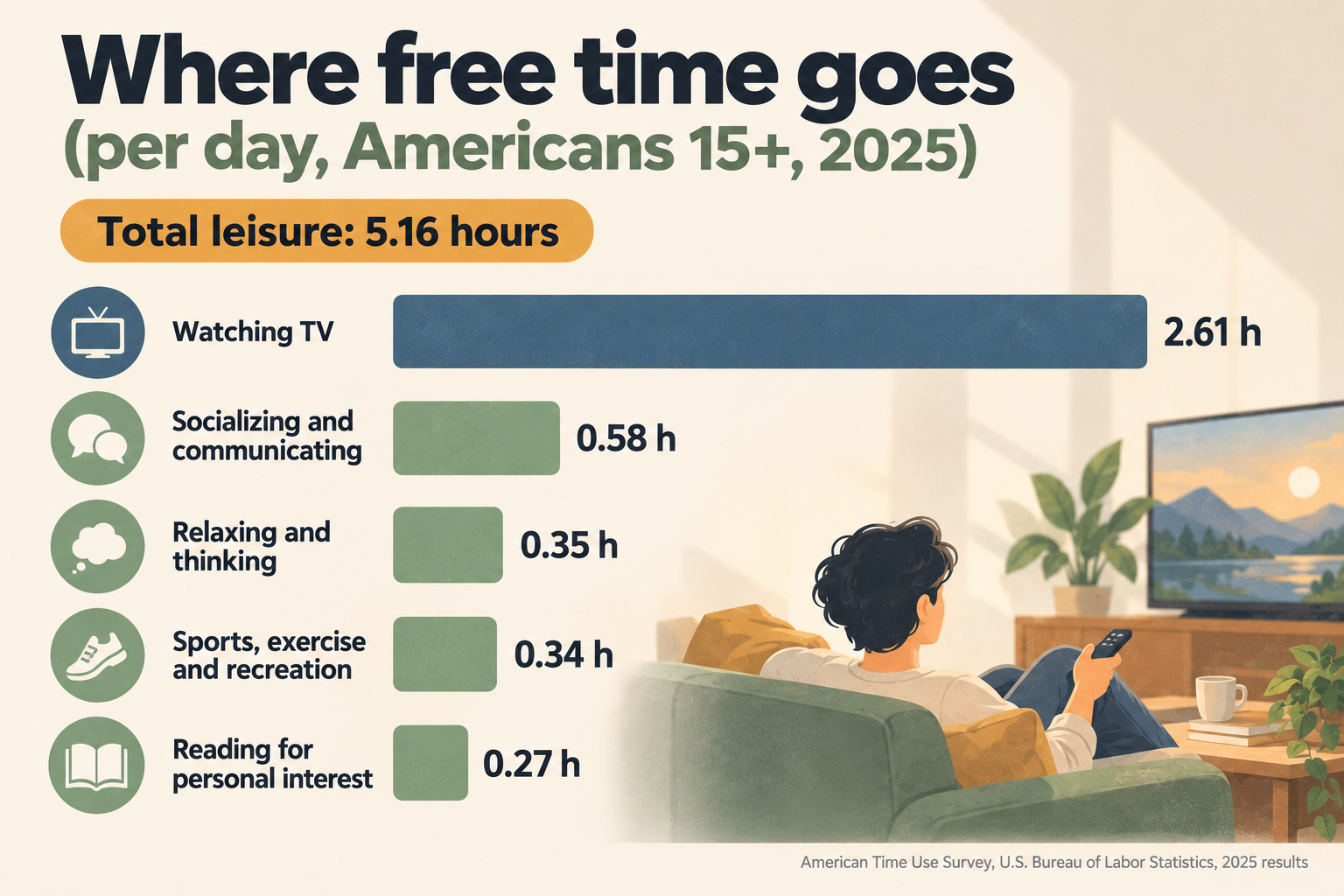
The American Time Use Survey, run by the U.S. Bureau of Labor Statistics, asks thousands of people to walk an interviewer through the previous day. The 2025 results, released in June 2026, show how Americans aged 15 and over spent their free time on an average day:
| Activity (Americans 15+, 2025) | Average per day |
|---|---|
| All leisure and sports | 5.16 hours |
| Watching TV | 2.61 hours |
| Socializing and communicating | 0.58 hours (about 35 minutes) |
| Relaxing and thinking | 0.35 hours (about 21 minutes) |
| Sports, exercise and recreation | 0.34 hours (about 20 minutes) |
| Reading for personal interest | 0.27 hours (about 16 minutes) |
In plain terms, TV took up about half of all leisure time, while reading took 16 minutes. Two notes: this is U.S. data, and no interviews were done from October 1 to November 12, 2025 because of the federal shutdown, which BLS says may have affected the yearly estimates. None of this means TV is bad. It shows how much of our free time goes to whatever is easiest when we don’t decide in advance.
Say you try this and discover that the “one episode” after dinner is usually three. That’s not a moral failing. It’s just information you didn’t have before.
Tonight, do this: write down what you did in each hour of your day, from memory, and mark which hours you chose and which ones simply happened. Pick one “happened” hour to decide on in advance tomorrow. If most of the drift is at work, how to be more organized at work has practical fixes.
10. Go somewhere new, even if it’s small
Same places, same faces, same days. They blur together in memory because nothing marks them apart.
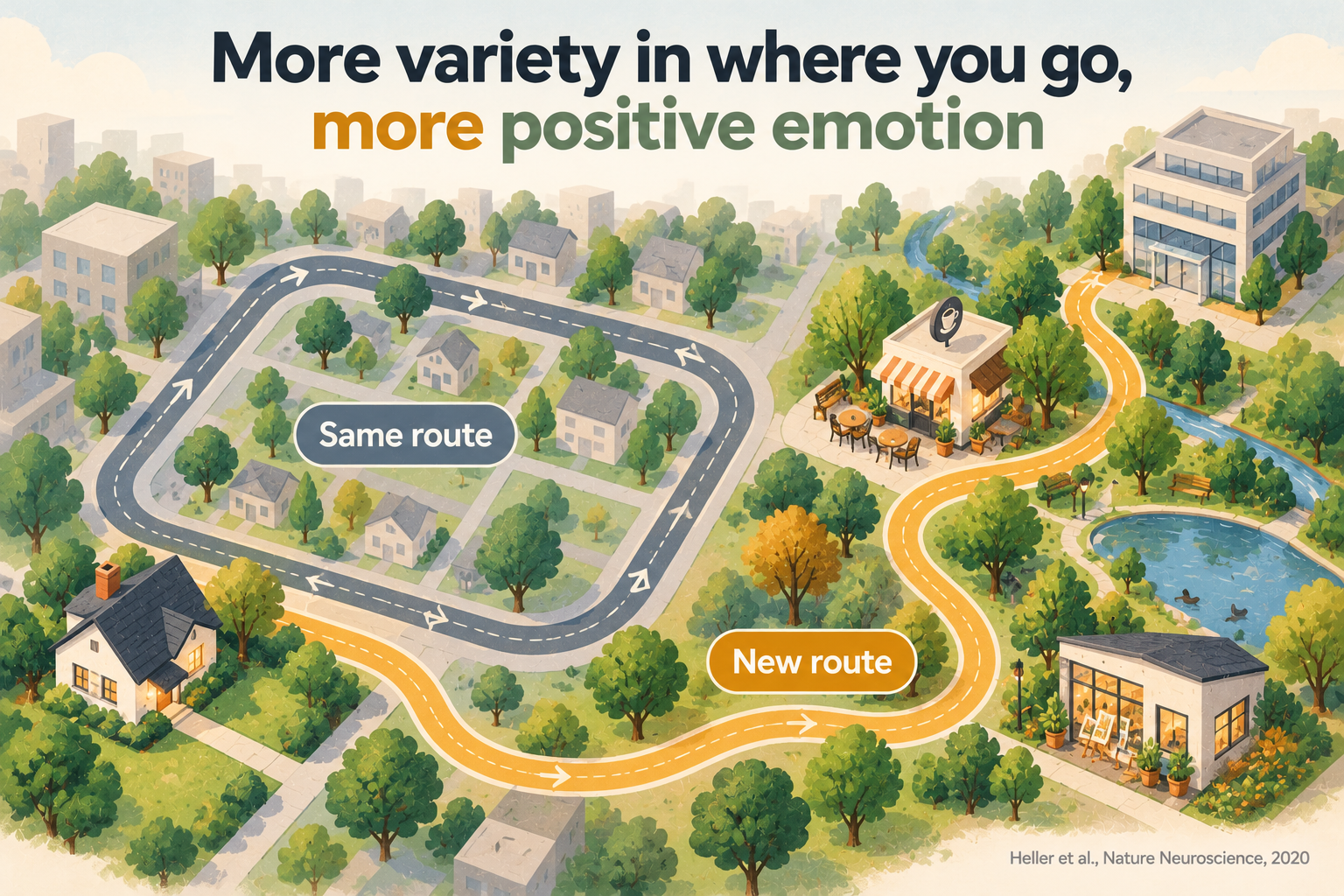
Catherine Hartley, a psychologist at New York University, put it simply in 2020 interviews about her research: you can build variety into a day through movement, by walking a new path or trying a new skill somewhere unfamiliar. When getting out is hard, she suggested looking for novelty in what you read, what you watch and who you talk to.
Her advice comes from a study published in Nature Neuroscience in May 2020, led by Aaron Heller at the University of Miami with Hartley. The team tracked 122 people in New York and Miami by GPS for three to four months and texted them regularly to ask how they felt. On days with more variety in where people went, they reported more positive emotion, and the lift carried into the next day. People whose brain scans showed stronger coupling between the hippocampus and the striatum (regions tied to novelty and reward) showed the strongest link. The data is correlational and ran both ways: feeling good also made people more likely to explore. It’s also pre-pandemic data, now six years old.
So this week, break the loop in one small way: eat lunch somewhere you’ve never sat, or finally sign up for the class you keep scrolling past. New experiences also tend to stick, which is one of the oddly practical ways to improve your memory.
11. Savor the good bits on purpose
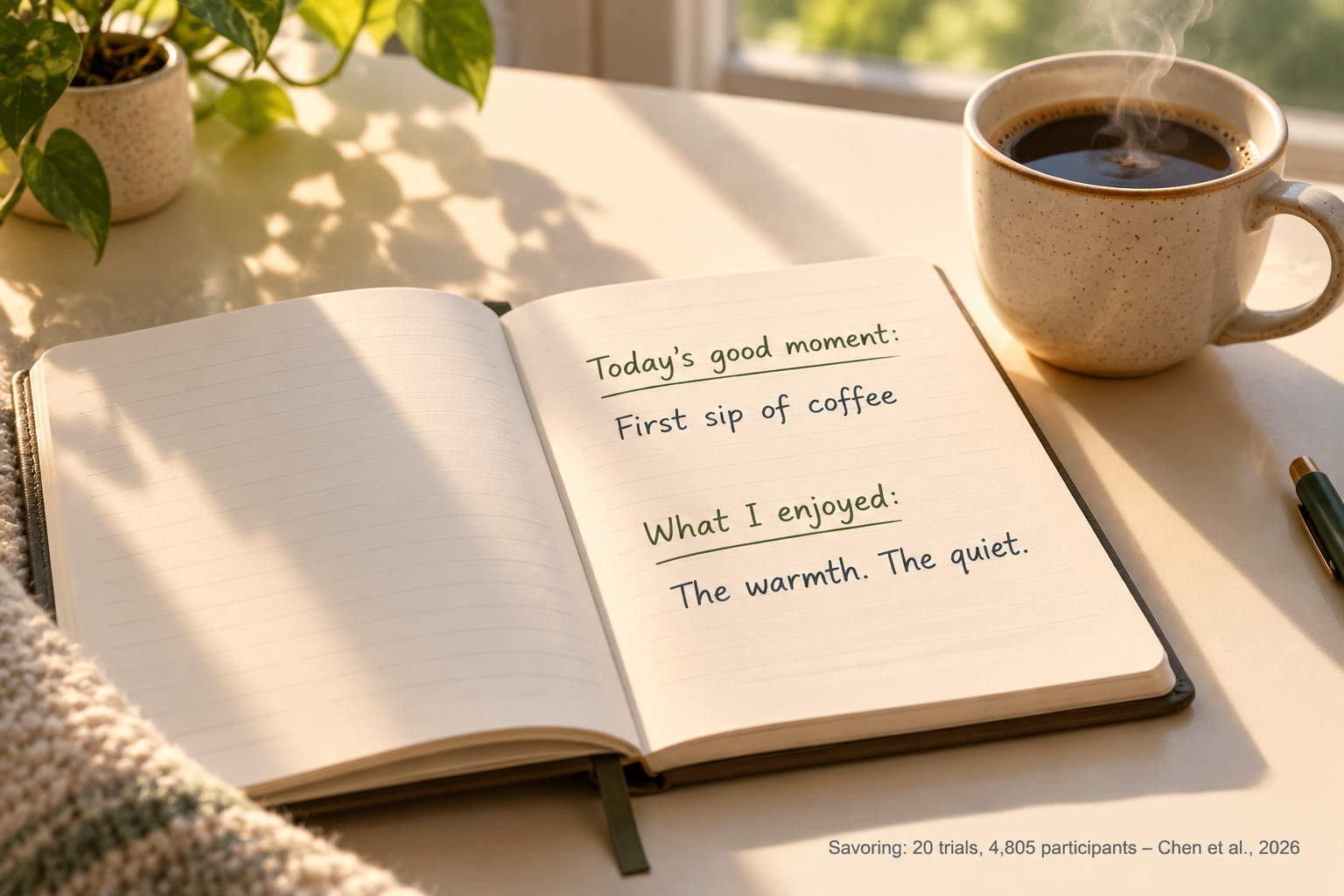
Autopilot is efficient. It’s also terrible at enjoying things. Savoring is the deliberate opposite: noticing a good moment and staying with it a little longer than you normally would.
The evidence here is recent and fairly solid. A 2026 systematic review and meta-analysis in Applied Psychology: Health and Well-Being, by Pei-Hsin Chen and colleagues, pooled 20 randomized controlled trials with 4,805 participants. Savoring interventions had a moderate overall effect on emotional outcomes (g = 0.51), and the effect on negative symptoms such as depression and anxiety was slightly larger (g = 0.61). Results held across delivery formats and cultures, and the authors’ publication-bias checks didn’t suggest the findings came from selective reporting. One wrinkle: effects looked bigger when savoring was compared with doing nothing than with another active activity, though that difference wasn’t statistically significant.
Think of it like pressing slow motion on a replay. The comparison holds in one way: you’re giving a moment more screen time than it would normally get. It breaks down in another: you can’t rewind a feeling on command, and forcing it tends to make it feel fake. Go gently.
Your move: once a day, when something good happens, however small (the first sip of coffee, a text from a friend), pause for a few extra breaths and name what you’re enjoying about it. If your brain likes to skip past the good stuff and scan for what might go wrong instead, read how to stop catastrophizing.
12. Treat sleep as part of the plan
You can do everything else on this list and still drift all day if you’re short on sleep. Here’s a likely reason why, step by step.
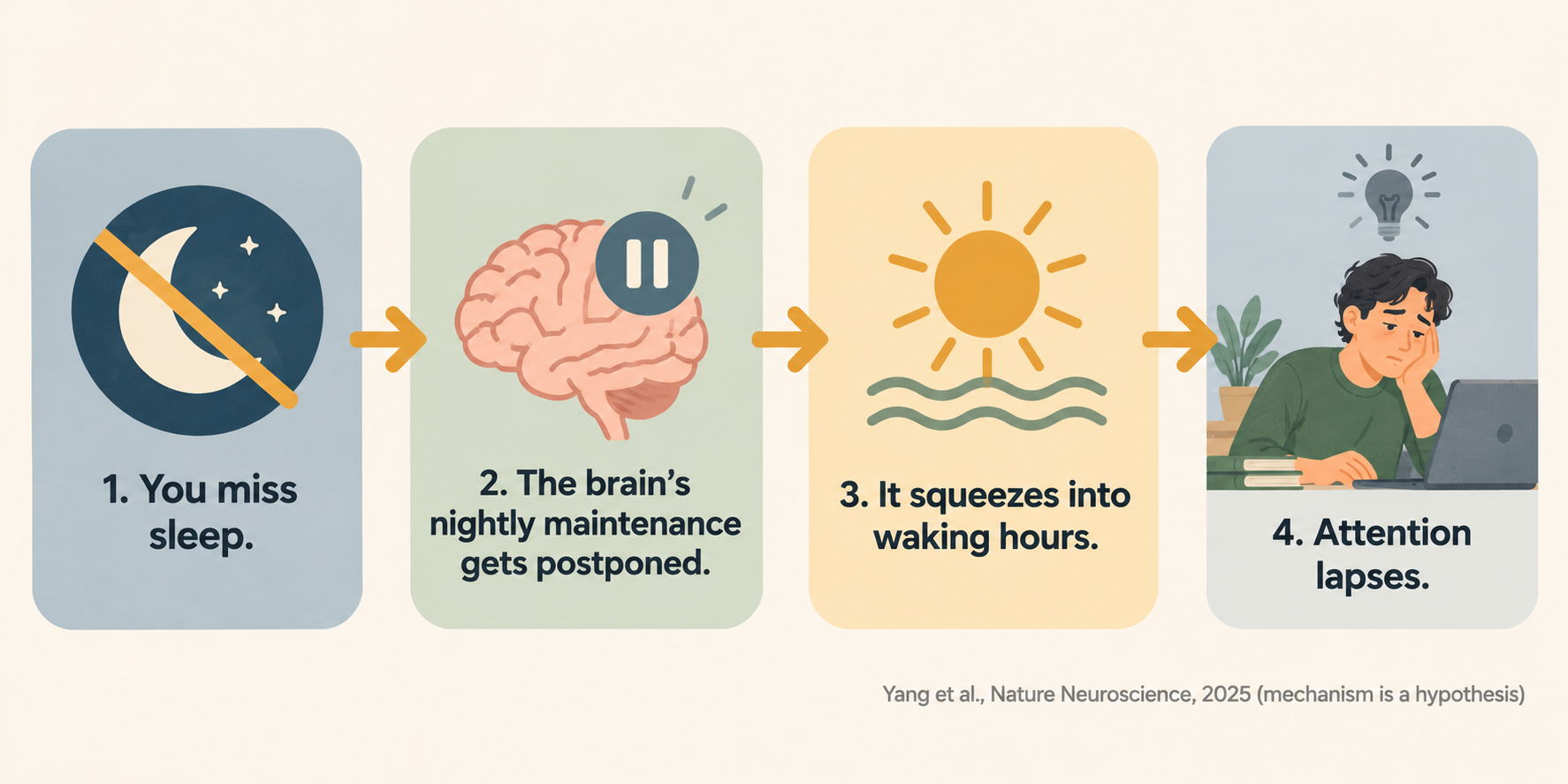
During sleep, cerebrospinal fluid washes through the brain in slow waves, a process linked to clearing waste built up during the day. In a study published in Nature Neuroscience in October 2025, Zinong Yang, Laura Lewis and colleagues at MIT tested 26 people on attention tasks twice: once after a night of sleep deprivation in the lab and once when rested. When sleep-deprived people had brief lapses of attention, a wave of that fluid flowed out of the brain, something that usually happens during sleep, and flowed back as attention returned. Breathing and heart rate slowed and pupils narrowed during the same moments.
So the chain looks like this: you miss sleep, the brain’s nightly maintenance gets postponed, the brain starts squeezing it into your waking hours, and attention drops each time it does. The researchers present that compensation idea as a hypothesis. What they showed directly is the tight timing between the fluid waves and the lapses. The sample was small, and a full night without sleep is more extreme than a run of short nights, so don’t stretch the findings too far.
Test it this week: choose a fixed lights-out time for five nights in a row, charge your phone outside the bedroom, and see whether the afternoon fog thins out.
What to do when you slip back into autopilot
You will slip. Probably by Thursday.
That’s not a sign the approach failed. It’s how habit change works. In a systematic review published in Healthcare in December 2024, Ben Singh and colleagues at the University of South Australia looked at 20 studies with 2,601 adults trying to build health habits. In the four studies that directly measured timing, habits took a median of 59 to 66 days to form, with individual times ranging from 4 days to 335. The old “21 days” rule didn’t hold up. Singh’s own advice was that consistency matters more than perfection, and missing a day isn’t failure as long as you pick the habit back up the next day.
A few ways to recover without drama:
- Restart at the next cue, not next Monday. If your door-handle check-in vanished for a week, the next door handle is your restart.
- Shrink the habit. Five minutes of breathing became zero? Do one minute.
- Notice the tone of your inner voice. Beating yourself up is its own kind of autopilot. If self-criticism is loud, how to stop hating yourself can help.
- Write off the bad day, not the plan. Our guide on how to turn a bad day around has practical resets.
One more thing. If the autopilot feeling is less “distracted” and more “numb,” and it lasts for weeks, talk to a doctor or therapist. That kind of fog is worth taking seriously.
Conclusion
You’ll never be present every minute, and you don’t need to be. Some autopilot is useful. The aim is to be there more often for the moments you care about.
Start with two items from this list, ideally one quick one (the door-handle check-in, a phone-free conversation) and one bigger one (an evening internet block, a fixed bedtime). Give them a couple of months before you judge them.
Then come back and add another. If you want more ideas for small changes that add up, browse our self-improvement articles.