
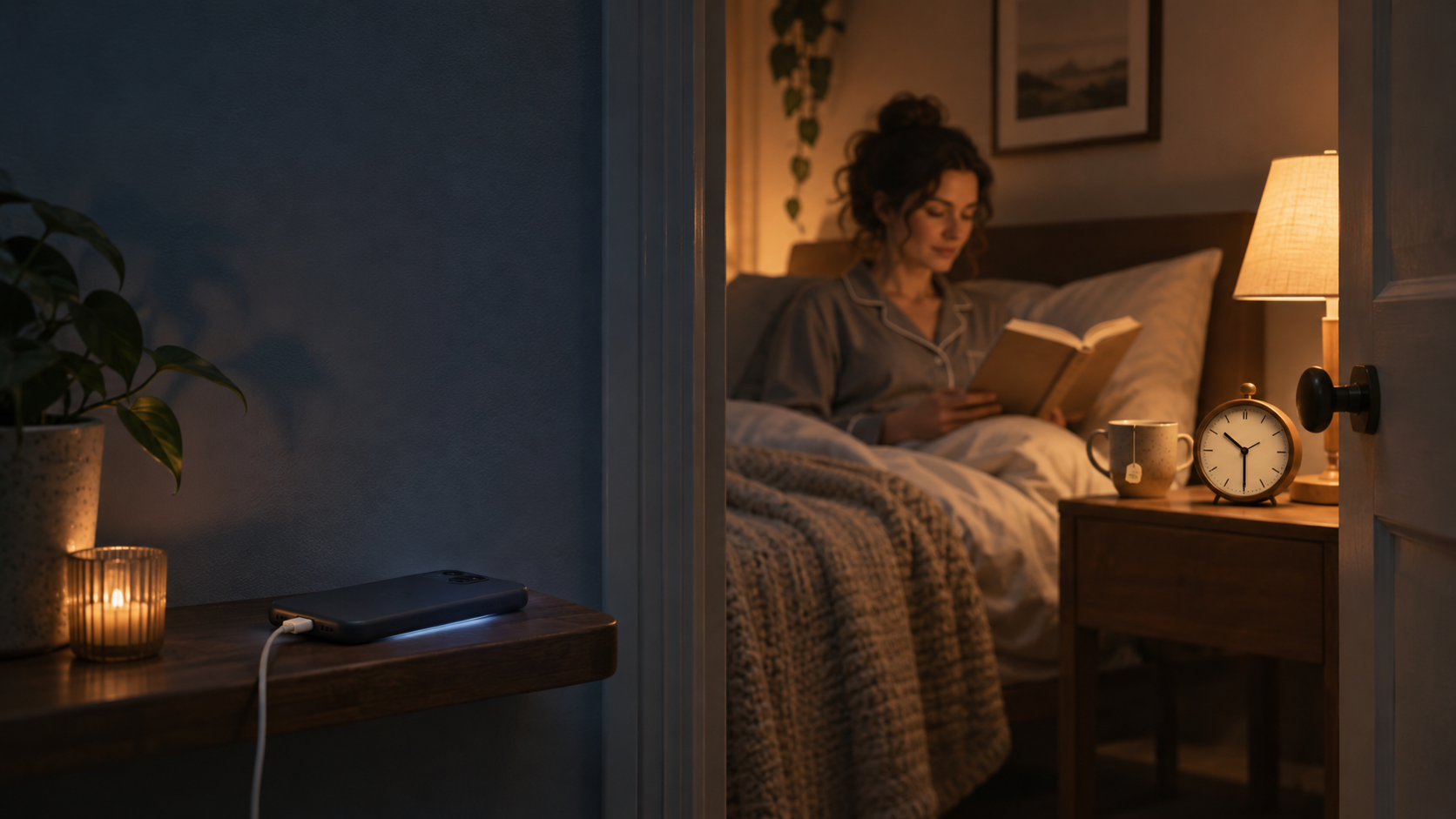
You know the moment. The dishes are done, the house is finally quiet, and for the first time since 7 a.m. nobody needs anything from you. You’re exhausted. You also have zero intention of going to bed.
So you watch one more episode. Then you check one more feed. Then it’s 1:15 a.m. and tomorrow-you is already furious.
That pattern has a name: revenge bedtime procrastination. Researchers at Utrecht University described “bedtime procrastination” back in 2014 as going to bed later than you meant to when nothing is actually stopping you. The “revenge” part came later, from a Chinese phrase about retaliatory staying up late, and it went global in 2020 after journalist Daphne K. Lee tweeted about it. The word fits. You’re not avoiding a task. You’re clawing back time that the day took from you.
And plenty of people are losing sleep over it. In a June 2026 report from the National Sleep Foundation (supported by mattress maker Tempur-Pedic), almost half of US adults said they don’t get enough sleep. Not all of that is revenge, but a lot of it is self-inflicted.
The good news is that this is a different problem from ordinary procrastination, so the fixes are different too. If you’ve already tried the usual tactics from guides on how to stop procrastinating and they didn’t touch your midnight habit, that’s why. Below are 12 ways that go after the actual causes: the stolen time, the tired brain, the phone and the stress underneath it all.
1. Measure the gap for one honest week
Most people underestimate how often this happens. In December 2025, Talker Research surveyed 2,000 Americans for Avocado Green Mattress, so treat this as a commercial poll rather than a scientific study. Still, the self-reported numbers are striking:
| What respondents reported | Figure |
|---|---|
| Admit staying up late on purpose for personal time | 96% |
| Average “revenge bedtimes” per week | 3.5 |
| Extra time awake each time | about 1 hour 50 minutes |
| Sleep lost per year | about 332 hours |
| “Always” or “often” regret it | 42% |
The useful part isn’t the headline. It’s that people could put a number on it at all. Once you see your own figure, the habit stops being a vague feeling of tiredness and becomes something you can track.
Say you’re sure it’s “only sometimes”. You log five weeknights and find that three of them ended after 1 a.m., all on days with back-to-back meetings. That’s a hypothetical, but it’s exactly the kind of pattern a log tends to reveal.
Give it a go: for seven nights, write down three things. When you meant to sleep, when the lights actually went off, and what filled the gap. Look over it on Sunday, ideally as part of a weekly review.
2. Figure out what you’re taking revenge for
Revenge needs a grievance. Usually the grievance is your day.
Here’s how the chain tends to run. A long day of other people’s demands leaves you with little self-control in the evening. A depleted brain grabs the easiest reward on offer, which is almost always a screen. The reward pushes bedtime later. You wake up short on sleep, which leaves you with even less self-control the next evening. Round it goes.
The research backs the middle links of that chain, though only as correlation. A 2022 meta-analysis by Vanessa Hill and colleagues at CQUniversity, published in Sleep Medicine Reviews and pooling 43 studies, found that bedtime procrastination had a moderate negative association with self-control. A 2025 study in Psychological Reports by Han Bao and Shichuan Li, covering 468 Chinese university students, added another piece: students with lower self-efficacy procrastinated their bedtime more, partly through more social media use and more fear of missing out. Neither design can prove cause and effect.
So the night-time scroll is often a symptom. If you only fight the symptom, you’re fighting a tired brain at its weakest hour.
Start small: the next time you catch yourself awake at 12:30, ask what today didn’t give you. Rest? Fun? Quiet? Someone to talk to? Write the one-word answer down. If the answer keeps being “a decent day”, it’s worth learning how to turn a bad day around before the evening even starts.
3. Move some me-time into daylight
If the night is the only time that belongs to you, you’ll defend it. Fair enough. The fix is to stop making the night the only option.
Psychiatrist Lisa MacLean, M.D., of Henry Ford Health, made this point in a September 2025 piece on revenge bedtime procrastination. Her advice is to use small pockets of the day for things you actually enjoy, like reading, a walk or a call with a friend, and to treat even short microbreaks as worth taking. Do that, she says, and you’re “less likely to feel like you have to claw back time” at night.
There’s an interesting twist from the research side. At the SLEEP 2025 meeting, University of Utah doctoral candidate Steven Carlson presented a study of 390 young adults (average age 24) who kept a 14-day sleep diary. The people who procrastinated their bedtime were less likely to report seeking out exciting, engaging or enjoyable activities. They also reported more negative emotion. It’s a conference abstract, not a full peer-reviewed paper, so hold it loosely. But it suggests the late-night scroll often isn’t pleasure at all. It’s a stand-in for pleasure.
Next time, do this: put a 20-minute block in your calendar before 6 p.m. and label it with something you’d normally save for midnight. Treat it like a meeting. If spending that time on your own feels strange, learning to enjoy being alone makes those blocks feel less like a chore.
4. Write a fresh if-then plan every evening, not once
Vague intentions lose to autoplay. Specific plans do better, especially when you renew them daily.
A registered report published in Psychology & Health in April 2025 tested exactly this. Berke Sezer, Nikos Ntoumanis, Hugh Riddell and Daniel Gucciardi had 281 UK adults practise a technique called mental contrasting with implementation intentions (MCII). You picture what you want, picture the obstacle that usually stops you, and then form an “if X happens, then I’ll do Y” plan. One group did it once at the start of the week. The other repeated it every evening for seven days.
The daily group’s bedtime procrastination came out about 16 minutes lower. In raw terms, they went to bed about 20 minutes later than planned on average, against about 36 minutes for the one-time group. The study also found that on nights people procrastinated more, they woke up in a worse mood. The limits matter: it lasted one week, sleep times were self-reported, the sample was mostly white and male, and about a third of the one-time group admitted practising more than once anyway.
Sixteen minutes doesn’t sound dramatic. Over a working week, it adds up to more than an hour of sleep.
A quick experiment: at dinner, write four short lines. The wish (“in bed by 11”). The best outcome (“I wake up before the alarm”). The obstacle (“autoplay at 10:45”). The plan (“If an episode ends after 10:30, then I close the laptop and go brush my teeth”). Do it again tomorrow, even if it feels repetitive. That repetition is the whole point, and it’s one of the more reliable procrastination hacks you can use on a habit like this one.
5. Get your phone off the mattress
This one is unglamorous and probably the most important.
A large 2025 study of screen use in bed among more than 45,000 Norwegian students, led by Gunnhild Johnsen Hjetland of the Norwegian Institute of Public Health and published in Frontiers in Psychiatry in March 2025, looked at what people did on screens after getting into bed. Each extra hour of screen time in bed was linked to 59% higher odds of insomnia symptoms and 24 minutes less sleep. Social media wasn’t worse than films, gaming or browsing. The total time was what mattered. The data are cross-sectional, so they show a link rather than proof, and they come from one country.
Think about how other entertainment ends. A book has chapters. A film has credits. A feed has no last page, so the natural “stop here” signal never arrives and you have to supply it yourself, at the exact hour your willpower is lowest. The analogy has limits, since an episode does end and autoplay simply skips past it, but that only proves the point: the stopping cue is being removed for you.
Your move: tonight, charge your phone somewhere you’d have to get out of bed to reach. Buy a cheap alarm clock if the phone is your alarm. If the pull is strong enough that this feels impossible, the guide on how to stop phone addiction goes deeper.
6. Close the workday on purpose
Some evenings are stolen before you even get home. Email at 9 p.m. counts.
Australia offers a real-world test of what happens when work gets a hard edge. Since 26 August 2024, employees at businesses with 15 or more staff have had a legal right to refuse to monitor, read or respond to work contact outside their hours, unless refusing is unreasonable. Small businesses joined on 26 August 2025. In its November 2025 Go Home on Time Day report, the Centre for Future Work at the Australia Institute found that full-time employees were doing 3.8 hours of unpaid overtime a week. Report author Fiona Macdonald noted that this continued a decline from 6.2 hours in 2023 and 4.1 hours in 2024, and said that for full-timers the right to disconnect is working. Part-time workers went the other way, rising to 3.7 hours. Some employment lawyers have called the law’s overall effect limited.
That’s a mixed result, and it isn’t a sleep study. Nobody measured whether Australians went to bed earlier. What it does show is that clear limits on availability change behaviour, even when they’re imperfect.
You probably don’t have a law protecting your evening. You can still copy the idea.
Test it this week: pick a “last email” time and stick to it. When it arrives, write tomorrow’s top three tasks, close every work tab and say out loud that you’re done. It sounds silly. It works as a line in the sand. If your days spill over because everything is scattered, these tips on being more organized at work help the shutdown happen on time.
7. Empty your head before it hits the pillow
Many late nights aren’t about fun. They’re about avoiding the moment when the lights go off and your brain starts its review of everything you didn’t finish.
According to the National Sleep Foundation’s June 2026 report Two Views of the Night, produced with Tempur-Pedic, 61% of US adults say they can’t calm their minds at bedtime. The release doesn’t give the survey’s sample size, and the partner sells mattresses, so take the exact figure with some caution. The direction rings true, though. Staying up and scrolling is one way to keep those thoughts from arriving.
One older experiment offers a cheap alternative. In 2018, Michael Scullin’s team at Baylor University brought 57 young adults into a sleep lab and measured their sleep with polysomnography. Half spent five minutes before bed writing a to-do list for the coming days, and half wrote about tasks they had already finished. The to-do group fell asleep roughly nine minutes faster, and the more specific their lists, the quicker they dropped off. It’s one small study, so it’s a promising lead rather than settled science.
The practical move is to take five minutes at the kitchen table, not in bed, and write tomorrow’s tasks as specifically as you can, so your brain has nothing left to rehearse when you lie down.
8. Keep your wake-up time boring
If you’re a night owl, this habit is stacked against you from the start.
The same 2022 Hill meta-analysis found that bedtime procrastination had a moderate positive association with an evening chronotype, and that it went along with shorter sleep, poorer sleep quality and more daytime fatigue. This review is now nearly four years old, but it’s still the broadest summary of the field. So night owls aren’t lazier. Their body clocks run later, which makes “just go to bed earlier” harder for them than for morning types.
A chaotic wake time makes it worse. Respondents in the Talker Research poll from point 1 said it takes about three days to get back on schedule after a late night. That’s self-report from a commercial survey, not a lab measure. Still, anyone who has slept until noon on Sunday and then lain awake until 2 a.m. will recognise it.
Here’s a simple way in: choose a wake-up time you can realistically keep all seven days, and protect it more fiercely than your bedtime. Bedtime tends to follow. It’s one of those good habits that pays off quietly for years.
9. Build a wind-down that feels like a treat, not a chore
Pilots don’t fly at cruising altitude until the runway appears and then drop. They start the descent long before the airport. Sleep works in a similar way. You can’t go from laptop at full speed to unconscious in ten minutes. The comparison breaks down in one place, though. Nobody is forcing your descent, so if the routine feels like punishment, you’ll skip it.
Harvard Health Publishing’s April 2026 article on revenge bedtime procrastination, reviewed by Dr. John Winkelman, lays out a wind-down routine that covers both sides. Dim the lights, silence notifications or put the phone out of reach, jot down tomorrow’s worries, and build a nightly ritual such as a bath or a skin care routine that signals the day is ending. Winkelman’s point is that a ritual works because it repeats in the same way, night after night.
The trick is to make the ritual something you’d want anyway. Revenge is about reward. Give yourself the reward earlier and in a form that leads somewhere useful.
Give it a go: pick three pleasant steps and always do them in the same order. Maybe a shower, then tea, then ten pages of a paper book. Set an alarm 45 minutes before bed and label it “descent”. If a controller is your usual late-night pull, look at how to stop video game addiction before you decide where gaming fits in your evening.
10. Go after the stress behind the scrolling
The strongest emotional link to bedtime procrastination isn’t sadness or worry. It’s stress.
A 2026 meta-analysis of bedtime procrastination and psychological distress by Obaid Azeem, Fatma Sulaiman and Zhu Haidong of Shihezi University, published in Frontiers in Psychology in March 2026, pooled 18 studies covering 35,097 university students. Here’s how strongly bedtime procrastination correlated with each outcome:
| Outcome | Pooled correlation (r) |
|---|---|
| Depression | 0.28 |
| Anxiety | 0.30 |
| Overall psychological distress | 0.34 |
| Perceived stress | 0.38 |
Perceived stress came out strongest. There are big caveats. Most of the studies (83%) were cross-sectional, nearly three-quarters came from China, and the results varied a lot between studies. So we can’t say whether stress causes the late nights or the late nights cause the stress. Most likely both.
A 2025 study in the same journal suggests it’s a loop. Lin and colleagues surveyed 1,423 Chinese college students twice, six months apart. Phone addiction predicted later bedtime procrastination, and bedtime procrastination predicted later phone addiction. Among the most stressed students, it was bedtime procrastination that predicted the phone problem.
Start small: find ten minutes earlier in the evening to discharge the day. Walk round the block, call someone, or try one of these emotional regulation skills. If social apps are where stress goes to multiply, work on a healthy relationship with social media in daylight hours, when you’ve got the energy to change settings and habits.
11. Make late-night time shared, not stolen
Sometimes the person you’re taking time back from is asleep next to you.
In the Harvard Health article, Winkelman suggests couples share their downtime instead of each guarding a separate slice of it, for example by sitting together while each watches something different. When people stay up after a partner goes to bed just to get time alone, he sees it differently from the usual framing: “I wouldn’t call that revenge, just a relationship.” The need is real. The midnight hour just isn’t the only way to meet it.
Picture this: two parents both stay up until 1 a.m. every night, each believing it’s the only time they get to themselves. Neither has ever said so out loud. A ten-minute conversation about who covers which evening could give each of them a protected hour before 9 p.m.
Next time, do this: tell your partner, flatmate or family what the late nights are really about, and ask to trade evening duties so each of you gets a real block of time. If that conversation feels hard to start, this guide on talking to your partner about needs not being met gives you a script.
12. Get proper help if the pattern won’t budge
Sometimes self-help isn’t enough, and that’s no failure. Bedtime procrastination can be bound up with emotion regulation, mood and long-held beliefs about sleep.
A small pilot trial published in BMC Psychology in July 2025 tested transdiagnostic cognitive behavioural therapy for people with severe bedtime procrastination. Thirty-two university students were randomly assigned either to 20 weekly one-hour sessions based on the Unified Protocol or to a waiting list. The therapy group improved substantially on bedtime procrastination, emotion regulation and sleep beliefs, and the gains held three months later. The waiting-list group didn’t change. With only 32 people and no active comparison group, it’s a promising signal rather than proof. Still, it fits a broader picture: when the late nights are tangled up with emotions, working on the emotions helps.
Your move: if a month of honest effort hasn’t shifted things, or the tiredness is hurting your work, mood or relationships, talk to your doctor or a therapist who works with sleep. Mention the bedtime pattern specifically, not just “I’m tired”.
What to do when you slip
You will slip. Some Friday a show will be too good, or a Tuesday will be so brutal that you’ll want the night back. That doesn’t end the project.
How you react matters more than the slip itself. A large August 2025 study in BMC Psychiatry, covering 5,153 Chinese college students, found that self-compassion was strongly linked to less bedtime procrastination (r = −0.54), and that students who were kinder to themselves felt less stressed. Earlier work by Fuschia Sirois, Sanne Nauts and Danielle Molnar, published in Mindfulness in 2019, pointed the same way: self-compassionate people procrastinated their bedtime less, partly because they experienced less negative mood. Both studies are correlational, so they show a pattern rather than a proven cause. But the practical logic holds up. Beating yourself up adds stress, and stress is exactly what feeds the next late night.
So after a late night:
- Get up at your usual time anyway. Sleeping in to “make up for it” pushes the next bedtime later.
- Write one line about what triggered it. Was it a hard day, a cliffhanger, or an argument?
- Redo your if-then plan that evening, adjusted for the trigger you just found.
- Talk to yourself the way you’d talk to a friend who stayed up too late. If your inner voice is harsher than that, the guide on how to stop hating yourself is worth your time.
One bad night is data. It isn’t a verdict.
Conclusion
Revenge bedtime procrastination makes sense. It’s a reasonable response to days that leave no room for you. The trouble is that the revenge lands on the wrong target. Your boss doesn’t lose sleep when you stay up until 1 a.m. You do.
You don’t need all 12 changes at once. Start with the gap log, get the phone off the bed, and write tonight’s if-then plan. Once those stick, work on the bigger levers: moving joy into your day, closing work properly, and dealing with the stress underneath. The goal isn’t to give up your evening. It’s to get it back at an hour when you can actually enjoy it.
Pick one change for tonight. Then browse more self-improvement guides to keep building days that don’t need avenging.