You pick up your phone to check the time. Twenty minutes later you know what a stranger in another country cooked for dinner, and you still don’t know the time.
If that sounds familiar, you have a lot of company. In a Pew Research Center survey of nearly 10,000 U.S. adults, run in May and June 2026, 53% said they spend too much time on their smartphone. Among people under 30, it was 70%. And 41% of all adults said their phone hurts their sleep.
A quick word on the label. “Phone addiction” is what most of us call it, but researchers usually say “problematic smartphone use.” Psychologist Susan Holtzman of the University of British Columbia Okanagan pointed out in late 2025 that it isn’t classified as an addiction in the way gambling is, even though the two share some features. You don’t need a diagnosis to want your evenings back, though.
Below are 17 changes that have research behind them, roughly in the order you might try them. Some of these are settings you can change in thirty seconds. Others take a few weeks. None of them asks you to throw your phone in a lake.
1. Look at your real numbers first
Most people guess low. Before you change anything, open your phone’s screen time report (Screen Time on iPhone, Digital Wellbeing on most Android phones) and look at three things: total hours, number of pickups, and the two or three apps that eat the most time.
The averages are sobering. Ofcom’s Online Nation 2025 report, published in December 2025, found that UK adults spent an average of 4 hours 30 minutes a day online on personal devices in May 2025, ten minutes more than a year earlier. Smartphones accounted for roughly three quarters of that time. For 18 to 24 year olds the daily total was 6 hours 20 minutes.
There’s a catch, though. A University of Amsterdam team, reviewing earlier experiments in a 2024 paper, noted that simply monitoring screen time didn’t change how much people used their phones. Numbers alone don’t fix anything. They tell you where to aim, which is the whole point of this first step. Measuring comes first for the same reason it does with most good habits worth having: you can’t steer what you haven’t measured.
Start small: write down your daily average and your top three apps. Don’t try to cut anything yet. Just pick the one app you’d most like to see shrink.
2. Catch the reach and ask what it’s for
The hand moves before the brain catches up. That’s why the most useful question in this whole article is a boring one: why am I picking this up right now?
Holtzman and her colleagues reviewed 61 studies covering more than 39,000 people in 11 countries, published in the journal Mindfulness in 2025. People who tended to be more mindful in daily life were less likely to have a problematic relationship with their phones. Most of those studies were correlational, so they don’t prove mindfulness causes the change. Holtzman’s practical advice, though, is simple: when you notice yourself reaching, stop and check whether you have a purpose or whether it’s pure habit. Mindfulness, she explained, can help people manage emotions, act less impulsively and ride out urges until they pass.
Often the answer is boredom, stress or a feeling you’d rather not sit with. Noticing that without scolding yourself is a skill, closely related to radical acceptance: the urge is there, you see it, and you don’t have to obey it.
Next time, do this: before you unlock, say the reason out loud or in your head. “Checking the bus time.” “Bored.” If you can’t name one, put the phone face down and wait sixty seconds.
3. Put your notifications on a schedule
Notifications arrive at random. Sometimes the buzz is a message you wanted, often it’s junk. That unpredictability is exactly what keeps a slot machine player pulling the lever, because the brain learns that the next check might be the good one. Each random ping trains you to check more, even when nothing has arrived.
Batching breaks that pattern. In a randomized field experiment with 237 smartphone users, published in Computers in Human Behavior in 2019, Nicholas Fitz, Kostadin Kushlev and colleagues delivered notifications three times a day for one group. Those participants felt more attentive, more productive, in a better mood and more in control of their phones, and reported lower stress. Interestingly, people who got no notifications at all didn’t do better. They reported more anxiety and fear of missing out. Hourly batches barely helped. The study is from 2019 and hasn’t been widely replicated, so treat the exact numbers loosely, but the logic holds: fewer, predictable interruptions beat constant random ones. It’s the same reason focusing on one thing at a time is so hard with a buzzing pocket.
On iPhone you can use Scheduled Summary to bundle non-urgent alerts. On Android, go through your app notification settings and silence everything that isn’t a person. Keep calls and messages from people who matter. Everything else can wait for the next batch.
4. Turn the screen gray
Colour is a big part of what makes apps feel rewarding. Red badges, bright thumbnails, glowing icons: all of it is designed to pull your eye. Remove the colour and the phone suddenly looks like a tool.
The evidence here is reasonably solid for such a small change. Researchers at the University of Amsterdam tracked the actual phone use of 84 people for two weeks, published in Mobile Media & Communication in September 2024. After a normal baseline week, participants switched to grayscale for a week. Daily screen time dropped by 20 minutes. People also felt more in control and reported less stress and less sense of overuse. What didn’t change was the number of unlocks, which the authors read as a sign of deep checking habits. Sleep and productivity didn’t improve either. Earlier studies they cite found reductions between 22 and 50 minutes a day.
So grayscale shortens sessions, but it won’t stop the reflex on its own. Pair it with the other steps here.
A quick experiment: on iPhone, set the Accessibility Shortcut so a triple press of the side button toggles grayscale; most Android phones have a similar shortcut in their accessibility settings. Leave it gray for seven days and switch to colour only for photos and maps.
5. Strip your home screen down
Every icon on your home screen is a cue. You open your phone to text someone, your eye lands on a red badge, and your thumb is in the app before you’ve decided anything. The fewer cues you see, the fewer of those automatic detours you take. It works like the biscuit tin on the kitchen counter: you eat more from the tin you can see than from the one in the back of a cupboard.
And there’s a lot to see. According to Ofcom’s 2025 report, UK smartphone users open an average of 41 apps a month, and about half of all time online goes to services owned by just two companies, Alphabet and Meta. That’s a lot of doors, and most of them were built to be walked through.
Your move: keep only tools on your first screen (maps, calendar, camera, notes). Put social, news, video and shopping apps in a folder on the last page, or remove them and use the browser version, which is clunkier on purpose.
6. Add a speed bump before your worst apps
Small friction works better than you’d expect. In a field experiment published in PNAS in February 2023, David Grüning, Frederik Riedel and Philipp Lorenz-Spreen studied 280 users of an app called one sec, which makes you wait a few seconds and asks whether you really want to open a chosen app. On average, people closed the target app 36% of the time after the pause appeared. Over six weeks, they also tried to open those apps 37% less often than in the first week. Combined, actual openings fell by 57%. One caveat worth knowing: Riedel is the app’s developer.
A follow-up presented at the CHI 2024 conference tracked 1,039 real users for an average of 13.4 weeks. The short delays kept cutting how often people tried to open their target apps, and openings became more deliberate over time. You don’t need one specific product for this. Many phones let you set app time limits that pop up a reminder, and any blocker with a delay will do something similar.
The principle is the same one behind most procrastination hacks: make the thing you want to avoid slightly harder to start.
Give it a go: add a 10-second pause to the single app you named in step 1. Nothing else for now.
7. Guard the first 15 minutes of your day
How you start shapes the rest. In Deloitte’s latest Digital Consumer Trends survey for Ireland, reported in February 2026, 60% of phone owners looked at their phone within 15 minutes of waking, down from 65% a year before. More than half said their phone kept them awake later than they’d planned. Almost three quarters felt they spent too much time on their phones. This is a consultancy survey of one country, so treat it as a snapshot. In the U.S., Reviews.org’s 2026 survey (more on it in step 9) put the share checking within ten minutes of waking at 84.6%.
Mornings are also a good slot for new habits. A systematic review by Ben Singh and colleagues at the University of South Australia, published in Healthcare in December 2024, found that habits practised in the morning tended to grow stronger than those practised later in the day. A phone-free morning is a habit in its own right, and you can build it the same way.
Test it this week: don’t touch the phone until you’re dressed and have had a glass of water. If you need the alarm, see the next step.
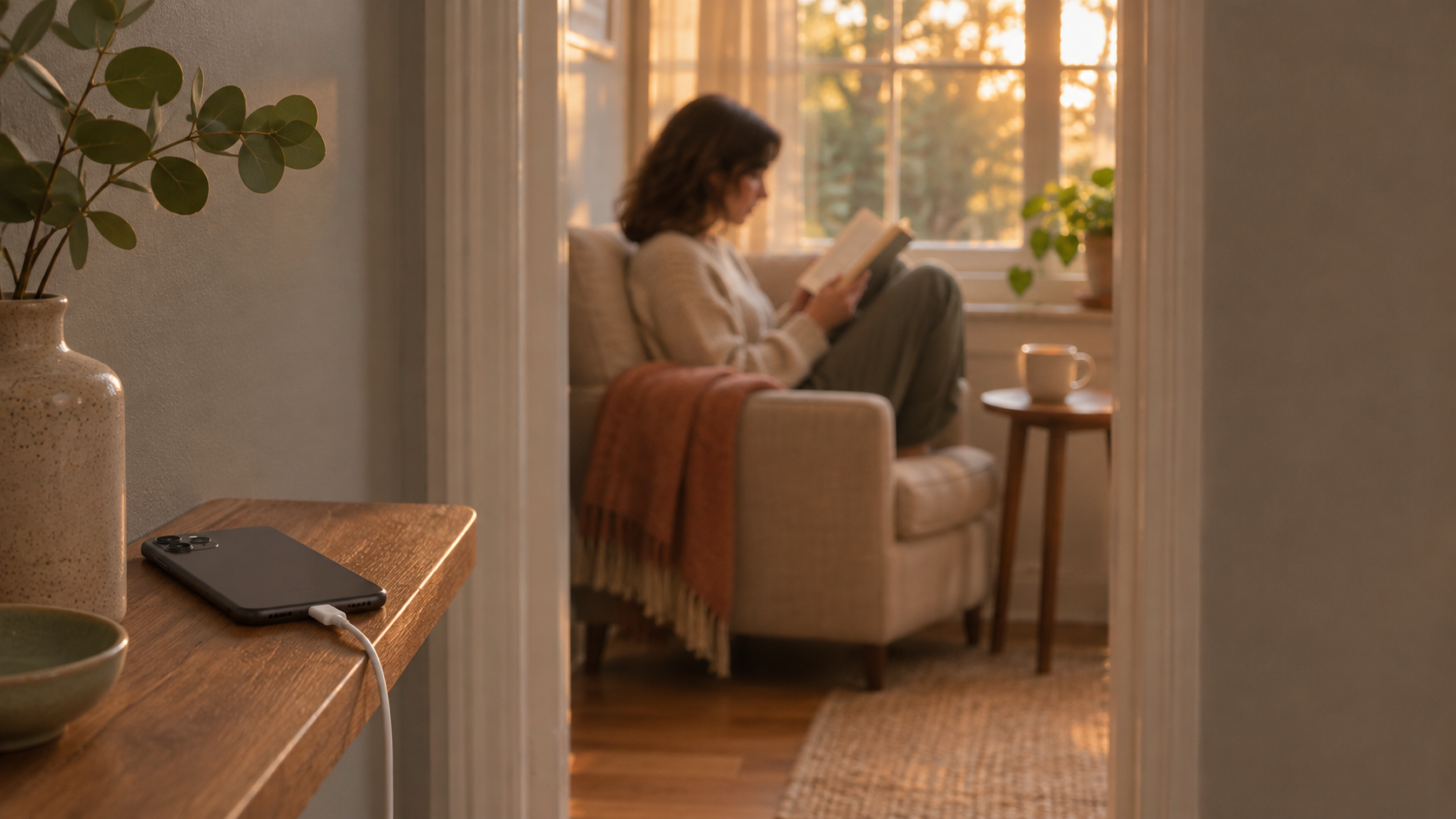
8. Charge it outside the bedroom
The bed is where phone use does some of its quietest damage. The American Academy of Sleep Medicine’s 2025 Sleep Prioritization Survey of 2,007 U.S. adults found that half use a screen in bed every day. About a quarter said they prioritise screen time on their phone over getting the recommended amount of sleep. The academy’s advice is blunt: power down 30 to 60 minutes before bed, keep phones in another room, and use a regular clock as your alarm.
The research points the same way. A study of 45,202 Norwegian university students, published in Frontiers in Psychiatry in March 2025 by Gunnhild Johnsen Hjetland and colleagues, found that each extra hour of screen use after going to bed was linked to 59% higher odds of insomnia symptoms and 24 minutes less sleep. What students did on screen mattered less than how long they did it. It’s a cross-sectional study, so it can’t show the phone caused the insomnia. Poor sleepers may simply scroll more. Still, removing the phone is the one change that tests both explanations at once.
Here’s a simple way in: buy a cheap alarm clock, put a charger in the kitchen or hallway, and swap the last half hour of scrolling for an evening wind-down routine you actually enjoy.
9. Keep it out of reach when you need to think
According to Reviews.org’s 2026 cell phone usage report, a commercial online survey of about 1,000 U.S. adults run in late 2025, Americans say they check their phones 186 times a day. That’s roughly once every five minutes while awake. Self-reported numbers like these are rough, but even half that would mean dozens of interruptions to whatever you were thinking about.
You may have heard that just having your phone on the desk drains your brainpower. The research is less dramatic. Douglas Parry’s 2024 meta-analysis in Media Psychology pooled 56 studies with 7,093 participants and found a negative effect of a phone’s mere presence on working memory, but null results for other cognitive functions, plus plenty of methodological weaknesses. Another 2024 meta-analysis found no overall effect at all. So the “brain drain” from a silent phone is probably small. What’s not small is the chance you’ll pick it up when it’s within reach.
When you sit down for anything that needs depth, put the phone in a drawer, a bag or another room. It’s one of the easiest ways to get into a flow state without relying on willpower every few minutes.
10. Try a mobile internet block for two weeks
This is the strongest experiment on the list. In a preregistered randomized trial published in PNAS Nexus in February 2025, Noah Castelo, Kostadin Kushlev, Adrian Ward and colleagues asked 467 adults to block all mobile internet on their phones for two weeks using a blocking app. Calls and texts still worked, and so did the internet on computers.
The effects were large for such a simple change. In the group that blocked first, average daily screen time fell from 314 to 161 minutes. Blocking mobile internet improved sustained attention, mental health and well-being, and 91% of participants improved on at least one of those three measures. The authors compared the attention gain to the size of ten years of age-related decline. People filled the freed-up time with socializing in person, exercise, time outdoors, hobbies and books.
Now the limits. Only about a quarter of participants kept the block on for most of the two weeks. The volunteers were motivated to cut back, and they knew what the study was about, which can colour self-reported mood. Still, it’s the clearest causal evidence we have that cutting mobile internet helps. Given how many habits are bad for your brain, this one is unusually easy to test.
Start small: you don’t need fourteen days. Turn off mobile data and Wi-Fi on your phone for one evening, or for a whole Saturday, and keep the laptop for anything you genuinely need.
11. Do a short fast, then come back with rules
Anna Lembke, an addiction psychiatrist at Stanford Medicine and author of Dopamine Nation, recommends something tougher than a block: a full break, then a planned return. In a Stanford piece from April 2025, she suggested starting with 24 hours away from your phone and other screens. She is frank that a single day probably isn’t enough to reset anything (she points to three to four weeks) but says it can show you how hooked you really are.
Her advice for the day itself is practical. Pick a start time, tell people you’ll be unreachable, and plan in-person activities. Expect anxiety, irritability and cravings, which she frames as withdrawal. When a craving hits, do something mildly uncomfortable: a cold shower, 20 sit-ups, cleaning out a closet. Afterwards, write down how the break made you feel, and decide in writing exactly how you’ll use the phone before you open it again.
A fair warning: Lembke’s approach comes from clinical experience, and she has said herself that she’d like to see more evidence for it. Leaning into discomfort takes a kind of everyday courage, so don’t judge yourself if the first attempt is shorter than planned.
Your move: pick one day in the next two weeks, put it in your calendar, and tell one person about it.
12. Take one week off social media
If the whole phone feels like too much to give up, target the part that does most of the damage for many people. In a study published in JAMA Network Open in November 2025, Elombe Calvert, John Torous and colleagues at Beth Israel Deaconess Medical Center followed 373 young adults aged 18 to 24. After two weeks of normal use, 295 of them chose to take a one-week break from Facebook, Instagram, Snapchat, TikTok and X.
Their social media time fell from about two hours a day to about 30 minutes. Depression symptoms dropped by 24.8%, anxiety by 16.1% and insomnia symptoms by 14.5%. The biggest gains showed up in people who started with more severe depression. Loneliness didn’t improve. Instagram and Snapchat were the apps people most often went back to.
This study has real weaknesses. There was no control group, participants chose to do the detox, and they may have expected to feel better. Still, it fits with the PNAS Nexus results in step 10.
Test it this week: log out of your two biggest social apps for seven days. Delete them if logging out isn’t enough. Keep a note of your mood each evening so you can compare.
13. Replace the scroll instead of just removing it
Willpower alone leaves a gap. Take the phone away and you’re left with the same boredom, stress or loneliness that sent you to it, just with nothing in your hand. The urge returns because the need behind it hasn’t gone anywhere. Fill the gap with something that meets the same need, and the urge has less to push against.
There’s some evidence for what works. A network meta-analysis by Li and colleagues, published in Frontiers in Psychiatry in September 2025, pooled 32 randomized trials with 2,891 participants, mostly Chinese university students. Badminton ranked highest for reducing phone addiction scores, followed by mindfulness-based therapy. Treat the ranking cautiously: the trials varied hugely, came mostly from one country and had small numbers per intervention. The broader lesson is that active, absorbing things seem to work better than passive ones.
Some of the best replacements are quiet ones, too. Learning to enjoy being alone without a screen is a skill that pays off far beyond this list.
Here’s a simple way in: write a list of five things you can do in under ten minutes without a screen (stretch, walk around the block, read three pages, call a friend, doodle). Keep it on paper next to where you usually scroll.
14. Make meals and conversations phone-free
Phones also cost you something besides time: attention that would otherwise go to the people around you. A meta-analysis by Nie Ni and colleagues, published in Frontiers in Psychology in May 2025, pulled together research on “partner phubbing,” snubbing a partner in favour of your phone. It found consistent links to lower relationship satisfaction, less intimacy and less emotional closeness. The effects were small to moderate and mostly correlational, and they varied between cultures. But the direction rarely changes from study to study.
The same goes for friends, kids and parents. A phone on the table quietly says that someone else might be more interesting, and people pick up on that, which makes it harder to keep family relationships strong.
Next time, do this: at the next shared meal, put every phone in a basket or another room. If someone needs to take a photo, one person keeps a phone and sends it round later.
15. Give your phone fewer jobs
Every function your phone handles is another reason to pick it up, and every pickup is a chance to drift. You open it to check the weather, see a badge, and the weather is forgotten. The more jobs the phone does, the more doors there are into the feed.
Pew’s 2026 survey shows how deep this goes. A quarter of U.S. adults (26%) said they use their smartphone almost constantly, rising to 42% of adults under 30. Some of that is genuine use. A lot of it is the phone sitting at the centre of tasks that used to need no screen at all.
So hand some of those jobs back to single-purpose objects. A watch tells the time without a feed. A paper notebook holds a shopping list. A cheap alarm clock wakes you up. A paperback on the train beats a hundred short videos. Each swap removes one reason to unlock, and the reasons add up quickly.
16. Write an if-then plan for your danger zones
Most phone overuse happens in predictable places: the commute, the queue, the sofa after dinner, the bathroom. Vague goals (“use my phone less”) fall apart in those moments. Specific plans hold up better.
Ben Singh, the University of South Australia researcher behind the habit review in step 7, has argued that planning how and when you’ll carry out a new behaviour helps cement it. His team’s review also found that people stuck with habits more when they enjoyed them and chose them themselves. That’s an argument for designing your own replacement rather than copying someone else’s.
The format is simple: “If [situation], then [action].” If I sit down on the train, then I open my book. If I’m waiting in a queue, then I look around. If I feel the urge to scroll at my desk, then I stand up and refill my water. It works for the same reason beating procrastination gets easier once the first step is decided in advance: there’s no decision left to make in the moment.
A quick experiment: write three if-then plans for your top three danger zones on a sticky note. Put it on the back of your phone case.
17. Pick one or two changes and give them time
Cutting back is harder than it sounds. Pew Research Center’s 2026 survey found that 45% of U.S. adults had tried to reduce their smartphone use in the previous 12 months. Of those, only 25% said they were extremely or very successful, 52% were somewhat successful, and 23% said it barely worked or didn’t work at all.
Most people, in other words, get partway. That’s normal, and it’s useful information. Trying seventeen changes at once is a fast route to the “not too successful” group. One or two changes, held for weeks, tend to compound: grayscale plus a charger in the hallway, say, or a social media break plus an if-then plan for the commute.
Give it a go: choose two steps from this list, write them down with a start date, and check your screen time report again in a month. Judge yourself by the direction of the numbers, not by a perfect week.
What to do when you slip
You will slip. Maybe a stressful week sends you back to two hours of late-night videos. That’s not failure. It’s how behaviour change actually looks.
Habits take longer to form than the popular 21-day myth suggests. The University of South Australia review found median formation times of 59 to 66 days, with individual times ranging from 4 days to almost a year. A bad week in the middle of that is part of the curve, not proof you can’t do it.
How you treat yourself after a lapse matters too. A 2024 study in the journal Appetite by Charlotte Hagerman and colleagues at Drexel University looked at people trying to lose weight. Those who responded to a slip with self-compassion felt more in control of their behaviour in the hours afterwards. The research was on diet, not phones, and self-compassion didn’t prevent another lapse the same day. But the takeaway carries over: harsh self-criticism tends to make people give up on the goal, while kindness keeps them in the game. If your inner voice gets brutal, it’s worth working on how you talk to yourself.
There’s encouraging data on bouncing back, too. In the CHI 2024 study of more than 1,000 one sec users, people often paused the tool for a while. The researchers reported that people bounced back from overuse quickly once they returned to it.
So when it happens: notice it without drama, look at what triggered it (stress, boredom, a late night), and restart the smallest step on your list the next day. One reset beats a perfect streak you never begin.
The bottom line
You don’t need to quit your phone. You need it to stop deciding for you. Start with the numbers, make the worst apps a little harder to reach, get the phone out of your bedroom, and give your hands something better to do. The studies here agree on one thing more than any other: even partial, imperfect cuts tend to help.
For more ways to make your devices work for you instead of the other way round, browse our technology guides.