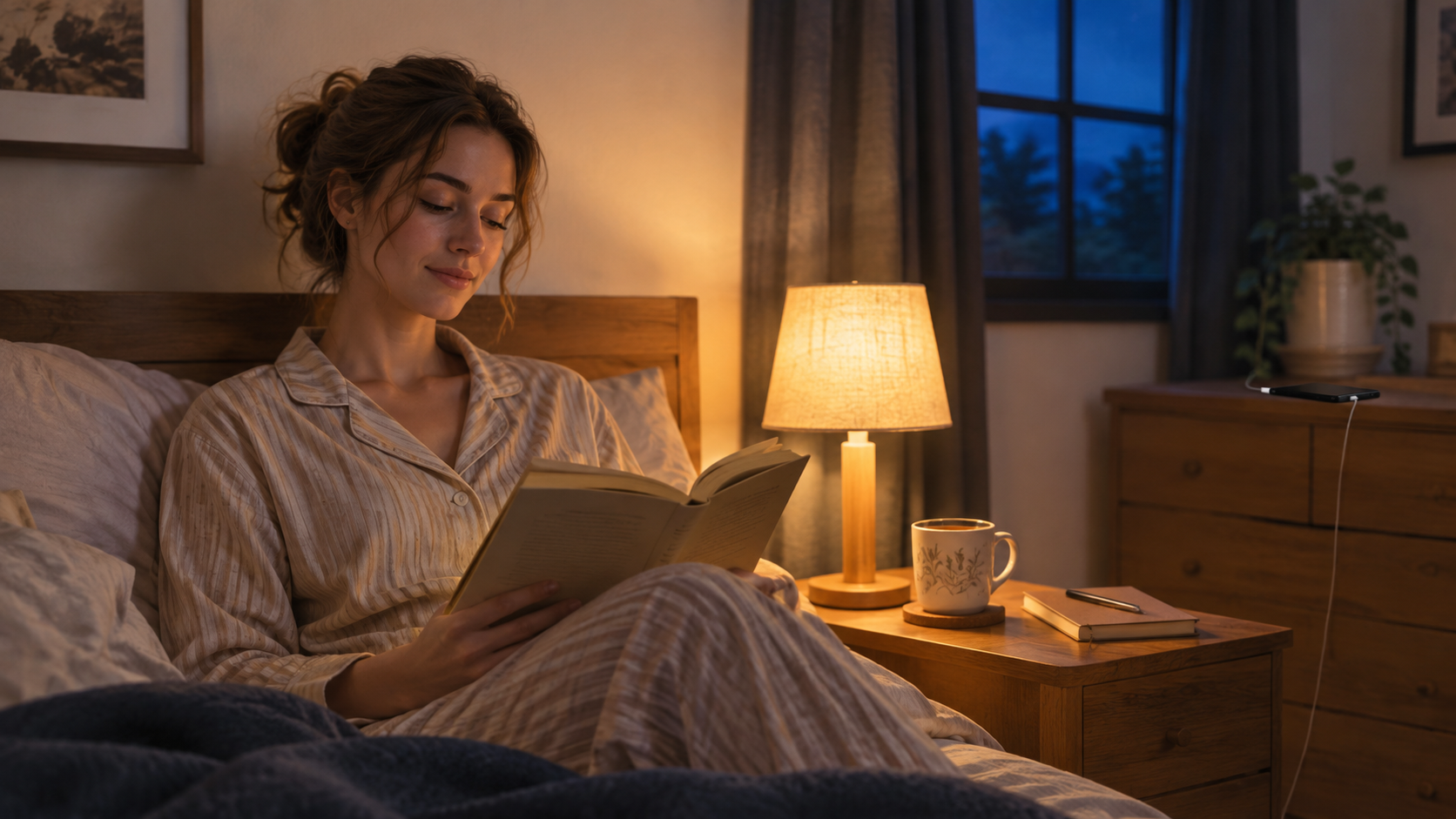
Picture this: it’s 11:40 p.m., the dishes are done, and the house is finally quiet. You sit on the edge of the bed with your phone, just for a minute. Forty minutes later you’re watching a stranger restore a rusty knife, and your alarm is set for 6:30.
Most of us don’t have a sleep problem so much as an evening problem. The last hour of the day gets squeezed by work, chores and screens, and then we expect the brain to switch off like a lamp. It won’t. In a June 2026 report from the National Sleep Foundation (produced with mattress maker Tempur-Pedic, so keep the sponsor in mind), most US adults said they sleep about 6.5 to 7 hours a night, the bottom of the recommended range. And 61% said they can’t calm their minds at bedtime.
That’s where a wind-down routine comes in. It sounds too simple to matter: a short, repeatable sequence that walks your body and mind from “on” to “off.” But it targets exactly the stretch of the day most of us waste. Below are 16 ideas, each tied to recent research, surveys or people who study sleep for a living. You don’t need all of them. Pick three or four. If you keep nodding off at your desk mid-afternoon, our guide on how to fight sleepiness at work covers the daytime half of the story. And if picking feels like one more chore at the end of a long day, that’s decision fatigue talking, which is why the list runs roughly in the order you’d use it.
1. Pick a lights-out time and protect it
A wind-down needs a finish line. Without one, “winding down” just stretches until the episode ends or the battery dies.
Regularity matters more than most of us assume. In a study published in Health Data Science in July 2025, researchers from Peking University and Army Medical University analysed wrist-tracker sleep data from 88,461 UK Biobank adults, followed for an average of 6.8 years, and linked sleep traits to 172 diseases. For 92 of those conditions, more than a fifth of the risk was attributable to poor sleep behaviour. Going to bed after 12:30 a.m. was tied to a 2.57-fold higher risk of liver cirrhosis. Senior author Shengfeng Wang argued that “good sleep” needs a definition that goes beyond hours. These are associations, though. The team itself says causality still has to be tested.
Why would timing matter at all? Your internal clock works by prediction. When lights-out drifts by two hours from one night to the next, the clock has a harder time deciding when to start the hormonal shift toward sleep, so you lie there wired at the “wrong” moment.
Start small: choose a lights-out time you can hit five nights out of seven, then count back 45 to 60 minutes. That’s when your wind-down starts. It sits comfortably next to the other good habits to have in a normal week.
2. Set an alarm for going to bed, not only for waking up
In the American Academy of Sleep Medicine’s 2025 Sleep Prioritization Survey (2,007 US adults, fieldwork June 5 to 13, 2025), 26% said phone screen time takes priority over getting enough sleep. Another 23% said the same about binge-watching shows or movies. Those aren’t scheduling conflicts. They’re decisions made at 10:45 p.m., alone, with nobody to argue the other side.
Sleep researchers call it bedtime procrastination. Steven Carlson and Paula Williams of the University of Utah presented a study at SLEEP 2025 in which 390 young adults kept 14-day sleep diaries; habitual bedtime procrastinators scored higher on neuroticism and lower on conscientiousness. Carlson’s reading was that the delay may have as much to do with managing anxiety and low mood before bed as with poor time management. It’s a conference abstract, so treat it as early evidence rather than settled fact.
Your move: set a recurring alarm labelled “start winding down” for the time you worked out in idea 1. When it rings, the phone goes on the charger. Bedtime procrastination is still procrastination, so the tricks in our guide on how to beat procrastination carry over surprisingly well.
3. Close the workday on purpose
Australia turned this idea into law. Its right-to-disconnect rules took effect on 26 August 2024 for most employees and on 26 August 2025 for small-business staff, letting eligible workers reasonably refuse to monitor, read or answer work contact outside their hours.
How did it go? In July 2025, recruiter Robert Half surveyed 500 Australian hiring managers. Some 93% said their organisation had taken at least one step, from email signatures stating that after-hours replies aren’t expected (29%) to redistributing workloads (25%). And 77% said they’d noticed better employee wellbeing and work-life balance. Keep in mind that’s employers’ perception, not measured health data. The picture is also patchy: an ADP poll of 1,019 Australians in late January 2026 found 38% were still contacted outside working hours every week.
So a law alone doesn’t switch people off. What seems to help is a boundary that’s visible and specific. “I’ll stop checking email at some point” isn’t one.
Test it this week: create a two-minute shutdown ritual. Close every work tab, write tomorrow’s first task on a sticky note, and tell yourself you’re done for the day. Our tips on how to be more organized at work make that sticky note much easier to write.
4. Empty your head onto paper
People take a lot of worry to bed. In the AASM’s June 2025 survey, 78% of US adults said they had lost sleep over financial worries, 65% over work and 56% over job security. Those figures count anyone who answered “rarely” or more often, so they capture occasional bad nights as well as chronic ones.
Writing it down helps, and the best-known test of the idea is older but still holds up. In a 2018 lab study in the Journal of Experimental Psychology: General, Michael Scullin’s team at Baylor University asked 57 young adults to spend five minutes before lights-out writing either a to-do list for the coming days or a list of tasks they had already finished. The to-do group fell asleep about nine minutes faster on average. The more specific their lists, the quicker they dropped off. One small study of healthy students isn’t proof for everyone, and nobody has shown it works for clinical insomnia.
The Stoics ran their own nightly review of the day two thousand years ago, and if that appeals, our piece on Stoic exercises has a few worth borrowing. Keep a cheap notebook by the bed, spend five minutes writing down everything you need to do tomorrow in as much detail as you can, then shut it and leave it there.
5. Dim the lights an hour before bed
Light is the strongest signal your body clock receives, and it doesn’t stop counting at sunset. In a study published in JAMA Network Open in October 2025, Daniel Windred and colleagues used wrist-worn sensors to track about 13 million hours of light exposure in nearly 89,000 UK Biobank participants, then followed them for up to 9.5 years. People with the brightest nights had a 56% higher risk of heart failure and a 47% higher risk of heart attack than those with the darkest nights, even after accounting for exercise, diet, sleep habits and genetics, according to Flinders University’s summary of the light-at-night study. It’s observational. It can’t prove that light caused the heart problems.
Co-author Andrew Phillips was clear that he isn’t talking about stadium floodlights. Scrolling in bed, or falling asleep with the TV or the bedroom light on, is enough exposure to matter, and he noted that even modest indoor light can nudge your rhythm.
Next time, do this: when your wind-down alarm rings, switch off the ceiling lights and use one or two warm lamps placed low. If a streetlight shines through the window, blackout curtains are the cheapest upgrade on this whole list.
6. Give your phone its own bedtime
This one gets the most eye-rolls, so here are the numbers. In the 2025 Frontiers in Psychiatry study of 45,202 Norwegian students, led by Gunnhild Johnsen Hjetland of the Norwegian Institute of Public Health, each extra hour of screen time after getting into bed was associated with 59% higher odds of insomnia symptoms. It also came with 24 minutes less sleep. Social media wasn’t worse than streaming or browsing; total time was what counted.
Hjetland’s explanation is refreshingly dull. Screens mostly steal sleep by eating the minutes you’d otherwise spend asleep, which researchers call time displacement. Her advice was to cut screen use in bed and ideally stop 30 to 60 minutes before sleep, and to switch off notifications if the phone stays nearby. One caveat matters: the data are cross-sectional and self-reported, so people who already sleep badly may simply reach for their phones more.
Here’s a simple way in: give the phone a charging spot outside the bedroom, or at least across the room, and plug it in when your wind-down starts. Late-night scrolling earns its place on our list of habits that are bad for your brain too.
7. Skip the nightcap
Alcohol feels like a sleep aid because, at first, it is one. It’s a sedative. The trouble comes later, and it follows a clear chain. You drink, so you feel drowsy. You fall asleep while your body is still processing the alcohol. As blood alcohol falls through the night, the sedation wears off, and sleep in the second half becomes lighter and more broken. The stage that takes the hardest hit is REM, the dream-heavy phase tied to memory and emotional processing. You log a full night and wake up feeling oddly flat.
The research backs each link. A systematic review and meta-analysis by Carissa Gardiner and colleagues, published in Sleep Medicine Reviews (April 2025 issue, online November 2024), pooled lab studies of healthy adults. Even a low dose, roughly two standard drinks, reduced REM sleep, and the damage grew with the dose. Faster sleep onset showed up only at high doses, around five drinks, which is a bad trade by any measure.
A quick experiment: for one week, swap the evening drink for something warm and alcohol-free, and jot down how you feel each morning. If the 9 p.m. glass is really about wanting something, our guide on how to overcome food cravings has tactics that work just as well for drinks.
8. Move your caffeine cut-off earlier
Coffee isn’t only a breakfast thing. In the National Coffee Association’s Spring 2026 National Coffee Data Trends report (1,850 US adults surveyed January 5 to 20, 2026), 66% of adults had coffee in the past day. Among those past-day drinkers, 22% had a cup in the afternoon and 11% in the evening. That’s before anyone counts tea, cola, energy drinks or the chocolate bar at 4 p.m.
Even if you can fall asleep after a late coffee, your brain may not rest properly. In a study published in Communications Biology in April 2025, Philipp Thölke, Julie Carrier, Karim Jerbi and colleagues at the University of Montreal recorded overnight EEG in 40 healthy adults on a caffeine night and a placebo night. Caffeine made the sleeping brain’s activity more complex, closer to the pattern seen in wakefulness, and weakened the slower rhythms linked to deep, restorative sleep. The effect was strongest in people aged 20 to 27. Forty people is a small sample, and the team measured brain signals rather than how rested anyone felt the next day.
Give it a go: pick a caffeine cut-off in the early afternoon, keep it for two weeks, and read the labels on afternoon sodas and pre-workout drinks while you’re at it.
9. Take a warm shower or bath one to two hours before bed
Warm water before bed sounds backwards, since your body needs to cool down to fall asleep. It works because of what happens afterwards. Warmth draws blood to your skin, and when you step out, heat escapes faster than usual, so your core temperature drops just as you’re getting into bed.
The newest large real-world test appeared in Sleep Health, the National Sleep Foundation’s journal, in late 2025. Yoshiaki Tai and colleagues studied 2,252 community-dwelling older adults and found that those who soaked in a hot tub before bed fell asleep faster, had better measured sleep quality and were less likely to report poor sleep. Skin-temperature readings showed more heat release around sleep onset. Tai said the most consistent benefits came with soaks shorter than 18 minutes and water cooler than 41.7°C (107°F). The study was observational and limited to older people, but it lines up with a 2019 meta-analysis of 17 studies by Shahab Haghayegh’s team at the University of Texas at Austin, which found that bathing at 40 to 42.5°C one to two hours before bed, for as little as ten minutes, shortened the time it took to fall asleep.
Move your shower to roughly 90 minutes before lights-out, keep it comfortably warm rather than scalding, and keep it short.
10. Finish hard workouts at least four hours before bed
Josh Leota, a sleep researcher at Monash University, has a rule of thumb worth stealing: the harder the workout, the longer you need to recover before you try to sleep. He’s said he now avoids late-evening sessions himself. Still, he’s careful not to scare anyone off the gym. Any exercise beats none, he stresses, and if evening is your only slot, he suggests finishing as early as you can, choosing lighter sessions, or winding down afterwards with meditation or gentle yoga.
That advice comes straight from his data. Leota’s team analysed a year of wearable data from 14,689 physically active people, more than 4 million nights, in a study published in Nature Communications in April 2025. Strenuous sessions ending within four hours of bedtime were linked to later sleep onset, shorter and poorer sleep, a higher resting heart rate overnight and lower heart rate variability. Workouts that ended four or more hours before sleep showed no such link. Everyone in the sample wore a WHOOP tracker, which makes them fitter and more data-minded than average, and the design was observational.
Start small: if you train after work, swap the late interval session for a walk or easy stretching, and move the hard stuff to the morning or lunchtime.
11. Breathe slower than feels natural
Slow breathing is one of the few wind-down tools that costs nothing and fits into five minutes. A systematic review published in Sleep Medicine Reviews in March 2026, by Elisabeth Myrlid Eide, Håkon Misund Hernes and Janne Grønli, gathered nine studies with 457 participants who breathed at ten breaths a minute or fewer before bed. In the seven studies that asked people about their sleep, self-reported duration and quality improved. Studies that measured sleep objectively were inconclusive, and three of them tested a single night only. Six studies also tracked heart rate variability and found slow breathing shifted the balance of the nervous system.
So the evidence says “promising,” not “proven.” For a free, side-effect-free habit, that’s a reasonable bar.
Your move: once you’re in bed, breathe in through your nose for about four seconds and out for about six. That works out to six breaths a minute. Keep it up for five minutes. No app required.
12. Read something on paper
Reading is one of the oldest wind-downs, and a paper book has two advantages a phone can’t match. It doesn’t shine light into your eyes. And it ends. A chapter finishes; a feed never does.
That second point is the cause-and-effect chain worth understanding. Bright, blue-enriched light held close to your face tells your brain it’s still daytime and holds back melatonin, the hormone that makes you sleepy. Meanwhile, endless fresh content keeps pulling your attention forward, so you keep going “one more.” A printed book removes the light and gives you a natural stopping point.
Christopher Höhn and colleagues at the University of Salzburg tested the light half of that chain in a lab study published in Brain Communications in May 2024. Sixty-eight young men read on a smartphone with no blue-light filter, on one with a filter, or from a printed book. Phone reading without the filter lowered melatonin, and the 18- to 25-year-olds still had reduced melatonin at bedtime, plus slightly less deep sleep early in the night. Overall sleep quality didn’t change much, and the sample was all male.
Tonight’s version: keep a paper book on the nightstand and make it the only thing you read in bed, ideally something calm and a little dull. If quiet evenings feel uncomfortable at first, our piece on how to enjoy being alone may help you settle into them.
13. Make the bedroom cooler, darker and quieter
The National Sleep Foundation’s June 2026 report Two Views of the Night combined a nationally representative survey with more than 190 million nights of smart-bed data from Tempur-Pedic. It named four main causes of poor sleep quality in the US. Racing thoughts, physical discomfort and snoring made the list, and so did the environment: temperature, noise and light, which the report described as consistent barriers to unbroken sleep. A mattress company helped fund it, so it has an obvious interest in your bedroom. The environmental point itself isn’t controversial.
Temperature has fresh evidence behind it. In a study published in BMC Medicine in 2025, Fergus O’Connor of Griffith University tracked 47 adults aged 65 and over through an Australian summer (December 2024 to March 2025) using wrist trackers and bedroom sensors. Once rooms rose above about 24°C (75°F), the odds of a meaningful drop in overnight heart rate variability, a sign of physical stress, climbed by about 40%. They roughly doubled at 26 to 28°C and nearly tripled above that. The study was observational and limited to older adults, and many younger sleepers prefer an even cooler room.
Test it this week: lower the thermostat or crack a window an hour before bed, put tape over glowing standby lights, and try earplugs or a fan if noise is the problem.
14. Put on slow music
Music is among the most popular sleep aids people reach for on their own, and the research is encouraging, if not airtight. A systematic review and meta-analysis in PLOS ONE in November 2025, by Cheng Li and colleagues, pooled 10 studies with 602 adults aged 50 and over and found that music therapy meaningfully improved sleep quality. The authors rated the certainty of evidence as very low, because the studies differed a lot in design and results. A separate narrative review in Frontiers in Sleep, published in December 2025 by Ethan Pan and Wei Wang, noted that successful trials typically used 30 to 45 minutes of listening before bed at a comfortable volume.
Build a short playlist of slow, lyric-free tracks, start it when you climb into bed, and set a sleep timer so it doesn’t play until morning.
15. If you can’t sleep, get up
This one sounds wrong, which is exactly why it’s worth hearing from someone who treats insomnia. Wendy Troxel is a licensed clinical psychologist, a certified behavioural sleep medicine specialist and a senior behavioural scientist at the RAND Corporation. Speaking to mindbodygreen (February 2026), she said her number one advice for being stuck awake is to get out of bed after roughly 20 to 30 minutes, estimated by feel rather than checked on a clock. Go to another room. Do something calm but mildly absorbing in low light, like reading, knitting or folding laundry, and return only when you feel sleepy. The technique is called stimulus control, and it’s a core part of cognitive behavioural therapy for insomnia. Her point is that the real damage comes from teaching your brain that bed is the place where you lie awake and get frustrated.
Say you’re lying there at 1:40 a.m., recalculating how many hours you have left before the alarm. That arithmetic is what keeps you awake. Getting up breaks the loop.
Next time, do this: set up a back-up spot in another room today, with a chair, a blanket, a lamp and that dull book, so leaving the bed at night takes no effort. Fighting a sleepless night rarely works. A bit of radical acceptance about the occasional bad night tends to work far better.
16. Keep the routine short enough to survive a bad day
Think of your wind-down as a plane’s landing approach. Pilots don’t drop from cruising altitude straight onto the runway. They run through the same descent steps every time, so the landing feels routine even in rough weather. Your evening can work the same way: the same few steps, in the same order, signal to your body that sleep is next. The comparison breaks down in one place, and it’s a comforting one. A pilot who skips a step has a serious problem. You don’t. Missing the shower one night won’t wreck anything.
What sleep experts stress is the personal, repeatable part. Joseph Dzierzewski, senior vice president of research and scientific affairs at the National Sleep Foundation, said in December 2025 that a personalised wind-down routine is one of the foundation’s core nighttime recommendations. He pointed to warm bathing as an example of a simple, enjoyable evening ritual with measurable benefits.
Here’s a simple way in: write your routine on an index card as three to five steps, for example lamps on, phone on the charger, shower, book, breathing. If one step keeps getting skipped, cut it rather than feeling guilty about it. Living on autopilot is usually something to fight, but this is the one part of the day where you want the evening to run itself.
What to do when you slip
You will slip. A late dinner, a deadline, a birthday, a child with a fever. The routine falls apart and you’re scrolling at midnight again. That isn’t failure. It’s what building a habit normally looks like.
A systematic review and meta-analysis by Ben Singh and colleagues at the University of South Australia, published in Healthcare in December 2024, covered 20 studies and more than 2,600 people. Health habits typically started to form after a median of 59 to 66 days, and individual times ranged from 4 days to 335. Only four of the studies reported formation time directly, so treat those figures as rough. Still, they make the “21 days to a habit” claim look silly, and they put a few messy nights in perspective. Inside a two-month learning curve, one bad Tuesday is noise.
A few ways back on track:
- Restart at your next step, not the first one. Missed the shower? Fine. Still dim the lights and plug in the phone.
- Keep your wake-up time. Sleeping in for hours to make up for a late night pushes the next bedtime later too. The AASM advises adults to keep consistent sleep and wake times, weekends included.
- Shrink the routine on hard nights. One step counts. Phone on the charger, lights low, done.
- Watch the story you tell yourself. “I always ruin this” is how a single slip turns into a month off. Our guide to self-sabotage explains how that thinking works, and if the slip came at the end of an awful day, start with how to turn a bad day around.
One more thing. If you’ve kept a decent routine for several weeks and still can’t sleep, or you’re exhausted during the day, that’s a reason to see a doctor rather than add another trick. The AASM says plainly that chronic sleep disruption deserves professional help, and effective treatments exist.
Your evening, your call
A good wind-down isn’t a luxury spa ritual. It’s a handful of small, boring moves, done in roughly the same order most nights: a fixed lights-out time, lower lights, the phone in another room, a warm shower, a few slow breaths, a book that ends. None of them is dramatic. Together, they give your brain a chance to do what it already wants to do.
Pick three ideas from this list and try them for the next two weeks. Then keep what works and drop what doesn’t. For more practical, evidence-based guides like this one, browse our self-improvement section.