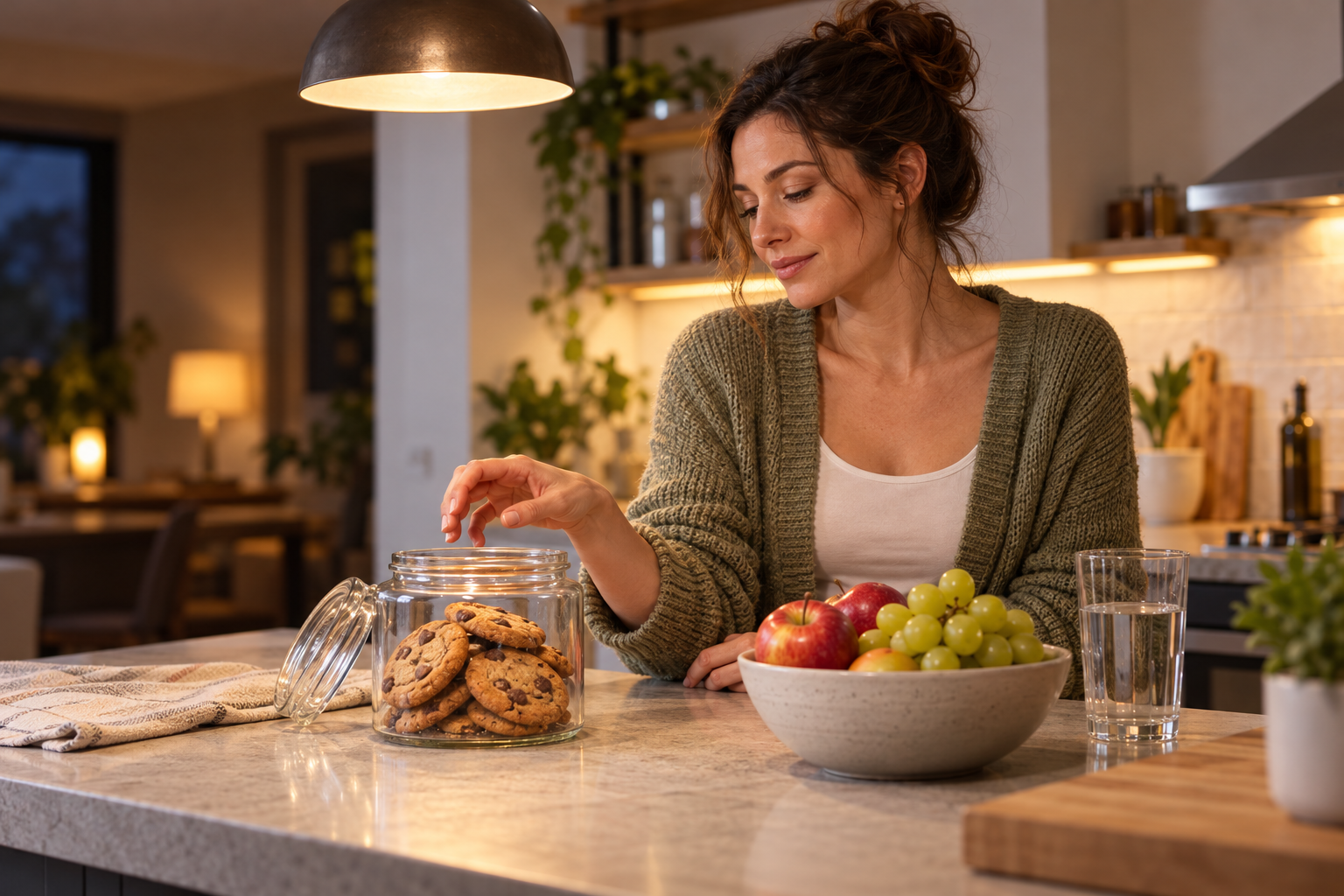
You probably know the scene. Dinner was fine. You’re not hungry, not really. And yet some part of your brain has locked onto the biscuits in the cupboard, and it keeps replaying the picture until you get up and open the door.
That pull isn’t a character flaw. Cravings are an ordinary mix of habit, biology, environment and mood, and most people have them. The good news is that each of those ingredients can be changed, a little at a time, and several of them respond to surprisingly small moves.
Below are 14 approaches that hold up when you check the research. Some work in the moment, when the craving is already shouting. Others work upstream, so the shouting starts less often. You don’t need all of them. Pick two or three that fit your life and start there.
1. Check whether you’re actually hungry
A craving and real hunger can feel identical at 6 p.m., but they behave differently. Hunger builds slowly and almost any food will settle it. A craving is narrow. It wants one specific thing, and a plate of chicken and rice won’t do.
The two also feed each other, which is why skipping meals backfires. A Drexel University team followed 189 adults through a 12-month weight-loss programme in 2017 (published in Annals of Behavioral Medicine), asking them several times a day, by smartphone, how they felt and what they ate. Higher momentary hunger and a sense of deprivation, along with tasty food nearby, predicted a lapse in the hours that followed. The chain runs like this: a long gap without food raises hunger, hunger raises the reward value of energy-dense food, and a mild craving at 2 p.m. becomes an urgent one by evening. The study was observational, so it shows a strong link rather than proof of cause, but the mechanism matches what most of us experience.
Breakfast seems to matter here too. In a small University of Missouri study led by Heather Leidy’s group, 20 young women who usually skipped breakfast ate either nothing, a 350-calorie breakfast with 13 g of protein, or one with 35 g, each for a week. Both breakfasts cut sweet and savoury cravings compared with skipping, and the higher-protein version cut savoury cravings further.
Next time, do this: before you reach for the snack, ask whether you’d happily eat a plain apple or a boiled egg right now. If yes, you’re hungry, so eat a proper meal. If only the biscuit will do, it’s a craving, and the rest of this list is for you. Regular meals are one of those good habits to have that quietly make everything else easier.
2. Protect your sleep
This one surprises people, because sleep feels unrelated to the snack drawer. The numbers say otherwise.
Researchers at Loughborough University and the University of Leicester, working with Nuffield Health, analysed sleep and eating habits in 27,263 UK adults. The paper appeared in Appetite, and Loughborough’s January 2026 summary of the sleep study sets out the main findings:
| Sleep pattern | Linked eating behaviour |
|---|---|
| Worst sleep quality | Up to 3.5 times higher odds of eating when stressed or bored |
| Short sleep (under 7 hours) | 47% higher odds of skipping meals, 24% higher odds of overeating |
| Poor sleep overall | Sweet snacks eaten 10 to 39% more often, fried food 10 to 21% more often |
The design was cross-sectional, so it can’t prove that bad sleep causes the cravings. Sleep and eating probably push on each other. An experiment by David Dickinson, Naomi Kakoschke and Sean Drummond (Scientific Reports, July 2025) adds a useful wrinkle: when 118 young adults slept 5 to 6 hours a night for a week at home, taste mattered more than healthiness in their food choices, though only for people who started out with stronger self-control, and everyone moved less.
Start small: move your bedtime 20 minutes earlier for one week and notice whether the evening pull changes. If tiredness is wrecking your afternoons as well, these ways to fight sleepiness at work can help you get through the day without leaning on sugar.
3. Turn down long-term stress
Short bursts of stress make some people lose their appetite. Long, grinding stress tends to do the opposite.
Susanne Kuckuck and colleagues at Erasmus MC in Rotterdam looked at this in 2025 (Psychoneuroendocrinology, January issue). They measured cortisone in the scalp hair of 108 adults with obesity, which reflects stress hormone exposure over the previous months rather than one bad afternoon. Higher hair cortisone went with more food cravings, and the link held even after accounting for how stressed people said they felt. Cravings and emotional eating were highest in those who scored high on both the biological and the psychological measure. It’s a single cross-sectional study in a clinical group, so treat it as a pointer, not a final word.
What it suggests is that chronic stress may make cravings a background condition rather than a series of random events. Dealing with the stress can be as useful as dealing with the snack.
Your move: when a craving arrives after a tense moment, say the stressor out loud in one sentence (“that email from my manager”), then take ten slow breaths before deciding anything. If the same worry keeps looping at night, work on how to stop ruminating thoughts, because rumination keeps the stress system switched on.
4. Move tempting food out of sight
Willpower gets most of the credit and blame, yet placement often does more of the work. England ran a large real-world test of this idea.
In October 2022, larger shops in England were banned from putting in-scope foods high in fat, sugar or salt at checkouts, store entrances and aisle ends. A University of Leeds team evaluated the result using store-level sales data from Asda, Morrisons, Sainsbury’s and Tesco, published in August 2025. Before the rules, 20 of every 100 items sold were in-scope products. Afterwards, 19. That sounds tiny until you scale it: around two million fewer of those items sold per day. The striking part is that 56% of shoppers surveyed didn’t notice any change in store, and 73% thought the rules wouldn’t affect their own shopping. They bought less anyway. Effects varied, though: one of the three retailers analysed showed no significant drop.
Michelle Morris, who led the analysis, called the legislation a step toward making healthy diets “the easy choice.” Your kitchen works the same way on a smaller scale.
A quick experiment: put treats in an opaque tin on the highest shelf, and put fruit or nuts at eye level on the counter. It’s the same principle behind digital minimalism: you change the setting so the default choice changes with it.
5. Play a visual game for three minutes
Cravings run on mental images. You picture the chocolate, almost taste it, and the picture pulls you toward the cupboard. Elaborated Intrusion theory, developed by Plymouth psychologists, says that if you fill your visual working memory with something else, the image weakens and the craving goes with it.
The best-known test is still a simple one. Jessica Skorka-Brown, Jackie Andrade and colleagues (Addictive Behaviors, 2015) gave 31 undergraduates smartphones for a week and texted them seven times a day. Cravings showed up on about 30% of occasions, most often for food and drinks. When the Tetris group played for three minutes, craving strength fell from 70% to 56%, and the effect didn’t fade as the week went on. An earlier lab study by the same team, with 119 volunteers, found the same pattern.
These studies are from 2014 and 2015 and the samples were small, students mostly. Still, the idea has held up across related experiments, including one where shaping modelling clay out of sight reduced chocolate cravings.
Keep a block-puzzle game, a jigsaw app or even a sketchbook within reach, and give the next craving three focused minutes of something visual before you decide whether you still want the food. If you’d rather lose yourself in something longer, here’s how to enter the flow state on purpose.
6. Surf the urge instead of fighting it
Think of a craving as a wave. It builds, peaks and breaks, and if you stay on the board long enough it passes under you. Fighting the wave, or diving straight into the snack, both tend to keep you in the water longer.
The comparison works because cravings really are time-limited. Where it breaks down is that real waves come in on their own schedule, while cravings can be set off again by a cue, like the smell of a bakery or an advert. Riding one wave doesn’t stop the next.
So does the surfing technique actually help? A meta-analysis by Seyed Amirhossein Allameh and colleagues (BMC Psychology, September 2025) pooled 23 randomised trials and found that mindfulness-based approaches lowered craving intensity, with a small effect (a standardised difference of 0.28). The authors rated the certainty as low, because the trials varied a lot in method. Small and uncertain isn’t nothing, though. For a technique that costs nothing and takes ten minutes, it’s a reasonable bet.
Give it a go: when the next craving hits, set a ten-minute timer. Notice where you feel it (mouth, chest, stomach), rate it from 1 to 10 every two minutes, and watch the number move. The approach has a lot in common with these Stoic exercises, which also train you to watch an impulse without obeying it.
7. Walk it off for 15 minutes
A short, brisk walk is one of the better-tested in-the-moment tools.
Larissa Ledochowski and colleagues at the University of Innsbruck ran a crossover experiment with 47 overweight adults who ate at least 100 g of sugary snacks a day (PLoS One, 2015). After three days without those snacks, each person either walked briskly on a treadmill for 15 minutes or sat quietly. Then came two tests: a stressful word-colour task, and unwrapping and holding a sugary snack without eating it. After the walk, urges were lower, and they rose less in response to both the stress and the snack. The study didn’t measure how much people actually ate later, and it ran in a lab.
A 2024 meta-analysis by Halim Moore and colleagues (Obesity Reviews) adds reassurance in younger people: across controlled trials in children and adolescents, a single exercise session didn’t raise later food intake, and it slightly reduced how much they said they wanted high-fat foods.
Test it this week: for your next three cravings, walk briskly for 15 minutes before you decide. Rate the urge before and after. You may find it’s down to a murmur by the time you’re back.
8. Eat the craved food less often, not just in smaller bites
Here’s where some popular advice gets it backwards. “Just have a small piece every day” can keep a craving alive.
Most researchers now see cravings as partly conditioned. Every time you eat a particular food in a particular situation (chocolate in front of the evening news, crisps on the drive home), the brain strengthens the link between cue and food. Each repetition is a rehearsal. Break the repetition and the link weakens, a process psychologists call extinction.
John Apolzan and colleagues at the Pennington Biomedical Research Center tested this in data from the two-year POUNDS Lost trial (Obesity, 2017). Among 367 adults on weight-loss diets, changes in how often people ate their craved foods tracked changes in cravings for those foods. Changes in how much they ate each time didn’t. A 2018 review by Corby Martin, Candice Myers and Apolzan concluded that most findings support this conditioning model. The data are correlational and the authors called for a direct test, so take it as a strong hint.
Here’s a simple way in: pick one cue-and-food pairing that happens almost daily. Then break the pattern. Have that food twice a week, at a planned time and in a different setting, rather than a nibble every night in the same chair.
9. Notice how ultra-processed foods hook you
Some foods are built to be hard to stop eating. That isn’t a slogan. You can measure it.
A University of Michigan team led by Lucy Loch and Ashley Gearhardt (Addiction, September 2025) used the modified Yale Food Addiction Scale 2.0 with more than 2,000 Americans aged 50 to 80 from the National Poll on Healthy Aging. The scale asks about experiences borrowed from substance-use criteria, such as intense cravings and repeated failed attempts to cut down.
| Group | Met criteria for ultra-processed food addiction |
|---|---|
| Women aged 50 to 64 | 21% |
| Men aged 50 to 64 | 10% |
| Women aged 65 to 80 | 12% |
| Men aged 65 to 80 | 4% |
People who said they often or sometimes felt isolated were more than three times as likely to meet the criteria. The survey covered only older US adults and was cross-sectional, but the pattern is a useful reminder. If you struggle more with crisps or sweets than with, say, plain yoghurt, the product design is part of the story.
Start small: choose one ultra-processed snack you eat most days and swap it for a less processed version, like popcorn you make yourself instead of a flavoured bag. And because loneliness kept showing up in the data, building connection counts too. These tips on how to improve social skills are a decent place to begin.
10. Read past the “healthy” label
Ashley Gearhardt, professor of psychology at the University of Michigan and head of its Food and Addiction Science & Treatment Lab, made a pointed observation when the 2025 study came out. People who see themselves as overweight may be especially exposed to what her team called health-washed products: snacks marketed as low-fat, low-calorie, high-protein or high-fibre, yet still formulated to maximise appeal. In her words, “These products are sold as health foods.” For someone trying to cut back, that’s exactly the wrong signal, because the label gives permission while the recipe keeps the craving going.
Say you swap your evening chocolate bar for a “protein” bar with a long ingredient list and a candy-bar texture. On paper you’ve made the better choice. In practice your brain may be getting the same sweet, soft, rewarding hit, and the habit stays wired in.
Flip the packet over before you buy. If the front says “high protein” but the back lists sugar or syrups near the top and a long string of additives, treat it as a treat, not a health food, and keep it to the planned occasions from item 8.
11. Slow down when you do eat it
You’re not going to avoid every craved food forever, and you don’t need to. How you eat it still matters.
A 2026 meta-analysis led by Khaleda Ahmadyar and Katy Tapper (Clinical Psychology Review, June 2026) pulled together 41 articles testing mindfulness and mindful eating. This 2026 review of mindful eating trials found that the techniques reduced how much people ate across 46 studies, with a small-to-modest effect (a standardised difference of −0.24). They didn’t change hunger or fullness ratings, and the effects were larger in lab settings than in everyday life. So mindful eating seems to work less by making you feel full and more by changing how you eat in the moment.
Tonight, test it: eat the thing you’ve been craving sitting down, off screens, and make the first three bites slow enough to notice the texture and flavour properly. Then check whether you still want the rest. A lot of overeating happens on autopilot, and learning to stop living on autopilot carries over well beyond the kitchen.
12. Count every craving you beat
Confidence isn’t a soft extra here. It’s part of the mechanism.
Jackie Andrade, professor of psychology at the University of Plymouth and one of the researchers behind the Tetris studies, put it plainly in a 2015 interview: each time someone gets through a craving, they should feel more confident about handling the next one. Feeling in control, she argued, is what keeps people motivated when cravings return.
A 2025 study by Eline Roordink and colleagues (Psychology & Health) backs this up with real-life data. Dutch adults trying to lose weight answered six random smartphone prompts a day. When their coping self-efficacy, meaning belief in their ability to resist, was higher, their odds of a dietary lapse dropped (an odds ratio of 0.81).
Your move: keep a simple tally in your phone’s notes. Every craving you ride out, walk off or delay gets a mark. After two weeks, read the number back to yourself. It works on the same streak logic as these hacks to beat procrastination: small, visible wins make the next one easier.
13. Picture a specific moment in your future
A craving is a choice between now and later, and “now” usually wins because it’s vivid. Episodic future thinking tries to make “later” vivid too. Instead of vague goals (“be healthier”), you imagine a concrete, positive event that’s coming up (your sister’s wedding in June, a hiking trip in spring) in sensory detail.
Emily Colton and colleagues at Monash University (Obesity Reviews, August 2024) meta-analysed 12 studies involving 951 adults with a BMI of 25 or more. Episodic future thinking improved delay discounting, the tendency to prefer small rewards now over bigger ones later, with a medium effect. It also improved later food choices, with a small effect. Not every review agrees: a broader 2024 analysis by Han Shi Jocelyn Chew and colleagues (Psychology & Health), which mixed several “time perspective” techniques, found no significant pooled effect across the five studies it could combine.
A quick experiment: write two or three sentences describing a specific good moment about three months away. Where are you, who’s there, what does it feel like? Save it on your phone and read it the next time a craving hits.
14. Know when it’s more than a craving
Most cravings are ordinary. Some aren’t, and it helps to know the difference.
The term “food noise” (constant, intrusive thoughts about food) took off alongside GLP-1 weight-loss drugs. Daisuke Hayashi and Travis Masterson analysed a nationally representative survey of 1,000 US adults run in May 2026 (Obesity Science & Practice, September 2026). About half said they experience food noise at least sometimes, and around 18% said often or always. Women (22.7%) and adults under 30 (26.5%) reported frequent food noise most. The strongest predictor, by far, was loss of control over eating, with nearly six times the odds.
A stricter measure gives a smaller number. A preprint by Branislav Jovanovic, Michael Lowe and colleagues (Research Square, October 2026, not yet peer-reviewed) used a validated food noise questionnaire with 3,646 adults surveyed in autumn 2025 and found that roughly 4 to 9.5% met criteria, rising to about 6 to 14% among adults with obesity. So frequent food thoughts are common, while the more intense, distressing version affects a smaller group.
If food thoughts crowd out your day, or you often feel you can’t stop once you start eating, that’s worth raising with your doctor or a registered dietitian. Help for this exists, from behavioural programmes to specialist eating disorder care to medication, and getting assessed isn’t a sign that you’ve failed.
What to do when you slip
You’ll give in sometimes. Everyone does. What happens in the next hour matters more than the slip itself.
The most common trap is the “I’ve blown it anyway” spiral, where one biscuit turns into the whole packet and then a written-off day. Charlotte Hagerman and colleagues at Drexel’s WELL Center studied the alternative (Appetite, 2023). They followed 140 adults in a weight-loss programme who reported lapses on their phones several times a day. When people responded to a lapse with self-compassion, they reported better mood and more control over their eating and exercise in the hours afterwards. Self-compassion here doesn’t mean dropping your goals. Hagerman’s team found that kindness and accountability worked together.
The 2025 study by Roordink and colleagues points the same way. Higher recovery self-efficacy, the belief that you can get back on track after a lapse, was linked to lower odds of lapsing again (an odds ratio of 0.81).
When it happens, try this sequence:
- Name it neutrally. “I ate more chocolate than I planned” is a fact. “I have no willpower” is a story, and usually a false one. If the harsh inner voice is loud, this guide on how to stop hating yourself is worth reading.
- Don’t compensate. Skipping the next meal brings back the hunger and deprivation from item 1, which sets up the next lapse.
- Look for the trigger. Tired? Stressed? Food on the counter? One honest answer tells you which item on this list to lean on.
- Keep it in proportion. One evening doesn’t undo weeks of progress, however it feels at 10 p.m. If your mind jumps straight to “I’ll never manage this,” these tips on how to stop catastrophizing help you check that thought.
- Reset the same day. Go for a short walk, drink some water, go to bed on time. You don’t need to wait for Monday, and if the whole day went sideways, here’s how to turn a bad day around.
Conclusion
Food cravings are loud, but they’re also predictable. They get stronger when you’re tired, stressed, hungry or surrounded by food that was designed to be hard to resist, and they get weaker when you change those conditions, practise riding them out and break the habits that keep them rehearsed.
You don’t need to overhaul your life this week. Pick one upstream change (sleep, regular meals, moving the treats) and one in-the-moment tool (a walk, three minutes of a visual game, a ten-minute urge surf). Try them for a fortnight, count your wins and adjust.
Want more practical, evidence-based ideas for building better habits? Browse the Self Improvement section and pick your next small change.