
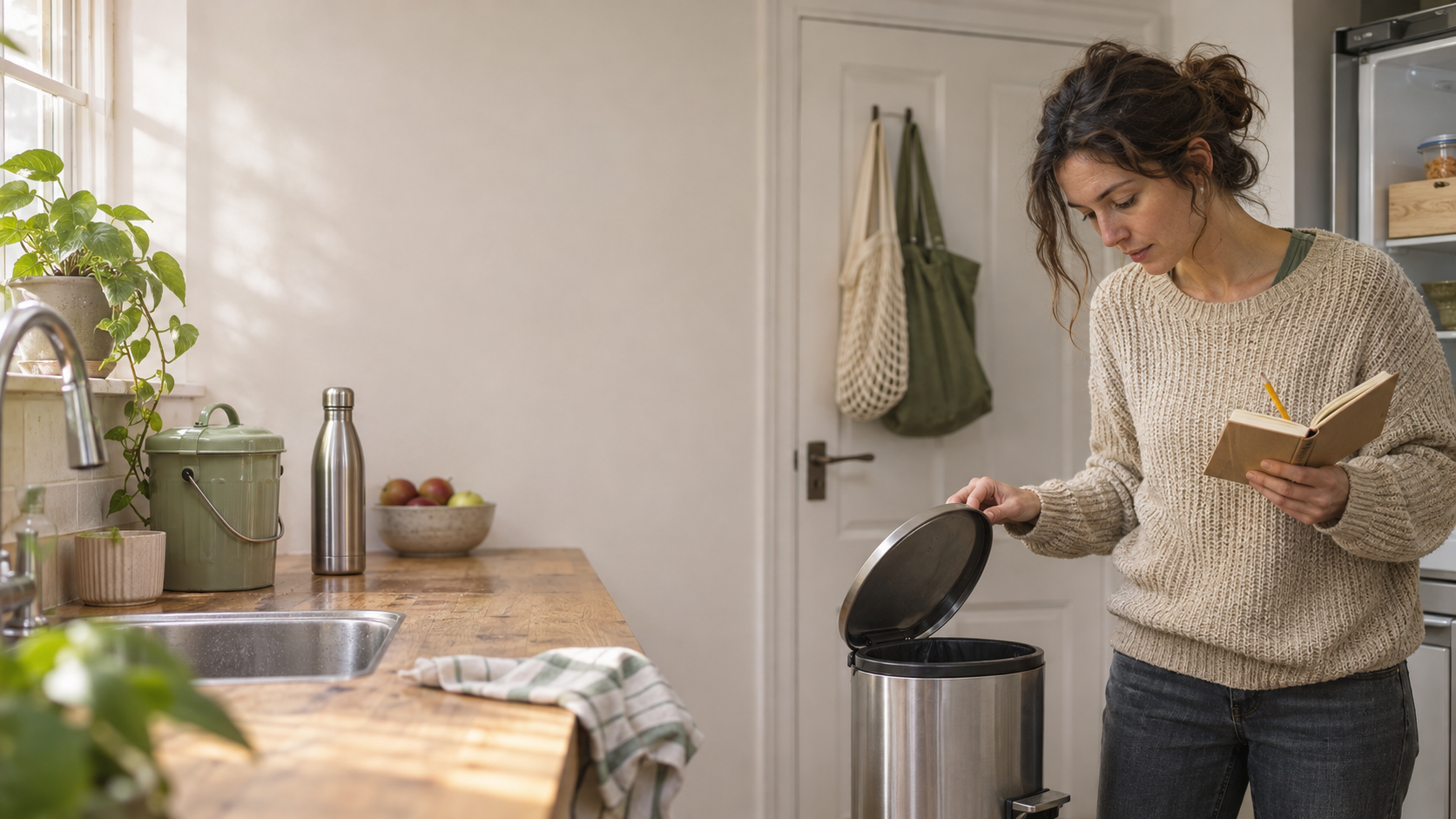
Zero waste has an image problem. Scroll through social media and you’ll see a single mason jar holding someone’s entire year of rubbish, a pantry full of matching glass containers, and a bamboo toothbrush lit like a museum piece. It looks lovely. It also makes the whole idea feel like a lifestyle you need to buy into all at once.
You don’t. The people who actually cut their waste for good tend to do something far less photogenic: they change one routine, let it settle, then change the next one. Nobody gets their bin to zero. Plenty of people get it to half.
This guide treats zero waste the way it actually works in a busy home, as a set of small habits. Each of the 17 steps below comes with the evidence for why it matters and one concrete thing to do this week. Start with whichever one looks easiest. That’s not cheating. That’s the method.
1. Look in your bin before you buy anything
Most people skip this step and go straight to shopping for reusable gear. Big mistake. You can’t cut waste you haven’t noticed, and most of us are bad at noticing our own.
WRAP’s UK Household Food Management Survey 2025, run with 5,509 adults in June and July 2025 and published in March 2026, found that four in five people believed they wasted less food than the average household. Shown a picture of what the average household actually throws away, even more of them (85%) decided they were better than average. Statistically, a lot of those people are wrong. The same WRAP research puts edible food thrown out by UK homes at 4.4 million tonnes a year, roughly £1,000 for a household of four.
The mechanism is simple. Rubbish disappears from view the moment the lid closes, so your memory of what went in there is fuzzy and flattering. A quick audit replaces the guess with a picture you can act on.
Give it a go: for one week, glance into your kitchen bin every evening and jot down the three things you see most often. Takeaway boxes? Bagged salad? Coffee pods? That list is your personal zero waste plan, and it’s probably different from the one Instagram would sell you.
2. Pick one swap, not ten
Enthusiasm is a trap here. The first weekend you get interested in zero waste, you’ll want to replace your cleaning products, your toothbrush, your food storage and your shopping routine. By week three, most of it has quietly reverted.
Habits take longer to form than the popular “21 days” story suggests. A systematic review and meta-analysis by Ben Singh and colleagues at the University of South Australia, published in Healthcare in December 2024, pulled together 20 studies with more than 2,600 participants. In the studies that measured timing, median times to form a health habit ran from 59 to 66 days, with individual cases ranging from four days to 335. The authors are open about the limits: only four studies reported formation time directly, and 11 of the 20 carried a high risk of bias. Still, the direction is clear. Two months is a more honest expectation than three weeks.
If one habit needs around two months to stick, ten habits at once is asking for a lot of willpower you don’t have.
Start small: choose the single swap that targets the biggest item from your bin audit. Commit to it for eight weeks before adding anything else. If you tend to put off starting at all, these practical strategies to stop procrastinating will help you get the first one off the ground.
3. Hang your reusable bags where you’ll trip over them
Reusable bags are the gateway habit for a reason. They’re cheap, they’re visible, and the evidence that small nudges change bag use at scale is unusually strong.
England’s single-use carrier bag charge is the clearest example. According to Defra’s carrier bag data for 2025 to 2026, published in July 2026, the main retailers sold 126 million single-use plastic bags that year. That’s a 98% drop compared with the 2014 figure, before the charge existed. Across all 94 reporting retailers, sales came to 399 million, around seven bags per person.
| Measure (England) | Figure | Period |
|---|---|---|
| Bags sold by main retailers | 126 million | 2025 to 2026 |
| Bags sold by all 94 reporting retailers | 399 million | 2025 to 2026 |
| Fall for main retailers vs. 2014 | 98% | Since the 2015 charge |
The charge works partly because it puts a tiny decision right at the till. Your own habit needs the same trick in reverse: a cue that fires before you leave the house, not after you’re already at the checkout.
When you unpack the shopping, hang the empty bags on the front door handle instead of putting them in a cupboard. Keep one folded bag in your coat pocket or work bag. If you constantly forget, the tips in how to improve your memory apply nicely to small, repeated errands like this.
4. Refill a bottle from the tap
Bottled water is one of the easiest single-use items to drop, and the case for doing so has grown beyond the plastic you can see.
In a review published in the Journal of Hazardous Materials in 2025, Sarah Sajedi of Concordia University, with Chunjiang An and Zhi Chen, looked at more than 140 studies on plastic particles in drinking water. Their estimate: people take in roughly 39,000 to 52,000 microplastic particles a year from food and water, and those who drink bottled water may ingest up to 90,000 more per year than people who stick to tap water. Bear in mind what kind of evidence this is. It’s a review of existing studies, measurement methods differ widely, and the long-term health effects of these particles are still poorly understood. What the review does suggest is that the bottle itself is a source, shedding fragments as it’s made, stored and heated.
Here’s a simple way in: put a refillable bottle next to your keys tonight and fill it before you go out. If your tap water tastes off, a basic filter jug is cheaper over a year than most bottled water habits.
5. Plan meals and write your list from the fridge
Food is where the real tonnage is. Packaging gets the attention, but a forgotten bag of spinach or half a loaf weighs more and goes straight to landfill in many places.
The UN Environment Programme’s Food Waste Index Report 2024, produced with WRAP, is still the most recent global edition. It estimated that 1.05 billion tonnes of food were wasted in 2022, around 132 kg per person, and that households were responsible for 60% of it. Put another way, homes around the world threw away the equivalent of more than a billion meals every day. The figures describe 2022, so treat them as a baseline rather than a live count.
Most of that waste starts before cooking. People buy for the week they imagine, not the week they’ll actually have, so the ambitious stir-fry ingredients wilt behind Thursday’s takeaway.
Before you shop, open the fridge and write down what needs eating first, then plan two or three meals around it. Only then add new items to the list. If planning feels like one more chore, the habit tips in how to be more organized at work transfer surprisingly well to a kitchen.
6. Make an “eat this first” shelf
This one is pure cause and effect. Food that sits at eye level gets eaten. Food pushed to the back of the fridge gets forgotten, then discovered, then binned. The chain runs like this: new shopping goes in the front, older food slides back, you stop seeing it, it passes its best, and it ends up in the bin. Nothing in that sequence involves a bad decision. It’s just shelf geometry.
So change the geometry. A dedicated shelf or a labelled box for anything that needs using up in the next two days interrupts the chain at the “stop seeing it” step.
Picture this: say you get home late on a Wednesday, too tired to think. You open the fridge, and the first thing you see is a box holding half an onion, two eggs and some cheese that needs using. That’s an omelette. Without the box, you’d probably have ordered something in plastic containers.
Test it this week: clear one shelf, label it “eat first”, and move anything that’s close to its date there every time you unpack the shopping.
7. Read “best before” as advice and “use by” as a rule
Date labels cause a surprising amount of perfectly good food to be thrown away. “Best before” is about quality: taste, texture, crunch. “Use by” is about safety. Mixing them up means binning food that’s fine.
A 2026 paper in Business & Society by Hyoje Jay Kim, Hyun Seung Jin, Chris Janiszewski and Joowon Ban tested what happens when products carry both a freshness date and a safety date instead of a freshness date alone. Across three experiments and one survey with participants in the US, UK and Australia, the combined label consistently cut discards. In one online experiment, people chose to throw out an average of 4.47 out of eight products with a freshness label only, against 2.36 with the combined label. In a controlled behavioural study, correct understanding of what the freshness date means rose from 48% to 74%. You can read the full paper on adding a safety date to a freshness date label. The limits: most of the studies measured intentions in online or lab settings, not what people did with their own fridges.
You can’t redesign supermarket labels, but you can do the mental version. When something passes its “best before” date, look at it, smell it, taste a little. Keep “use by” dates strict for meat, fish and ready meals.
8. Say yes to the reusable cup
Takeaway coffee cups look like paper, yet many recycling systems can’t handle them. Bringing your own cup works, but a city-wide deposit system shows how much easier it gets when reuse is the default.
Aarhus in Denmark launched a reusable cup scheme called REUSEABLE in January 2024, run by the municipality with TOMRA and local cafés. Customers pay a small refundable deposit (5 Danish kroner) for a polypropylene cup, drop it in any of the automated return machines around the city, and tap a card or phone to get the money back. According to the European Commission’s Green City Accord case study, more than 1.6 million cups were returned between January 2024 and December 2025, with a 91% return rate. A TOMRA survey a year after launch found 84% of users were satisfied or very satisfied. The scheme works because returning the cup takes less effort than finding a bin.
Your move: if your town has a cup-return or deposit scheme, use it. If not, keep a lidded cup in your bag and ask your regular café to fill it. Many will knock a little off the price.
9. Repair before you replace
A broken kettle, a phone with a tired battery, a jacket with a split zip. Each one is a fork in the road, and the easy path usually leads to a new purchase.
The European Commission estimates that throwing away consumer goods early generates 35 million tonnes of waste in the EU each year. That’s the reasoning behind the Right to Repair Directive (EU 2024/1799), which member states had to apply from 31 July 2026. It requires manufacturers to offer repair for certain products, such as washing machines, fridges, vacuum cleaners and smartphones, at a reasonable price even after the legal guarantee runs out. When a consumer chooses repair under the seller’s guarantee, the guarantee is extended by 12 months. Rollout is uneven: only a handful of countries met the July 2026 transposition deadline, so your rights depend on where you live.
Next time something breaks, spend ten minutes searching for a repair guide, a local repair café, or the manufacturer’s repair service before you look at replacements. For devices you mostly use out of habit, how to stop phone addiction might also help you hold off on the next upgrade.
10. Buy secondhand first
Clothing and home textiles are one of the fastest-growing waste streams, and they’re easy to overlook because they leave the house a bag at a time.
The European Environment Agency’s briefing Circularity of the EU textiles value chain in numbers, published in March 2025, found that average textile consumption in the EU reached 19 kg per person in 2022, up from 17 kg in 2019. That’s 8 kg of clothing, 7 kg of household textiles and 4 kg of shoes, roughly a large suitcase of new stuff per person per year. Textile waste sat at around 16 kg per person.
| EU textiles per person, 2022 | kg |
|---|---|
| Clothing | 8 |
| Household textiles | 7 |
| Footwear | 4 |
| Total consumption | 19 |
Buying used doesn’t make the problem disappear, but it slows the flow of new material into the system and keeps existing items in use longer.
Test it this week: before buying any new piece of clothing or homeware, check one secondhand option first. A charity shop, a resale app, or a friend’s clear-out all count.
11. Use what you already own before buying “eco” stuff
Zero waste shops are full of beautiful things: beeswax wraps, steel straws, glass containers, organic cotton bags. Buying a whole set feels like progress. Often it’s the opposite.
Think of it like a gym membership. Signing up isn’t the healthy part; turning up is. A reusable product only pays back its footprint if you use it, many times. The analogy breaks down in one way, though: an unused gym membership costs you money, while an unused tote bag has already cost the planet the resources to make it.
The evidence backs this up. The UN Environment Programme’s 2020 meta-analysis of life cycle assessments on shopping bags, an older report but still the main reference on the topic, concluded that a cotton bag needs to be used somewhere between 50 and 150 times to have less impact than a single-use plastic bag. Use it twice and it’s worse.
Start small: before buying any zero waste product, check your cupboards. Old jam jars make perfectly good storage. The tote bags you already own from events and shops are enough. Buy new only when something has genuinely worn out.
12. Learn your local recycling rules
Recycling is the last resort in a zero waste home, not the first. Still, doing it badly can undo a lot of good effort, and most of the losses happen right at home.
The Recycling Partnership’s 2026 State of Recycling Report, based on data from more than 9,000 recycling programmes serving 97% of the US population, found that only 21% of recyclables from American households are actually recovered and turned into new products. About 76% are lost at the household level, before collection even happens. The report links part of the problem to access: only 8% of people in multifamily buildings have recycling on their property.
| US residential recycling (2026 report) | Share |
|---|---|
| Recyclables recovered | 21% |
| Lost at household level, before collection | 76% |
| Multifamily homes with on-site recycling | 8% |
Rules vary from town to town, and the confusion is real. Something accepted in one area can contaminate a load in the next.
Give it a go: look up your council’s or hauler’s recycling page, screenshot the “yes” and “no” lists, and stick a printout on the inside of a kitchen cupboard. Staying curious about the boring details pays off here; how to stay curious as an adult has a few ideas for keeping that habit alive.
13. Stop wishcycling
Wishcycling is putting something in the recycling bin because you hope it’s recyclable. It feels generous. It isn’t.
Follow the chain. A plastic bag goes into the recycling. At the sorting facility it wraps itself around the spinning discs that separate paper from containers. The line has to stop while someone cuts it free. Meanwhile, greasy or wrong items mixed in with clean paper lower the quality of the whole batch, and if the quality drops far enough, buyers reject it and the lot goes to landfill. One hopeful item can drag down far more than its own weight.
This isn’t hypothetical. Eco-Cycle, which runs the Boulder County Recycling Center in Colorado, explained in March 2024 that staff shut down machinery to remove tangled plastic bags every day, often several times a day.
A quick experiment: for the next month, follow the rule “when in doubt, leave it out”. Anything you’re unsure about goes in the general waste or gets checked online first. It feels wrong. It’s better for the system. If you want to get sharper at questioning your own assumptions, how to improve your reasoning skills is a good companion read.
14. Compost your food scraps
Even a careful cook ends up with peelings, coffee grounds and the odd forgotten lemon. Where they end up matters more than most people realise.
In an October 2023 report, Quantifying Methane Emissions from Landfilled Food Waste, the US Environmental Protection Agency estimated that about 58% of the methane escaping from municipal landfills comes from food waste, even though food makes up only around 24% of what’s landfilled. Food breaks down fast, often before gas collection systems are in place. It’s an older report, but it’s still the agency’s main estimate on the subject.
Composting keeps those scraps out of landfill and turns them into something useful. If you have a garden, a simple bin works. If you don’t, check whether your council collects food waste separately; many now do.
Here’s a simple way in: keep a small lidded caddy next to the sink this week and see how fast it fills. That number will probably surprise you, and it’s a good motivator to keep going.
15. Tell the people you live with what you’re doing
Zero waste is hard to sustain alone in a shared home. If you’re the only one rinsing jars and checking recycling rules, resentment builds quickly, on both sides.
Social comparison helps. Economists Ek and Söderberg ran two large randomised trials with around 20,000 households in Varberg and Partille in Sweden, published in the Journal of Public Economics in 2024. Households received letters comparing their waste with that of similar neighbours. Residual waste fell by roughly 7% to 12%, mainly because people recycled more packaging, and much of the effect held a year after the letters stopped. Note that this was a municipal programme with official feedback, not a family chat, so the effect at home could be bigger or smaller.
The broader lesson: people change when they can see what others are doing and how they compare.
Next time you change something at home, explain why in one sentence and ask for one small favour, not a total overhaul. If those conversations tend to turn tense, these tips on how to argue without fighting can keep things friendly.
16. Attach each new habit to one you already have
New habits stick faster when they ride on the back of old ones. You already make coffee, unpack shopping and take the bins out. Each of those is a perfect hook.
Dr Ben Singh, the University of South Australia researcher behind the habit-formation review mentioned earlier, pointed out in January 2025 that planning and preparation make a new behaviour easier to repeat. His examples were things like laying out your gym clothes the night before or having lunch ready in the fridge. He also noted that fitting a new habit into your morning routine seemed to help. Translate that to zero waste and you get pairs like these: when the kettle boils, fill your water bottle; when you put the shopping away, move older food to the “eat first” shelf.
Try writing three “when I do X, I’ll do Y” pairs on a sticky note and putting it on the fridge. For more on building routines that last, see these good habits to have in life.
17. Label your bins at home
The last step is about design. If your bins are confusing, your household will make mistakes, no matter how good their intentions.
A 2025 systematic review in Frontiers in Psychology by Brent Wilson, Magali Delmas and Deepak Rajagopal pulled together 99 experimental and quasi-experimental studies on waste and resource behaviour. Among the findings on recycling, adding icons or pictures to signs improved sorting accuracy by about 7%. The authors also warn that the very large effects in the literature are probably inflated by publication bias, and that solid waste is studied less than energy and water. So treat 7% as a ballpark, not a promise.
Your move: put a simple picture label on each bin at home. A drawing of a bottle and a can on the recycling, an apple core on the compost caddy. It takes ten minutes and helps everyone in the house, including guests, get it right without thinking. Keeping it to one task at a time, as in how to focus on one thing at a time, makes small projects like this feel less fiddly.
What to do when you slip
You will forget your bags. You’ll buy the multipack in plastic because it was cheaper and you were tired. You’ll find a forgotten lettuce turning to liquid in the salad drawer. None of that means you’ve failed.
How you react to the slip matters more than the slip itself. A study led by Hagerman at Drexel University’s WELL Center, published in Appetite in early 2024, followed people trying to lose weight through smartphone surveys several times a day. When participants responded to a lapse with self-compassion instead of self-criticism, they reported a better mood and more sense of control over their behaviour in the hours afterwards. Self-compassion didn’t stop another lapse that same day, and the study was about eating, not waste. But the pattern is consistent with research on goals more broadly: harsh self-talk drains motivation, and kindness helps you get back on track faster.
Remember the habit research too. Singh and colleagues found formation times ranging from four days to almost a year. A wobbly few weeks is normal.
So when you slip, do three things. Name what happened without drama (“I forgot the bags again”). Ask what made it hard (“they were in the car, not by the door”). Change that one thing. If you notice yourself spiralling into “I’m useless at this”, the ideas in how to stop hating yourself and how to get over a bad day are worth a read. And if you tend to abandon plans the moment they wobble, how to stick to your decision covers that pattern in more depth.
Conclusion
Starting zero waste habits isn’t about perfection or a jar of rubbish on a shelf. It’s about noticing what you throw away, picking one change, and giving it enough time to become automatic. Look in your bin. Choose one swap. Hang the bags on the door. Then, in a couple of months, add the next one.
The evidence is reassuring on one point in particular: small, well-designed changes add up, whether it’s England’s bag charge, a cup deposit in Aarhus or a picture label on your recycling bin.
Pick one step from this list today and start it before the weekend. For more ideas on running your home with less stress and less waste, browse the Home section.