
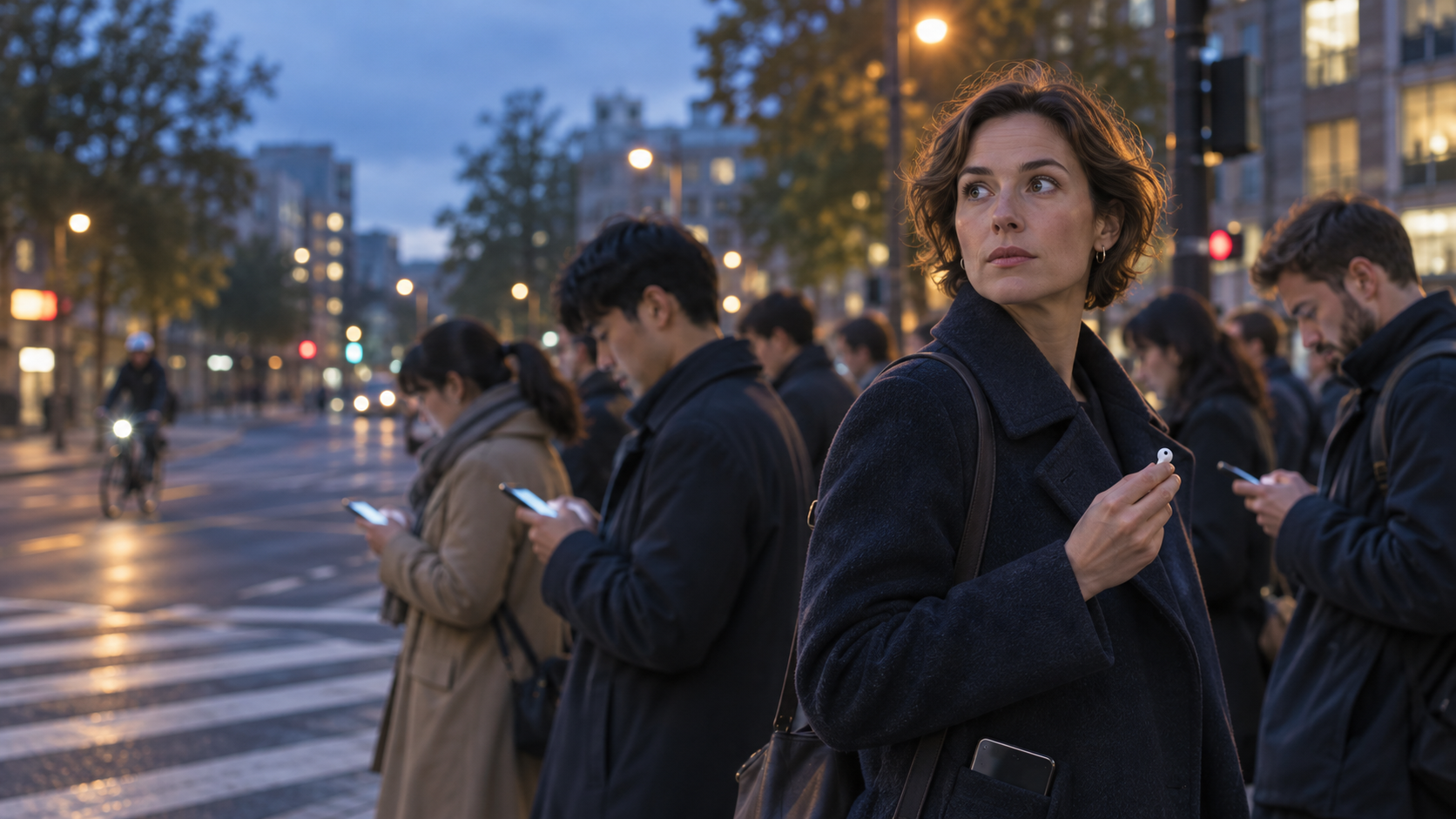
You walk the same route every day. Same crossing, same coffee shop, same shortcut through the car park. And if someone asked you tomorrow what colour the van parked outside your building was, or where the second exit in that coffee shop is, you probably couldn’t say.
That’s normal. Your brain is built to save energy, and familiar places get filed under “nothing to see here.” The trouble is that the moments that matter rarely announce themselves. A cyclist comes round a blind corner. A stranger keeps drifting back into your space. A fire alarm goes off and everyone waits to see what everyone else does.
Situational awareness is the skill of noticing what’s around you, working out what it means, and guessing what happens next. Pilots, police officers and lifeguards train it on purpose. The rest of us mostly leave it to luck.
You don’t need to become paranoid or walk around like a secret agent. You need a handful of habits that keep your attention pointed outward a bit more often. Below are 13 of them, each backed by research, official data or a well-tested framework, with a small action you can start today.
1. Keep your phone in your pocket when you’re on the move
The single biggest drain on your awareness is probably in your hand right now. When your eyes and thoughts are on a screen, the street becomes background noise, and other people can see that.
Thieves certainly can. The Office for National Statistics reported in July 2026 that police-recorded theft from the person in England and Wales fell 20% to 121,161 offences in the year ending March 2026. That sounds like good news, and partly it is. But the same bulletin notes the figure had been climbing since the year ending March 2021, when it stood at 49,666. Part of that rise reflects the lockdown low point, so read it with care. Still, theft from the person in recorded crime is more than double what it was five years ago, and a phone held loosely at the kerb is about as easy a target as it gets.
The fix isn’t to give up your phone. It’s to separate “walking time” from “screen time.” Stop, step out of the flow of people, check the message, put it away, then move.
If you find that hard, it might be worth looking at how to stop phone addiction more broadly, because the urge to check is usually a habit, not a need.
Start small: for the next week, make one rule. No scrolling while crossing a road or standing on a platform edge.
2. Learn the three levels of awareness
“Be more aware” is vague advice. It helps to know what you’re actually training.
Human factors researcher Mica Endsley described situational awareness in 1995 as three levels stacked on top of each other. Level one is perception: noticing the elements around you. Level two is comprehension: understanding what they mean. Level three is projection: predicting what they’ll do next. The model is old, but it’s still the reference point in aviation, medicine and police training, and nothing has replaced it.
Here’s why the split matters. Each level depends on the one below. If you never notice the man pacing near the cash machine (level one), you can’t wonder why he’s there (level two), and you certainly can’t predict he might follow the next person who withdraws money (level three). A July 2026 piece from police simulation-training company FAAC makes the same point for officers: training usually targets perception because it’s easiest to grade, while projection is the hardest level to build because it needs the first two working well.
So when you practise, practise all three. Notice something. Ask what it means. Guess what happens next. This is close to the skills behind better reasoning, just applied to the street instead of a spreadsheet.
Give it a go: on your next walk, pick three things you see and run each one through “what is it, what does it mean, what happens next?”
3. Protect your sleep like it’s safety equipment
Tired brains miss things. Few findings in attention research are as consistent as this one.
And plenty of people are running tired. A CDC National Center for Health Statistics data brief published in April 2026 found that 30.5% of US adults slept less than seven hours on average in 2024, based on the National Health Interview Survey. Roughly one adult in three, in other words, is starting the day below the recommended minimum.
What does one short night actually cost you? A 2024 meta-analysis in Sleep Medicine Reviews by Larissa Wüst and colleagues at the University of Basel pooled 44 studies and found that a single night of restricted sleep (around four hours versus eight) raised sleepiness and impaired sustained attention, the kind of attention you need for driving or walking through a busy area. Other cognitive measures showed weaker or mixed effects, so it’s not that everything collapses. It’s that the “keep watching” part of your brain gets less reliable.
Building sleep into your routine is one of those good habits that pays off in places you wouldn’t expect.
Next time, do this: when you know you’ve slept badly, treat that day like driving in fog. Leave more margin, skip the shortcut through the badly lit alley, and save the headphones for later.
4. Take one earbud out (or switch on transparency mode)
Your ears are an early-warning system. They pick up a car reversing behind you, a bike bell, footsteps closing in, long before your eyes do. Music and noise cancelling switch that system off.
The vehicle-safety organisation DEKRA covered this in July 2025. It cited a test by the Institute for Work and Health of the German Social Accident Insurance in which participants listening to music reacted 50% slower to sirens and horns. DEKRA accident researcher Denis Preissner warned that noise cancelling is particularly risky because it works even at low volume, so “I’ll keep it quiet” doesn’t really solve the problem. His summary was blunt: “no technical aid can replace attention.”
Note that this is a test reported by a safety organisation rather than a peer-reviewed paper, so take the exact number as a guide rather than gospel. The direction of the effect, though, matches what you’d expect from how hearing and attention work.
Headphones are brilliant for getting into a state of flow at your desk. On a busy street, they’re a blindfold for your ears.
A quick experiment: tomorrow, walk your usual route with one earbud out or transparency mode on, and count how many things you hear that you’d normally miss.
5. Find two exits every time you walk into a room
Most people leave a building the same way they came in. That’s fine until the way in is blocked, packed or on fire.
A study published in Safety Science (online November 2024, print February 2025) by Tong, Bode, Haghani and Lovreglio tracked 497 real exit choices during drills and false alarms in a university library. People tended to follow the crowd, pick closer exits, go where staff pointed, and choose exits they already knew. Familiarity pulled hardest on the ground floor. Interestingly, crowding and familiarity mattered less during announced drills than during false alarms, which suggests drills don’t fully capture how we behave when we think it might be real.
One building, one country, so it’s not the final word. But the pattern is consistent: under pressure, you default to the door you know. The only way to “know” a better door is to look for it before you need it.
This takes about five seconds. Walking into a restaurant, a cinema, a hotel corridor or an office you’re visiting, glance around and locate two ways out. One is usually the door you came through. The other is the one that matters.
Your move: do the two-exit check in every new place you enter this week until it happens without thinking.
6. Know what “normal” looks like before you judge “odd”
You can’t spot something unusual if you don’t know what usual looks like. Security trainers call this the baseline.
The logic runs in a chain. Every place has a typical rhythm: how loud it is, how fast people move, where they look, what they carry. Your brain learns that rhythm quickly if you let it. Once it’s in place, anything that breaks the pattern stands out on its own, without you having to scan for “threats” all the time. Someone wearing a heavy coat on a hot day, a person standing still in a crowd that’s moving, a car idling in a spot where nobody waits. None of these is proof of anything. They’re just signals worth a second look.
Picture this: you’re at a café you visit every Saturday. The baseline is relaxed chatter, people on laptops, staff moving between tables. One afternoon a man sits near the door, orders nothing, and keeps watching the counter instead of his phone. Nothing has happened. But because you know what normal looks like here, you noticed, and noticing gives you options.
Building a baseline is partly a memory skill, so practising your short-term memory helps. It’s also about reading people, which is a big part of emotional intelligence.
Test it this week: in one place you visit often, spend 30 seconds describing to yourself what’s “normal” there. Sound, pace, who’s usually present.
7. Raise your guard a notch after dark
Your eyes simply work worse at night, and so do drivers’. The numbers are stark.
The Governors Highway Safety Association’s pedestrian report, published in July 2026, found that 76.5% of US pedestrian deaths with known lighting conditions in 2024 happened after dark. The same report projects 6,732 pedestrians were killed on US roads in 2025, still above the pre-pandemic level even after three years of decline.
Darkness doesn’t cause crashes by itself. It shrinks everyone’s margin. Drivers see you later, you judge their speed less accurately, and shadows hide kerbs, cyclists and people. Put a phone or headphones on top of that and the margin almost disappears.
So adjust your behaviour to the light. At night, cross where there’s lighting even if it’s a few steps further. Wear or carry something visible. Make eye contact with drivers before stepping out, or at least confirm they’ve slowed.
Here’s a simple way in: set a mental “night mode” that switches on when the streetlights do, with phone away, both ears open and crossings only where you can be seen.
8. Don’t wait for the crowd to decide for you
When something odd happens, most of us look at other people first. If they look calm, we stay calm. It feels sensible. It can also be how a whole room stays put while the situation gets worse.
A study published in February 2026 in Natural Hazards and Earth System Sciences by Booloot Arshaghi and colleagues at the University of Nottingham and Nottingham Trent University tested this in virtual reality. In a VR flood scenario with 84 participants, people chose between a risky route through floodwater and a safe bridge. Watching a crowd take the risky route pulled choices towards it and slowed decisions: in the first experiment, people took about 13.8 seconds to move with a risky crowd versus about 7.5 seconds with a safe one. Larger crowds and a hidden destination made people lean on the crowd even more. When the water was clearly deep, though, nobody followed the crowd in.
Keep the limits in mind. It’s a small sample, mostly students and staff, in a simulation, and some comparisons were only trends. But it lines up with what disaster researchers have long described as normalcy bias: the pull to assume everything is fine because nobody else is panicking.
The antidote is to trust your own read, even when it feels awkward. If a situation feels wrong, act on that feeling first and explain it later. You can always come back. Learning a few emotional regulation skills helps here, because a calm body makes faster decisions than a frozen one.
Start small: next time an alarm sounds and everyone looks around, be the first to pick up your bag and walk.
9. Scan your space the way a lifeguard watches a pool
Think of a lifeguard on a high chair. They don’t stare at one swimmer. They sweep the whole zone, again and again, and their eyes linger on whatever breaks the pattern. That’s a good model for how to watch a station, a car park or a crowded bar.
The analogy has a catch, and it’s useful. Many lifeguard agencies teach a “10:20 rule”: scan your whole zone every 10 seconds, reach anyone in trouble within 20. A study published in August 2025 in Europe’s Journal of Psychology by Jenny Smith and colleagues tested the 10-second part with 25 working lifeguards watching pool videos. Even with explicit instructions, none managed full coverage every 10 seconds, and their hazard detection (53%) wasn’t meaningfully better than when they scanned naturally (50%).
So the lesson isn’t “scan faster.” It’s “scan regularly, and don’t fix on one spot for too long.” Lifeguards who scanned naturally did about as well as those following a rigid rule. Where the analogy breaks down is that you’re not paid to watch, and you can’t do it for hours. You only need a few sweeps at the moments that count: arriving somewhere, waiting somewhere, leaving somewhere.
Positioning helps too. A seat facing the door, a spot with your back to a wall, a place on the platform where you can see who’s coming. It’s the lifeguard’s high chair, just at street level. Paying attention to your space like this also strengthens your memory for places, because you’re actually encoding them.
Give it a go: when you sit down anywhere new, do one slow left-to-right sweep before you get comfortable.
10. Practise predicting what happens next
Projection, the third level of awareness, is the one that turns noticing into avoiding. And it’s trainable.
In July 2024, researchers led by Prabhakharan, with David Crundall among the co-authors, published a systematic review and meta-analysis of hazard perception training in Accident Analysis and Prevention. Most of the research was on drivers, where training had a large effect on hazard perception skills (g = 0.78). Cyclists showed a similar large effect (g = 0.97), and the five pedestrian studies showed a moderate one (g = 0.64). The authors noted big differences between programmes, and that training worked best when it actively engaged people rather than just showing them videos. Long-term retention is still poorly studied.
What these programmes have in common is simple: watch a scene and say out loud what could go wrong before it does. The parked van might hide a child. The car edging forward might pull out. The group arguing outside the pub might spill onto the pavement.
You can run the same exercise on your own. Some people call it “commentary walking.” As you move, narrate quietly in your head: “That bus is about to pull out. That dog isn’t on a lead. That cyclist hasn’t seen the door opening.”
If you like structure, add it to a weekly review: note one near-miss or surprise from the week and what early sign you could have caught.
Test it this week: spend five minutes of one walk predicting what each moving thing around you will do in the next three seconds.
11. Say hello to whatever makes you uneasy
This one sounds odd at first. When someone’s behaviour bothers you, the instinct is to avoid them. Security agencies often suggest the opposite, at least in safe settings.
The US Cybersecurity and Infrastructure Security Agency (CISA) promotes what it calls the Power of Hello, set out in guidance updated in May 2025. Its OHNO approach has four steps: Observe what’s happening, Initiate a hello, Navigate the risk by deciding whether the behaviour is actually suspicious, and Obtain help if it is. CISA’s examples of behaviour worth noticing include leaving a bag behind and walking away, loitering with no clear reason, filming security features, and violent gestures like clenched fists. If you feel threatened, the agency’s advice is to calmly walk away and call emergency services.
The greeting works in two directions. A friendly “hi, can I help you find something?” often clears up an innocent situation in seconds, because most odd behaviour has a dull explanation. And for someone who was up to something, being noticed is a strong reason to go elsewhere.
This is easier if small talk doesn’t scare you, so working on your social skills has a safety bonus. If the person turns out to be hostile, knowing how to deal with people who are angry at you helps you keep your distance without escalating.
Your move: at work or in your building, greet one person this week whose presence you’d normally just wonder about.
12. Keep an eye on what’s in your glass
Alcohol is a situational awareness eraser. It narrows attention to whatever’s right in front of you and slows the jump from “that’s odd” to “I should go.”
The GHSA’s July 2026 pedestrian report points to how big the problem is on the road: alcohol involvement reached up to 38% among fatally injured pedestrians aged 35 to 44. That figure is for one age group, not everyone, but it’s a reminder that impairment isn’t only a driver’s problem.
You don’t have to stop drinking to stay aware. A few practical rules go a long way. Decide how you’re getting home before the first drink. Keep your drink in your hand or in sight. Agree with friends that nobody leaves alone. And if you’ve had a few, accept that your judgement of distances, speeds and people’s intentions is worse than it feels.
A quick experiment: on your next night out, alternate every drink with water and notice how much more of the room you take in by the end of the evening.
13. Train your attention with short mindfulness sessions
Everything above relies on one thing: being able to pull your attention back to the present when it drifts. Mindfulness practice trains exactly that.
The strongest evidence comes from a 2024 meta-analysis in Health Psychology Review by Nur Hani Zainal and Michelle Newman, which pooled 111 randomised controlled trials with 9,538 participants who were new to meditation. Mindfulness programmes produced small-to-moderate improvements in several areas, including executive attention and sustained attention, compared with waitlist or no-treatment groups.
Even short sessions may help. In a September 2025 study in the Journal of Intelligence, Zoe Hughes and colleagues at the University of Lancashire gave 117 people either a 10-minute breathing-focused mindfulness recording or a 10-minute audiobook. The mindfulness group responded faster on a sustained attention task, though they weren’t more accurate. It’s one study, groups weren’t truly randomised, and there was no baseline test, so treat it as a promising hint rather than proof.
Mindfulness in this sense means noticing, on purpose, where your attention is, then moving it. That’s the same muscle you use when you catch yourself staring at your phone at a crossing and look up.
Here’s a simple way in: once a day, stop for one minute wherever you are and name five things you can see, four you can hear and three you can feel.
What to do when you slip
You will forget. You’ll walk half a mile scrolling, or realise you sat with your back to the door all evening, or follow the crowd before you remember not to. Everyone learning a new habit goes through this.
A systematic review and meta-analysis by Ben Singh and colleagues at the University of South Australia, published in Healthcare in December 2024, looked at 20 studies with 2,601 adults forming new health habits. The median time for a habit to take hold was around 59 to 66 days, and individual times ranged from four days to almost a year. Only a few studies measured timing directly, so the numbers are rough, but the message is clear: the 21-day rule is a myth, and the occasional miss doesn’t reset your progress.
How you treat yourself after a slip matters too. In a set of experiments published in 2012, psychologists Juliana Breines and Serena Chen at the University of California, Berkeley found that people who responded to a personal failure with self-compassion were more motivated to improve than those who propped up their self-esteem or did nothing. Harsh self-talk feels like discipline, but it tends to make people quit. If that inner critic is loud, it’s worth reading about how to stop hating yourself.
So when you catch a lapse, keep it light. Notice it (“I wasn’t paying attention there”), name the trigger (“I was tired and rushing”), and pick the smallest habit from this list to restart with. One earbud out. One exit check. One sweep of the room.
Conclusion
Some people seem born alert, but for most of us situational awareness comes down to a set of small habits that keep a slice of your attention outside your own head. Phone down when you move. Ears open. Two exits. A sense of what’s normal. A willingness to act before everyone else does.
You don’t need all 13 at once. Pick two that fit your daily routine, practise them until they feel automatic, then add another. In a few weeks you’ll notice that you notice more, and that’s the whole point.
If you want more practical, research-backed ways to sharpen how you think and live, browse our self-improvement guides and pick the next skill to build.