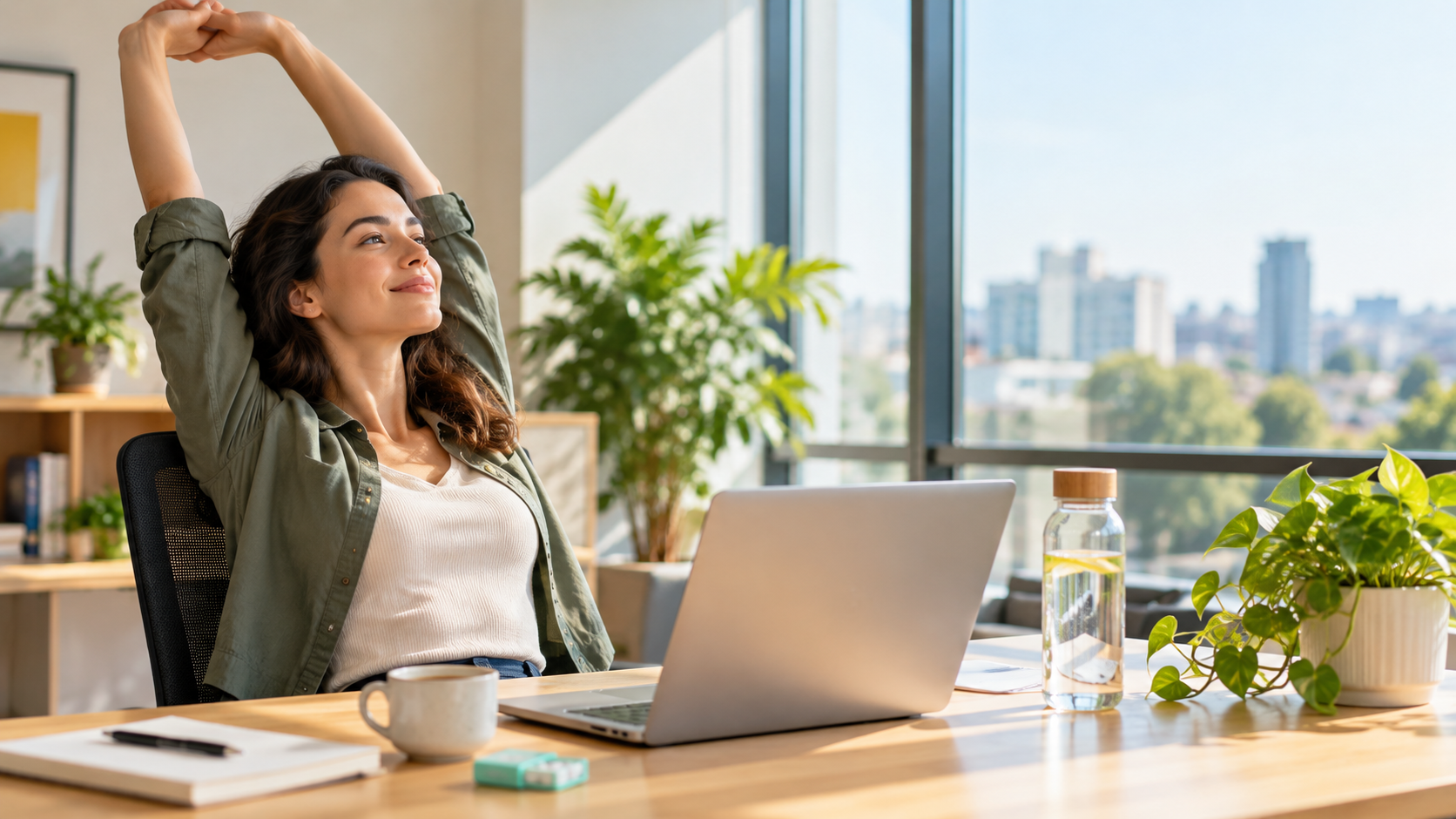
It’s 2:40 p.m. The spreadsheet in front of you has gone slightly blurry, you’ve read the same email three times, and your eyelids feel like they’ve been hung with fishing weights.
You’re not alone in this, and you’re probably not lazy either. Sleepiness at work is usually a mix of biology, habits and environment, and most of it can be nudged. Some of it can’t, and I’ll tell you which parts those are. (If you suspect the problem really is motivation rather than tiredness, that’s a different fight, and how to deal with procrastination and laziness covers it.)
Below are 22 fixes that hold up when you check the research. Each one comes with the research behind it, including where that research is thin. Some work in minutes. Others pay off over weeks. Pick three, not twenty-two.
1. Get outside light into your eyes early
Your brain has a master clock, and light is the main thing that sets it. Special cells in the retina that contain a pigment called melanopsin report brightness straight to that clock, which then decides how alert you should feel and when melatonin should rise in the evening.
In March 2022, eighteen circadian scientists led by Timothy Brown of the University of Manchester published consensus recommendations in PLoS Biology on how much light people need. Their advice: at least 250 lux of “melanopic” light at eye level during the day, ideally from daylight, and very dim light in the three hours before bed. A typical office often falls short of that daytime target. An overcast sky outdoors usually doesn’t.
So the commute matters. A ten-minute walk to the train in daylight does more for your clock than the same ten minutes under the kitchen lights.
Start small: drink your first coffee outside or next to a window, without sunglasses, for ten minutes.
2. Eat a breakfast that won’t spike your blood sugar
What you eat in the morning shapes how quickly you shake off grogginess. Raphael Vallat and colleagues at UC Berkeley, working with data from 833 adults in the PREDICT study, published the results in Nature Communications in November 2022. People felt most alert after a breakfast rich in complex carbohydrates and low in sugar. The worst performer was a pure glucose drink. A high-protein breakfast, surprisingly, came second worst.
The pattern held at the individual level too. A smaller blood-sugar rise after breakfast went with better alertness over the following hours. The data were collected at home, which is a strength, but alertness was self-rated and the study didn’t measure morning light.
Tomorrow morning, swap the pastry and sweet latte for oats with berries and see how your 11 a.m. feels.
3. Wake up at the same time every day
Sleeping in on Saturday feels like a reward. Your body clock reads it as jet lag.
In the largest objective study of its kind, Daniel Windred and colleagues tracked more than 10 million hours of wrist-sensor data from 60,977 UK Biobank participants (SLEEP, January 2024). People with the most regular sleep-wake timing had a 20% to 48% lower risk of dying during follow-up than the least regular group, and regularity predicted that risk better than sleep length did. It’s an observational study, so it shows a strong link, not proof that regularity itself protects you. Still, a stable clock is the foundation for most of the other tips here.
Your move: pick a wake-up time you can keep seven days a week and let your weekend lie-in shrink to 30 minutes or less. If you need help making it stick, these good habits to have in life work on the same principle.
4. Brighten your desk, especially in the afternoon
This one was tested in real offices. Researchers at the Lighting Research Center at Rensselaer Polytechnic Institute, led by Mariana Figueiro and working with the U.S. General Services Administration, had already measured light levels for 109 workers in five federal buildings. Even in offices with big windows, most people weren’t getting enough light to stimulate their body clock, because of desk orientation, season and cloud cover.
So the team installed small light units next to the computer monitors of 19 employees in three U.S. Department of State buildings in Washington, D.C. (Lighting Research & Technology, 2020). Over three weeks, the workers reported feeling less sleepy and more energetic, and an afternoon red-light setting gave an alerting boost close to the 3 p.m. slump. In earlier phases with circadian-effective lighting, workers reported feeling much less sleepy than at baseline. It’s a small field study with self-reported outcomes, but it’s a real building with real staff.
Give it a go: move your desk so you face a window rather than sit with your back to it, or add a bright daylight-white desk lamp and switch it on after lunch.
5. Put a cut-off time on your caffeine
Coffee works. The problem is when you drink it.
Carissa Gardiner and colleagues pooled 24 controlled studies in a meta-analysis for Sleep Medicine Reviews (February 2023). On average, caffeine cut total sleep time by 45 minutes and sleep efficiency by 7%, added 9 minutes to the time it took to fall asleep, and trimmed about 11 minutes of deep sleep. To avoid losing sleep, a regular coffee (around 107 mg of caffeine) had to be finished at least 8.8 hours before bed. A typical pre-workout supplement needed 13.2 hours.
That’s how the trap works. Less sleep, more coffee, worse sleep, even more coffee the next day.
Here’s a simple way in: if you go to bed at 11 p.m., make 2 p.m. your last-coffee time and switch to decaf or herbal tea after that.
6. Chew a piece of gum
It sounds too easy, and the effect is modest. But it’s real enough to mention.
A systematic review and meta-analysis by Sophie Miquel and colleagues (Physiology & Behavior, April 2019) looked at 21 papers on chewing and attention. Chewing produced a small but statistically significant improvement in sustained attention, and alertness tended to drop less during demanding tasks, though that second finding only just missed significance. An earlier lab study by Andrew Johnson and colleagues (2012) found that gum reduced a physiological marker of sleepiness measured through pupil movements. The mechanism isn’t settled. Extra brain activity from chewing is one idea, the mint flavor is another.
Keep a pack of sugar-free mint gum in your desk drawer and reach for it the next time you feel your focus sliding during a long document.
7. Save your hardest work for your sharpest hours
Not everyone peaks at 9 a.m. Night owls forced into early schedules pay for it.
Researchers analyzing the Korean Work, Sleep, and Health Study, a national panel of workers followed from 2022 to 2024, reported in Sleep Health (published online June 2025) that evening types had more than twice the odds of poor work ability compared with morning types (adjusted odds ratio 2.29). They also lost about 5.4 percentage points more productivity to health problems. The authors put this down to circadian misalignment, the gap between when your body wants to be awake and when your job needs you. The data are observational and self-reported, so take the size of the effect loosely.
Track your energy for a week on a simple 1 to 10 scale at four points in the day. Then guard your best two-hour window for deep work, the kind of focus described in how to enter the flow state on command.
Test it this week: block your peak window in your calendar as a meeting with yourself.
8. Put on music you actually like
Silence isn’t always golden when you’re drowsy.
Luca Kiss and Karina Linnell ran two online experiments with people who normally listen to music while they work (Scientific Reports, 2024). Their own chosen music cut mind-wandering, increased focus on the task and sped up reaction times, and the effect ran through higher mood and arousal. A follow-up lab study by the same group (Psychological Research, July 2024) measured pupil size in 39 students and confirmed that preferred background music raised physiological arousal.
One caveat. These were people who already like working with music. If lyrics distract you, go instrumental.
A quick experiment: build a 45-minute “afternoon” playlist of upbeat tracks you know well and play it the next time the slump arrives.
9. Take micro-breaks before you need them
Most of us wait until we’re fried to stop. Better to stop earlier and more often.
Patricia Albulescu and colleagues at West University of Timișoara pooled 22 study samples with 2,335 participants in a meta-analysis for PLOS ONE (August 2022). Breaks of 10 minutes or less had small but significant effects: they boosted vigor (d = 0.36) and reduced fatigue (d = 0.35). They didn’t reliably improve performance overall, except on less demanding tasks, and longer breaks did more for performance than shorter ones.
So micro-breaks are mainly about energy, not output. That’s still worth having. A five-minute pause can also snap you out of the dazed, autopilot mode that a long screen session puts you in.
Next time, do this: set a timer for every 50 minutes and spend the next five looking out of a window, stretching or refilling your water.
10. Air out the room, but don’t blame CO₂ for everything
Stuffy meeting rooms feel sleep-inducing, and plenty of articles blame carbon dioxide. The evidence is more mixed than that.
In a tightly controlled experiment, Stefan Flagner and colleagues at Maastricht University sealed 20 healthy office workers in an airtight respiration chamber for eight hours at either 900 or 3,000 ppm of CO₂ (published in Indoor Environments, 2025). They found no statistically significant effect on cognition, decision-making or physiology. On the other side, a year-long Harvard study by Young and colleagues (Building and Environment, April 2024) followed 206 remote workers and found only a slight, borderline link between higher home CO₂ and poorer scores on one attention test.
What does that mean for you? Ventilation still dilutes other pollutants and makes a room more comfortable. But a fresh-air break probably helps mainly because it also brings movement, cooler air and daylight.
Open a window for five minutes after a long meeting, or better, take the conversation outside.
11. Walk for five minutes every half hour
This one comes with numbers.
Keith Diaz and his team at Columbia University had 11 adults sit for eight hours in a lab, testing five different walking schedules against sitting still (Medicine & Science in Sports & Exercise, January 2023). Five minutes of light walking every 30 minutes worked best for blood sugar and blood pressure. Every walking routine except one minute per hour also significantly reduced fatigue and lifted mood. None of them changed cognitive test scores, and the sample was tiny, so treat this as a promising signal rather than settled science.
Say you’re stuck on a long report. Instead of a fourth coffee, you walk to the far kitchen, refill your bottle and take the stairs back. That’s your five minutes.
Start small: put walking breaks into your calendar the way you’d schedule anything else; how to be more organized at work has a few tricks for protecting that time.
12. Keep a water bottle within reach
Dehydration doesn’t feel like thirst at first. It feels like tiredness.
The first step in the chain is easy to measure. When you lose fluid without replacing it, your blood and urine become more concentrated. A controlled crossover study by Nathalie Pross and colleagues (British Journal of Nutrition, 2013) put 20 healthy women through 24 hours without fluids and tracked exactly that. Alongside the rise in concentration came the mood changes: lower alertness, more sleepiness, more fatigue and confusion, which were the most consistent effects they saw. How the one leads to the other inside the brain isn’t pinned down, so this is a well-documented link rather than a fully mapped mechanism.
Two cautions keep this honest. That was a fairly harsh day without drinking, and a 2025 study by Fein and colleagues (Nature and Science of Sleep, May 2025) found that mild dehydration didn’t measurably change sleep itself. So water is about your daytime energy, not your night.
Your move: fill a one-liter bottle when you arrive and aim to empty it by lunch, then refill.
13. Don’t skip lunch to “stay sharp”
Some people skip lunch thinking it will keep them alert. The evidence doesn’t really back that.
Andrew Smith at Cardiff University tested 120 university students on memory and attention tasks before and after lunch, or after skipping it (World Journal of Pharmaceutical Research, January 2024). Lunch raised heart rate but made no difference to performance on those tasks. Skipping it, though, left people in a worse mood in the early afternoon. Smith notes in the same paper that earlier research linked larger meals to more occasional errors, so size still matters.
Eat a normal-sized lunch with protein, vegetables and some slow carbs, and save the three-course feast for the weekend.
14. Plan around the 2 p.m. dip
Even if you eat nothing at noon, your alertness will probably sag in the early afternoon.
Why? Two systems run your sleepiness. One is sleep pressure, a chemical load (mostly adenosine) that builds the longer you’ve been awake. The other is your body clock, which pushes back against that pressure during the day. In the early afternoon, the clock’s push briefly weakens while pressure keeps climbing, and you feel the gap. Smith’s 2024 paper summarizes decades of research showing performance drops in this period both in workplaces and labs, and notes the dip comes partly from the meal and partly from internal rhythms. That’s correlational and mechanistic reasoning, not a single clean experiment, but it explains why the slump arrives on schedule.
The practical answer is to stop fighting the dip with your hardest work. Use it for admin, calls or walking meetings. If you run meetings, keep them short and active at that hour; how to conduct effective meetings in the workplace has more on that.
Give it a go: move one demanding task out of your 1 to 3 p.m. slot this week and see what changes.
15. Take a short nap, and keep it under an hour
If your workplace allows it, a nap is one of the strongest tools on this list.
The most recent big-picture look is an umbrella review by Pengqiang Du and colleagues, published in Public Health Reviews in February 2026. It pulled together 16 meta-analyses covering 244 health outcomes. The 2026 umbrella review on daytime napping concluded that naps under 60 minutes gave the biggest cognitive boost (standardized mean difference 0.69) and reduced fatigue, while naps over an hour were linked with higher risks of heart disease and diabetes.
Read the fine print, though. That cognitive figure comes from trials in young, active adults, most of the evidence was rated low quality, and the risks of long naps come from observational data that can’t prove cause. Naps also support memory, which ties into how to improve your memory.
Test it this week: on a day after a short night, set an alarm for 20 minutes and lie down somewhere quiet, ideally before 3 p.m.
16. Try a coffee nap
This sounds like a contradiction. It isn’t.
Caffeine works by blocking adenosine, the sleep-pressure chemical, from its receptors. A short nap clears some adenosine away. Caffeine takes roughly 20 minutes to reach full effect, so if you drink it just before a 20-minute nap, it starts working as you wake, landing on receptors that the nap has just cleared. That’s the theory.
The evidence is older and small. Mitsuo Hayashi and colleagues at Hiroshima University tested ten young adults (Clinical Neurophysiology, 2003). Taking 200 mg of caffeine before a 20-minute afternoon nap was the most effective option for both sleepiness and performance, and the benefit lasted the full hour after waking. Bright light after the nap came close.
Here’s a simple way in: drink an espresso quickly, lie down straight away, set a 20-minute alarm, and don’t try this after mid-afternoon or you’ll break your own caffeine cut-off.
17. Splash cold water on your face
The old trick works, briefly.
The same 2003 Hayashi study also tested face washing after a nap. It suppressed sleepiness straight after waking, but the effect was mild and short-lived compared with caffeine or bright light. So it’s a reset button, not a fix.
Use it at the right moment: just after a nap, or right before a meeting where you need to be switched on, then follow it with something that lasts longer, like a walk outside.
18. Treat sleep as a work task
Every trick above is a patch. Sleep is the repair.
The National Sleep Foundation’s 2025 Sleep in America Poll (released March 2025, the latest adult edition; the 2026 poll focused on children) found that 6 in 10 U.S. adults don’t get enough sleep. Adults with poor sleep health were two and a half times more likely to report not being productive at work, according to the foundation’s research lead, Joseph Dzierzewski. The NSF recommends seven to nine hours for most adults.
Think of it like a phone battery. You can carry a power bank (coffee, naps, light) to get through the day, and that works. But if you never charge overnight, you’re living on the power bank, and it runs out faster each day. The analogy breaks down in one place: unlike a battery, sleep debt drags down mood and judgment as well as energy. Being well rested is one of the quiet ways people impress the boss at work without trying.
A quick experiment: for one week, set a “start winding down” alarm 30 minutes before your target bedtime and treat it as non-negotiable.
19. Move your body on most days
A single brisk walk perks you up. Regular exercise changes your baseline.
Carly Wender, Mika Manninen and Patrick O’Connor analyzed 81 randomized trials with 7,050 participants (Frontiers in Psychology, June 2022). Exercise programs reduced feelings of fatigue by a small amount (g = −0.37), increased energy by a small to moderate amount (g = 0.42) and raised vitality by a moderate amount (g = 0.54). Moderate-intensity training was typical. In the Vallat breakfast study mentioned earlier, more physical activity the day before also predicted better alertness the next morning.
Next time, do this: book two 30-minute brisk walks or bike rides into your week, earlier in the day rather than late at night.
20. Get the phone out of your bed
Your sleepiness at 3 p.m. often starts at 11 p.m.
Gunnhild Johnsen Hjetland and colleagues at the Norwegian Institute of Public Health analyzed survey data from 45,202 students aged 18 to 28. Their 2025 study in Frontiers in Psychiatry found that each extra hour of screen use after going to bed went with 59% higher odds of insomnia symptoms and 24 minutes less sleep. It didn’t matter much whether people scrolled social media or watched shows. It’s cross-sectional, so the authors can’t rule out that poor sleepers simply reach for their phones more.
Hjetland’s own suggestion is to stop screens 30 to 60 minutes before sleep and mute notifications. If your phone keeps winning that battle, digital minimalism is worth a read.
Charge your phone in another room tonight and buy a cheap alarm clock if that’s your excuse.
21. Go easy on the nightcap
Alcohol knocks you out. It doesn’t let you rest.
In a meta-analysis of 27 studies, Carissa Gardiner and colleagues (Sleep Medicine Reviews, 2025) found that even a low dose, about two standard drinks, reduced and delayed REM sleep, and the disruption grew with each extra drink. Higher doses helped people fall asleep faster, but that likely made the later REM disruption worse. Effects on total sleep time were too uncertain to call. In plain terms, you can log seven hours and still wake up foggy.
If you drink in the evening to quiet a busy mind, the techniques in how to stop ruminating thoughts target the same problem without the REM cost.
Try this tonight: if you’re drinking, stop at one and finish it at least three hours before bed.
22. Rule out sleep apnea
If you sleep eight hours and still nod off at your desk, the problem may be your breathing, not your habits.
A 2025 systematic review in Respiratory Medicine (published November 2025) estimated that 83.7 million U.S. adults, or 32.4% of those aged 20 and over, had obstructive sleep apnea in 2024, adjusting for obesity. That’s 39.1% of men and 26.0% of women. The work was presented at the SLEEP 2025 meeting by Ali Azarbarzin, and several co-authors work for industry, which is worth knowing. A separate analysis in Thorax (February 2026) put the figure closer to 1 in 5 adults in the U.S. and UK, using different methods, and an accompanying editorial noted that most cases go undiagnosed.
The estimates disagree on size, but they all point the same way. Loud snoring, gasping at night, morning headaches and stubborn daytime sleepiness deserve a conversation with your doctor, and a simple home sleep test can often answer the question.
What to do when you slip
You’ll have a bad week. A deadline will eat your sleep, you’ll drink coffee at 5 p.m., and your phone will end up in bed again. That’s normal, not failure.
A systematic review by Ben Singh and colleagues at the University of South Australia (Healthcare, December 2024) found that new health habits took a median of 59 to 66 days to form, with huge variation from 4 to 335 days. The often-quoted 21 days doesn’t hold up. Singh’s advice was to aim for consistency rather than perfection, since missing a day doesn’t sink you if you pick the habit back up the next day. An earlier study behind the 66-day figure, by Phillippa Lally’s team at University College London (2010), likewise found that a single missed opportunity didn’t really change how quickly a habit formed.
So when you slip:
- Restart with the next normal day, not “next Monday”. Keep your wake-up time even after a late night, because a lie-in shifts your clock again.
- Don’t fix one bad night with a long nap or a late espresso. Gardiner’s caffeine work shows how quickly that becomes a cycle.
- Pick the single habit that matters most for you and rebuild that one first.
And if the whole day has gone sideways, how to turn a bad day around has a few steps for getting back on track.
The bottom line
Fighting sleepiness at work comes down to two layers. The quick layer gets you through the afternoon: light, a short walk, gum, music, water, a well-timed nap. The deep layer means you need the quick layer less: a fixed wake time, enough sleep, caffeine with a curfew, no phone in bed and a check for sleep apnea if nothing else helps.
Don’t try all 22 at once. Pick one quick fix for this afternoon and one deep habit for this week, and give the deep one two months before you judge it.
Want more ways to work smarter without burning out? Browse the rest of our work articles.