
Two thousand years ago, a Roman emperor sat in a military camp on the Danube and wrote notes to himself about staying calm. He wasn’t writing a book. Marcus Aurelius was practicing.
That’s the part people forget about Stoicism. The word now suggests a clenched jaw and a refusal to feel anything. The original Stoics, Seneca, Epictetus and Marcus among them, meant something closer to training. You notice your judgments, you rehearse hard moments before they arrive, and you keep returning your attention to the one thing you actually run: how you respond.
The good news is that modern research has started to test these drills. It’s still a young field, and some of the evidence is thin, so I’ll tell you where it’s strong and where it isn’t. Below are 16 Stoic exercises, each with the reason it seems to work and one small way to start today. You don’t need all of them. Pick two, maybe three, and give them a few weeks.
1. Rehearse the day before it starts
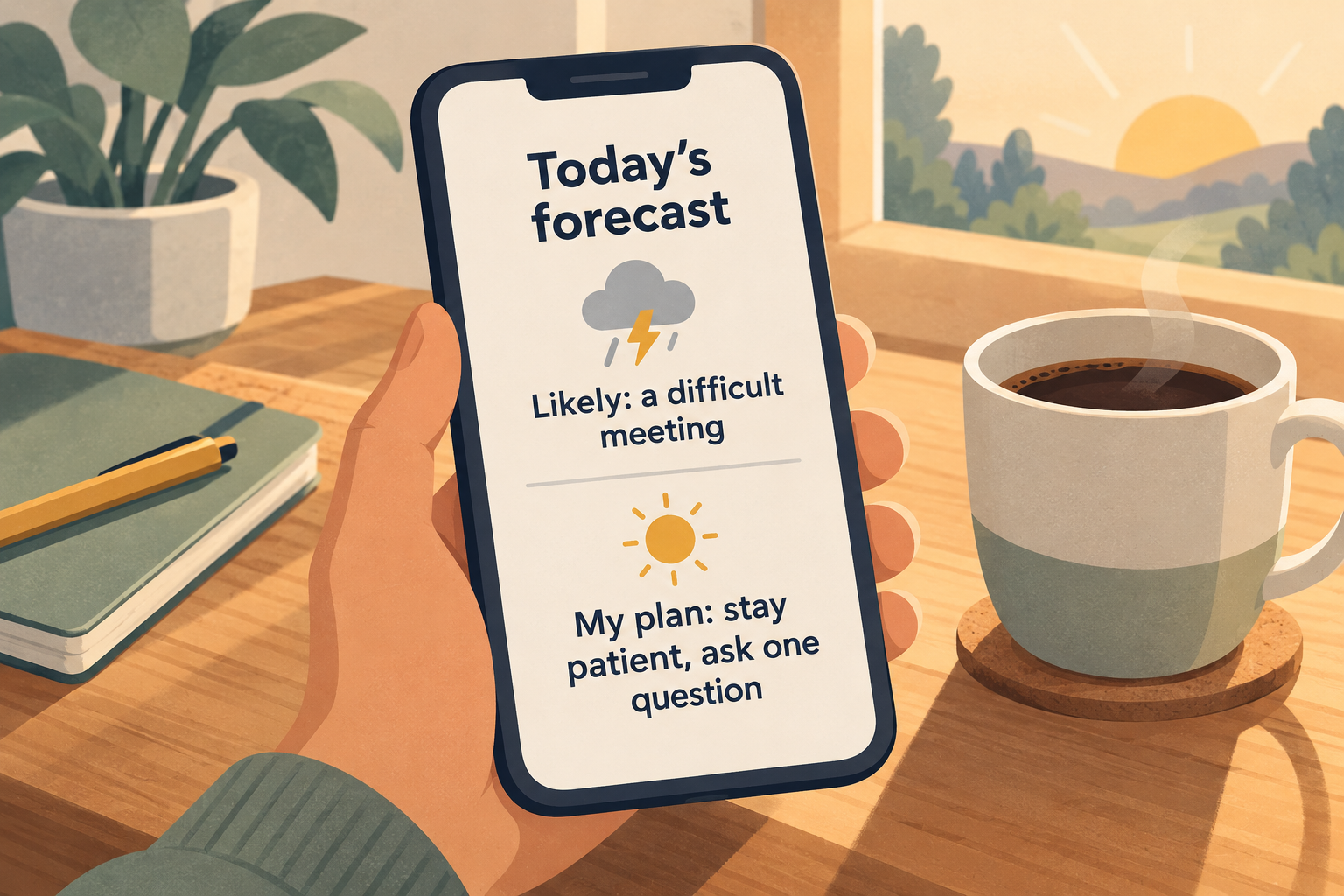
Marcus opened Book 2 of his Meditations with a morning reminder: today I’ll meet people who are rude, ungrateful and difficult, and none of them can force me to act badly. It sounds grim. It’s really a weather forecast for your temper.
This morning preparation is a core part of Stoic Week, the free seven-day course that the nonprofit Modern Stoicism has run every year since the early 2010s. In the Stoic Week 2025 report, research director Tim LeBon described the before-and-after questionnaires: 1,424 people completed them at the start of the week and 410 at the end. Among those who finished, the averages moved like this:
| Measure (Stoic Week 2025 completers) | Average change |
|---|---|
| Negative emotion | down 18% |
| Mental well-being (WHO-5) | up 20.5% |
| Life satisfaction | up 12% |
| Positive emotion | up 10% |
| Flourishing | up 8% |
Read those numbers with care, though. There’s no control group, participants chose to take part, and everything is self-reported. LeBon says as much. What gives the figures some weight is consistency: the pattern has repeated for thirteen years.
Start small: tomorrow, before you open your inbox, name one situation likely to test you and decide in one sentence how you want to handle it. If you like routines, fold it into the habits you already keep every day.
2. Sort what’s up to you from what isn’t
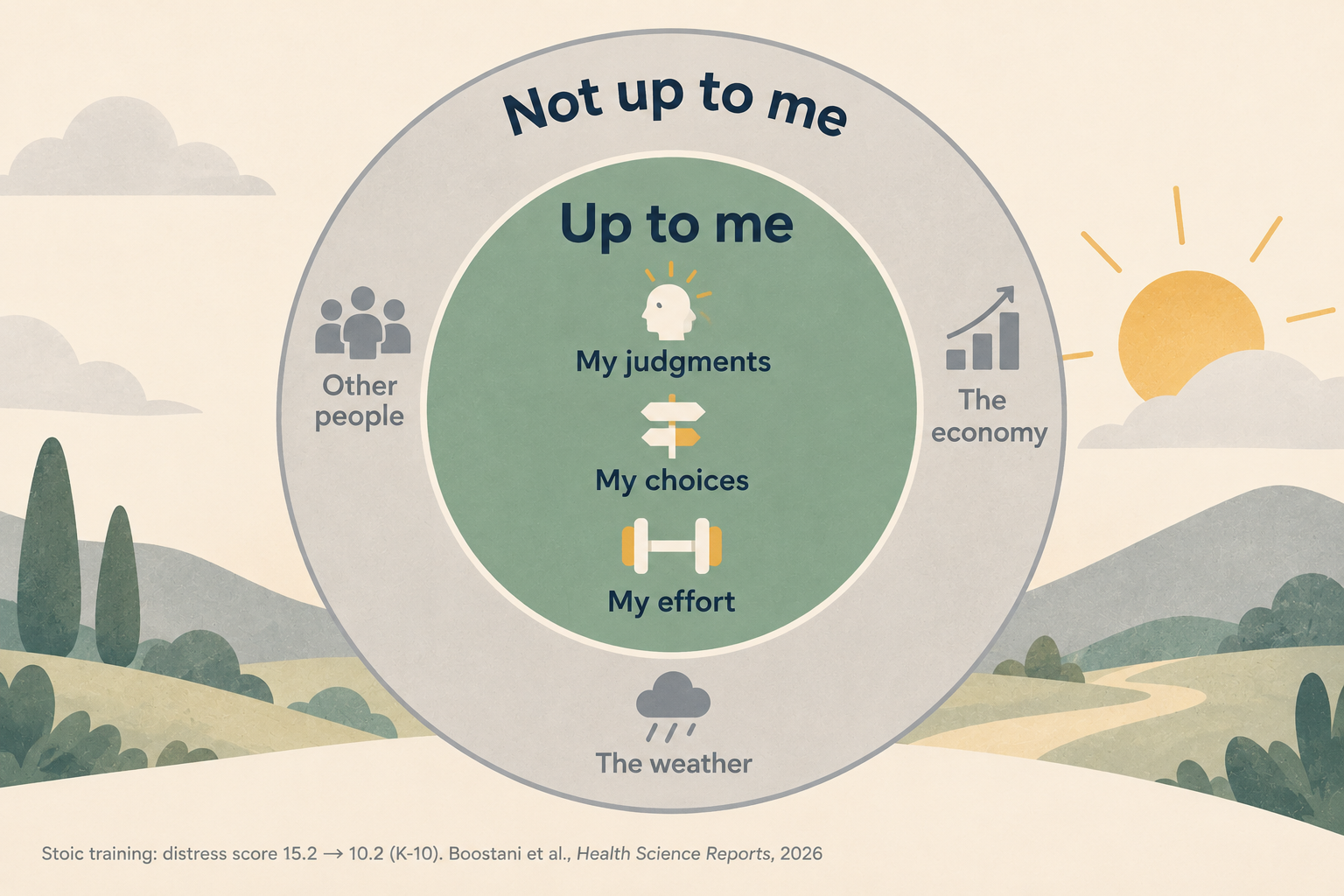
Epictetus built his whole teaching on one split. Some things are up to us: our judgments, our choices, our effort. Most things aren’t: other people, the economy, the weather, our own bodies to a large degree. Calm comes from pouring energy into the first pile and loosening your grip on the second.
This idea just got one of its first proper clinical tests. In a randomized controlled trial published in Health Science Reports in October 2026, Amirhossein Boostani, Mozhgan Moshtagh and colleagues at Birjand University of Medical Sciences in Iran taught Stoic principles to people on hemodialysis, a group that lives with a great deal that is outside their control. Over eight weeks, 54 patients were randomized and 50 were analysed. The intervention group listened to a weekly 20-minute podcast and met a trained researcher in person to practise scenarios. In the Boostani et al. 2026 hemodialysis trial, psychological distress scores in the Stoic group fell from about 15.2 to 10.2 on the K-10 scale, while the control group drifted slightly upward.
The limits matter. It was a single centre, participants knew which group they were in, and follow-up lasted one month. The effect on self-efficacy was only significant in an adjusted analysis, not in the pre-registered one. Still, it’s a real trial with a real comparison group, which this field badly needs.
Draw two columns on a sticky note tonight, “mine” and “not mine”, list what’s worrying you, and spend tomorrow’s effort only on the left column.
3. Catch the judgment, not the event
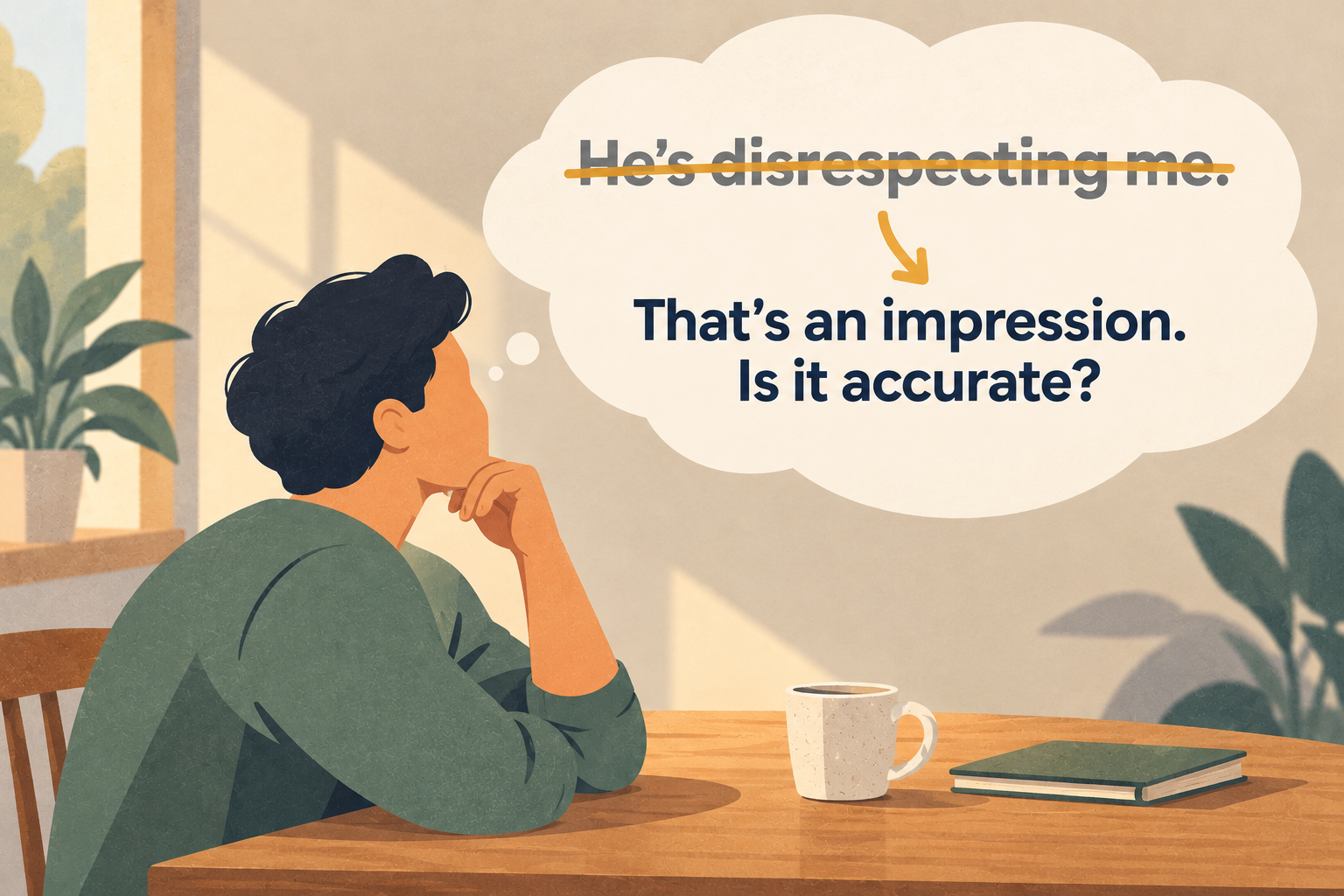
Epictetus put it bluntly in the Enchiridion: it isn’t things that disturb us, it’s our opinions about them. Here’s the mechanism as the Stoics described it, step by step. Something happens. An impression forms almost instantly (“he’s disrespecting me”). Then comes a second step, where you either agree with that impression or don’t. Only after you agree does the full emotion arrive.
The gap between steps two and three is where the work happens. If you notice “this is an impression, not a fact,” you’ve created a moment to test it. Is it accurate? Is it helpful? Is there another reading? That’s the reasoning modern cognitive therapy later borrowed. To be clear, the step-by-step model is a philosophical account; psychology supports the idea that reappraising a situation changes how you feel about it, but nobody has measured “assent” as a discrete mental event.
There is early experimental support for training this skill in a Stoic package. A 2025 randomized waitlist-controlled trial by Georgie King at Royal Holloway, University of London, gave participants two weeks of online Stoic training with three daily practices and readings every other day. According to a mid-2026 ScienceBlog summary, the Stoic group ended with lower depression symptoms and less experiential avoidance than the waitlist group, while anxiety improved only at the one-month follow-up. The caveat is a big one: it’s an unpublished PhD thesis under embargo until 2027, so the details aren’t peer-reviewed yet.
Next time, do this: when a thought makes your chest tighten, say silently “that’s an impression” and ask one question about it before you react. If the same thought keeps looping, these ways to stop ruminating thoughts pair well with it.
4. Calm the body before you argue with the mind
Seneca wrote an entire treatise on anger and kept coming back to one remedy: delay. Don’t act while the heat is on.
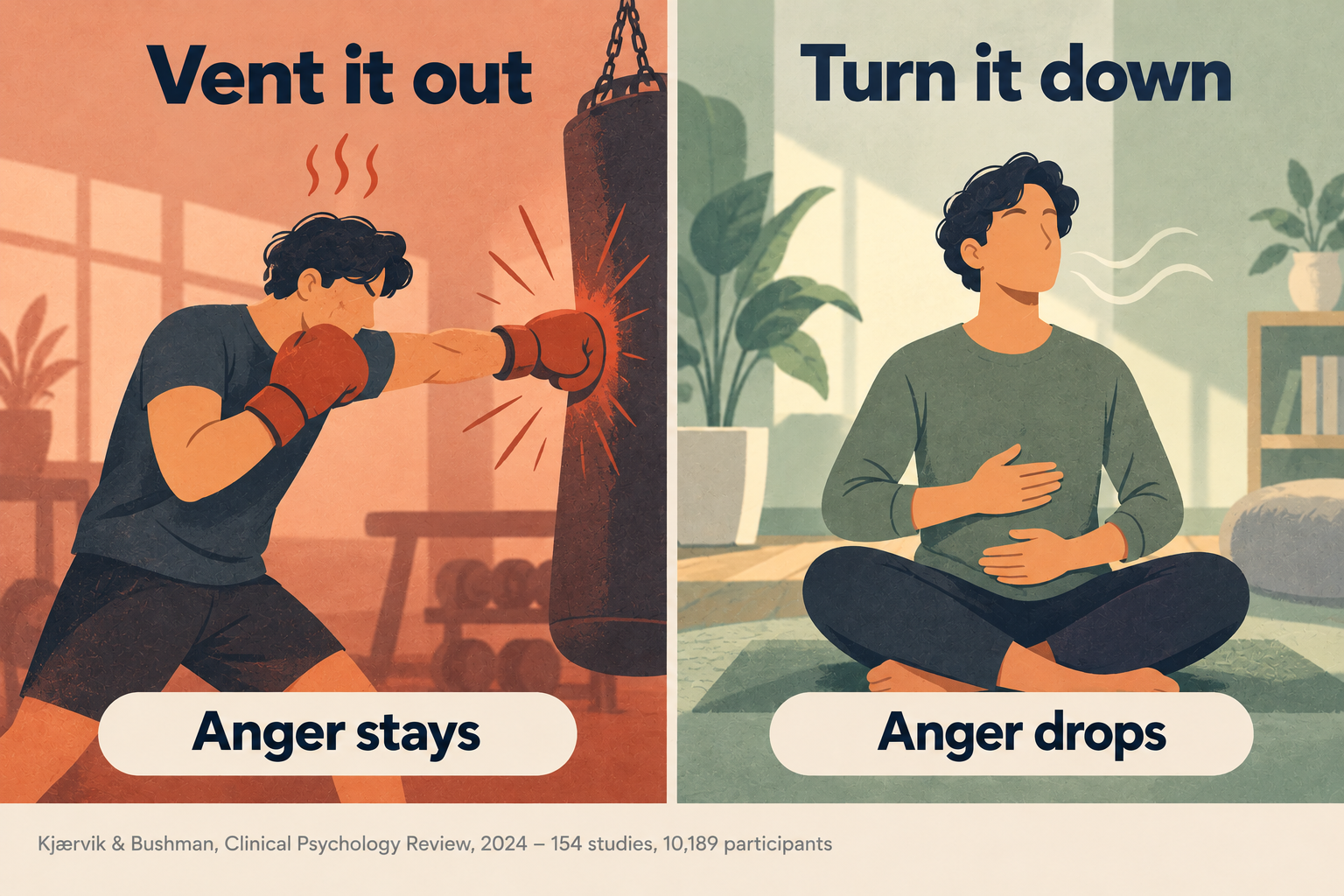
The best recent evidence backs him up and adds a twist. Sophie Kjærvik of Virginia Commonwealth University and Brad Bushman of Ohio State University published a meta-analysis in Clinical Psychology Review in March 2024 pooling 154 studies with 10,189 participants. Activities that lower physiological arousal (slow breathing, progressive muscle relaxation, mindfulness, slow yoga, a simple time-out) reduced anger and aggression with a moderate-to-large effect. Activities that raise arousal, like hitting a bag or going for a run while furious, did essentially nothing on average, and jogging was the one most likely to make anger worse. Venting, in other words, isn’t release. It’s rehearsal.
So the Stoic delay works best when the delay is physical. Lower the heart rate first, then do the thinking from item 3.
Your move: pick one calming action now, such as six slow breaths with a longer exhale, so it’s ready the next time someone pushes your buttons. It also helps when the angry one is someone else; here’s how to deal with angry people without catching it.
5. Premeditate the obstacles
Premeditatio malorum, the rehearsal of difficulties, works a bit like a fire drill. Nobody runs a fire drill because they expect the building to burn. They run it so that if the alarm ever sounds, their feet already know the way to the stairs. Seneca’s version: imagine the trip delayed, the deal falling through, the friend letting you down, and decide in advance how you’ll carry yourself.
The analogy holds in one important way: rehearsal reduces surprise, and surprise is what knocks you off balance. It breaks down in another. A fire drill has a clear endpoint, while mental rehearsal can slide into endless worst-case spirals. The Stoics never meant you to dwell. They meant you to plan, then let go.
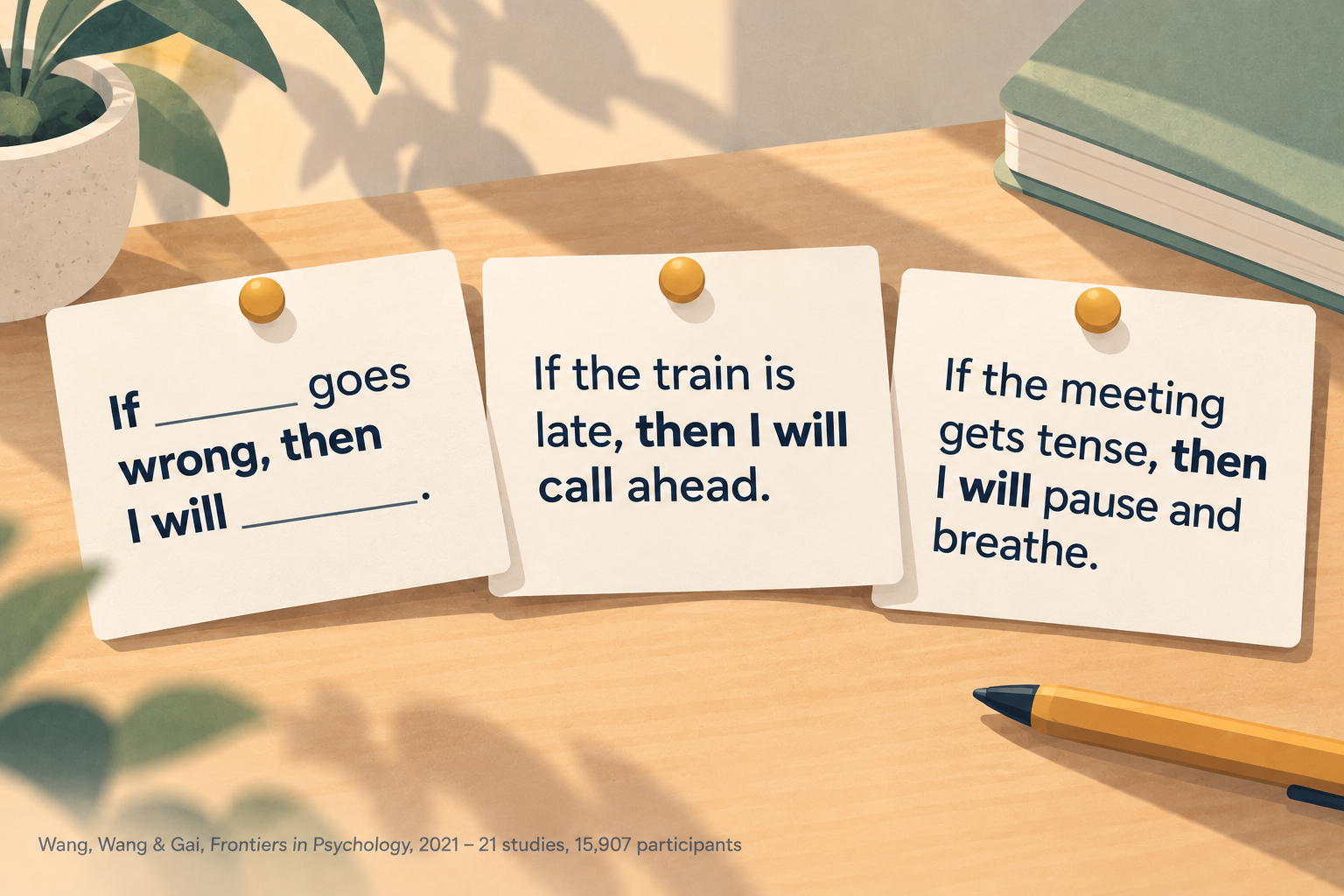
That planning element has decent evidence behind it. A 2021 meta-analysis in Frontiers in Psychology by Guoxia Wang, Yi Wang and Xiaosong Gai looked at mental contrasting with implementation intentions, a technique where you picture your goal, name the obstacle in your way, and write an “if X happens, then I’ll do Y” plan. Across 21 studies and 15,907 participants, it improved goal attainment with a small-to-medium effect, though the authors note some publication bias may inflate that estimate.
A quick experiment: before your next stressful event, write one line: “If ___ goes wrong, then I will ___.” Then stop. If your mind keeps adding disasters, you’ve crossed from rehearsal into catastrophizing, and these ways to challenge worst-case thinking can pull you back.
6. Imagine losing what you have
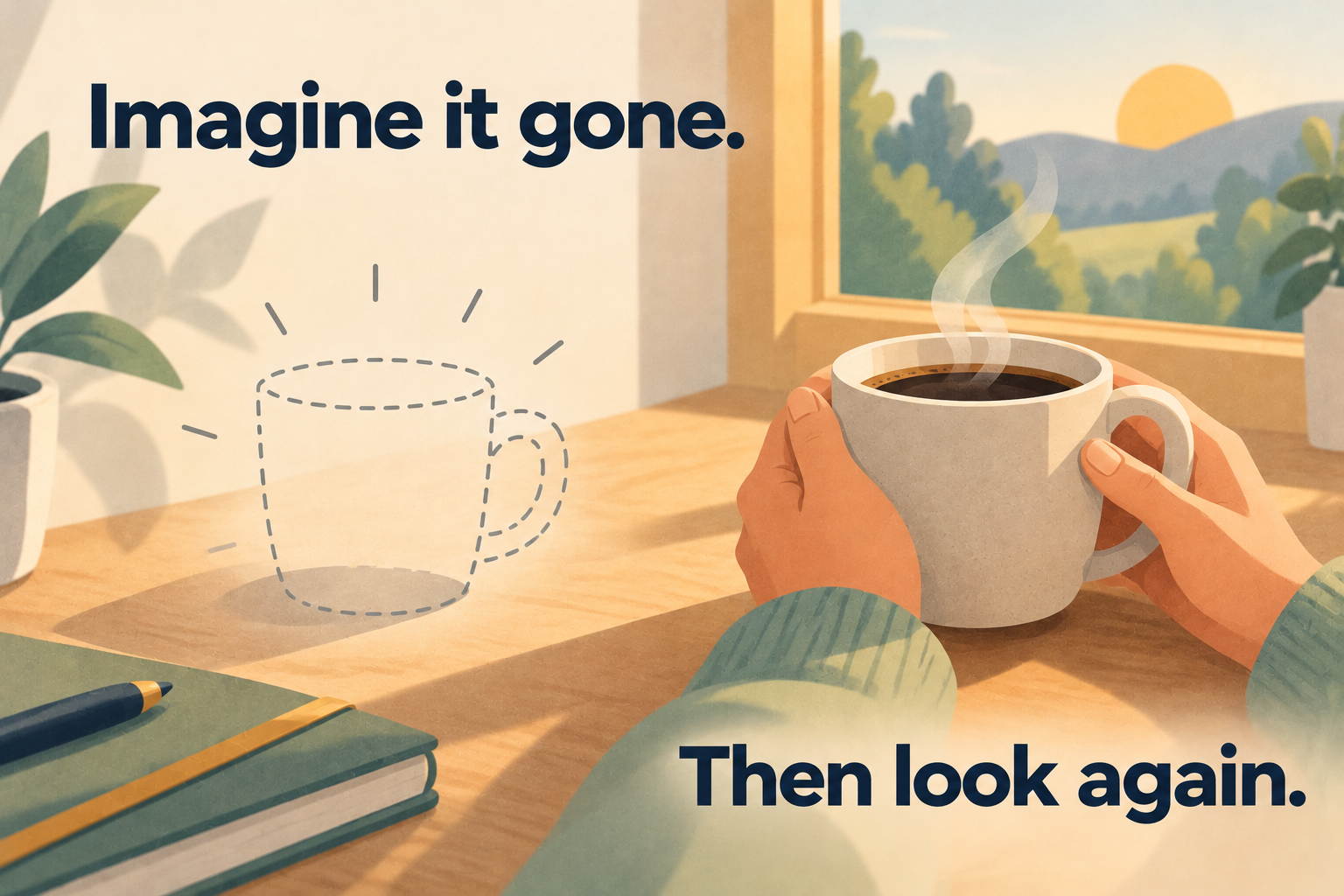
Negative visualization is the gentler cousin of item 5. Instead of picturing problems, you briefly picture losing something good: your health, your home, a person you love. Then you come back and look at it again. The point isn’t fear. It’s to break the habit of taking things for granted, which the Stoics saw as a quiet source of discontent.
In practice, this is close to what psychologists call gratitude writing. In May 2025, Lauren Hoult and colleagues at Northumbria University published a systematic review in PLOS One covering 51 studies of positive writing exercises. Gratitude and “best possible self” writing showed the most consistent benefits for well-being and positive mood. Effects on stress and anxiety were less consistent, and the authors rated the overall quality of the studies as poor to fair.
That fits an earlier caution. A 2021 meta-analysis by David Cregg and Jennifer Cheavens in the Journal of Happiness Studies (27 studies, 3,675 participants) found gratitude interventions had only a small effect on symptoms of depression and anxiety. So treat this as a mood lifter for ordinary days, not a treatment.
Once a day this week, look at one thing or person you rely on and spend thirty seconds imagining your life without them, then write one sentence about what you’d miss.
7. Take the view from above
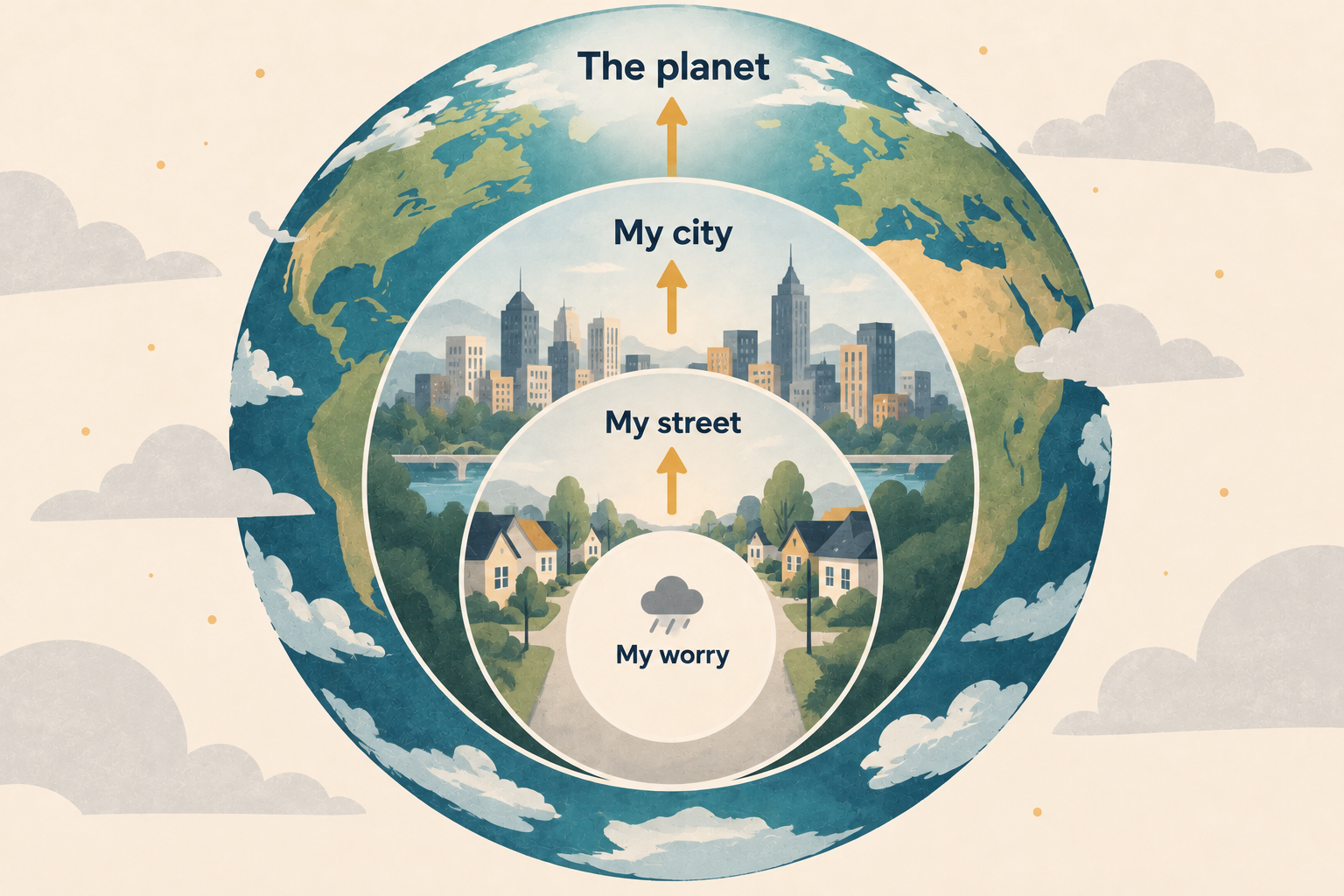
Marcus often zoomed out. He pictured cities, armies and whole generations from a great height, and his own worries shrank to their true size. The view from above is a perspective exercise, and it overlaps with what researchers now call awe.
The largest comparison of well-being interventions to date, published in Nature Human Behaviour in January 2026 by Lowri Wilkie, Andrew Kemp and colleagues at Swansea University, pooled 183 randomized trials with 22,811 adults. Most approaches beat inactive controls. Mindfulness, compassion training, positive psychology exercises, yoga and exercise all landed at moderate effects (standardized mean differences of 0.41 to 0.49). The strongest category was combined movement and psychological practice, at 0.73, and the Swansea team named awe walks as an example of that combination. One note on freshness: the searches ran to March 2023, so the newest trials aren’t in it.
Awe on its own has been tested too. A 2025 randomized trial in Scientific Reports by Maria Monroy, Dacher Keltner, J. E. López and colleagues gave patients with long COVID an awe intervention and found lower stress and depression symptoms and higher well-being than in the control group. It was small, with 30 people in the awe group and 38 controls.
Test it this week: take a 20-minute walk somewhere with a big sky or long view, and spend part of it deliberately picturing your street, then your city, then the planet. A solo walk works well for this, and if you find time alone uncomfortable, start with these ideas for learning to enjoy being alone.
8. Ask what your sage would do
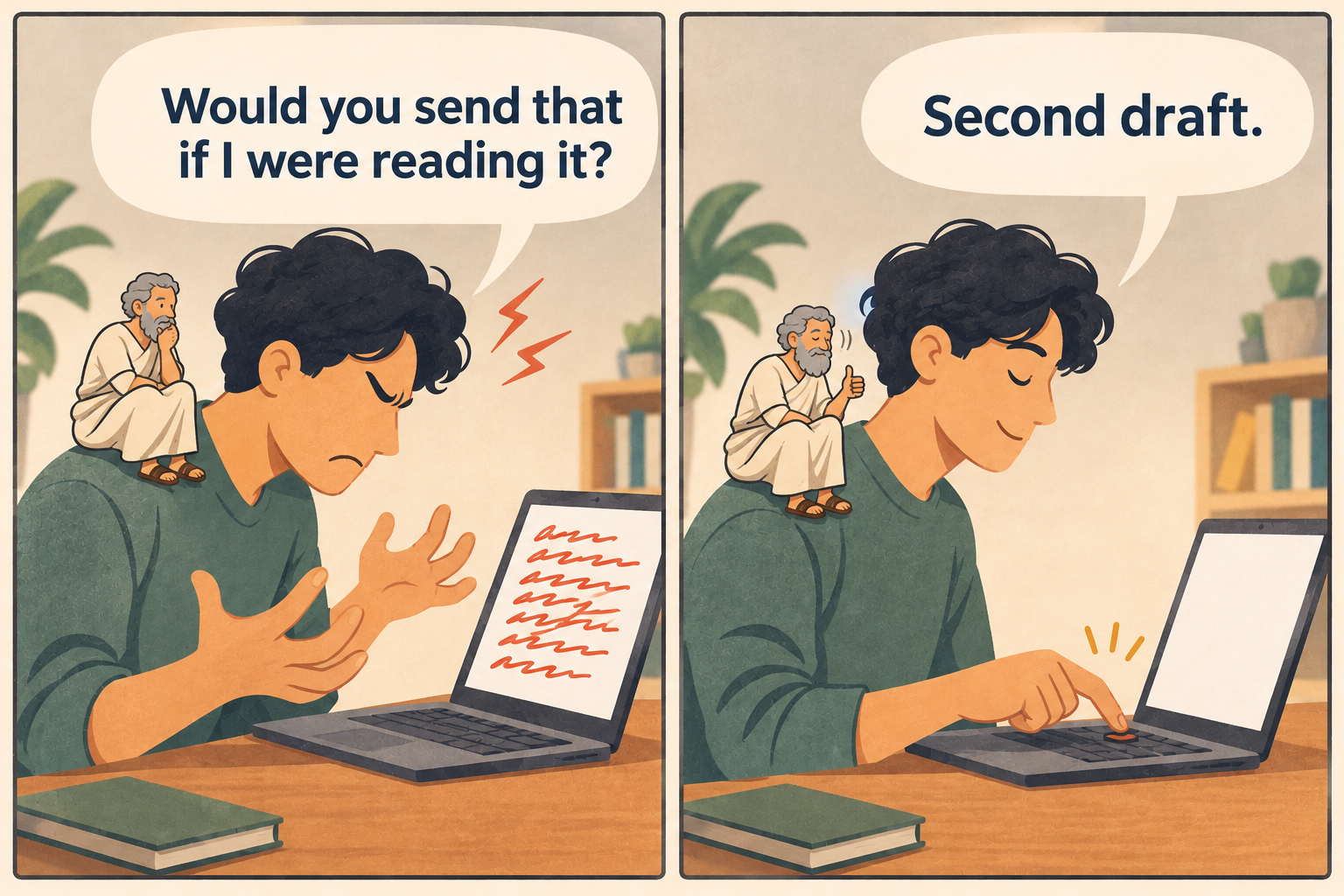
Seneca advised picking a person of good character and imagining them watching you. Epictetus pointed to Socrates. Modern Stoics call it the “sage on your shoulder.” When you’re stuck, you ask: what would that person do here?
Psychologists study a close relative of this, called self-distancing: reflecting on your situation as if from the outside, or in the third person. Elizabeth Murdoch, Monique Crane, Daniel Gucciardi and colleagues published a pre-registered meta-analysis in Stress and Health in April 2023 pooling 25 experiments and 2,397 adults. Self-distanced reflection on a past stressful event beat self-immersed reflection, with a small effect (g = 0.19). The authors were careful to say that risk of bias in the studies leaves real uncertainty, so this is a modest tool, not a magic trick.
Say you’re about to send a sharp reply to a colleague. You picture your calmest mentor reading over your shoulder, and the reply suddenly needs a second draft. That’s the whole exercise.
Here’s a simple way in: choose your sage today, a real person or a historical one, and write their name somewhere you’ll see it. If you want to build the wider skill of reading your own emotions, these ways to improve emotional intelligence go well alongside it.
9. Choose a small discomfort on purpose
Seneca recommended setting aside a few days to live on cheap food and rough clothing, then asking yourself whether this was what you’d been so afraid of. The idea behind voluntary discomfort is that comfort you can live without can’t hold you hostage.
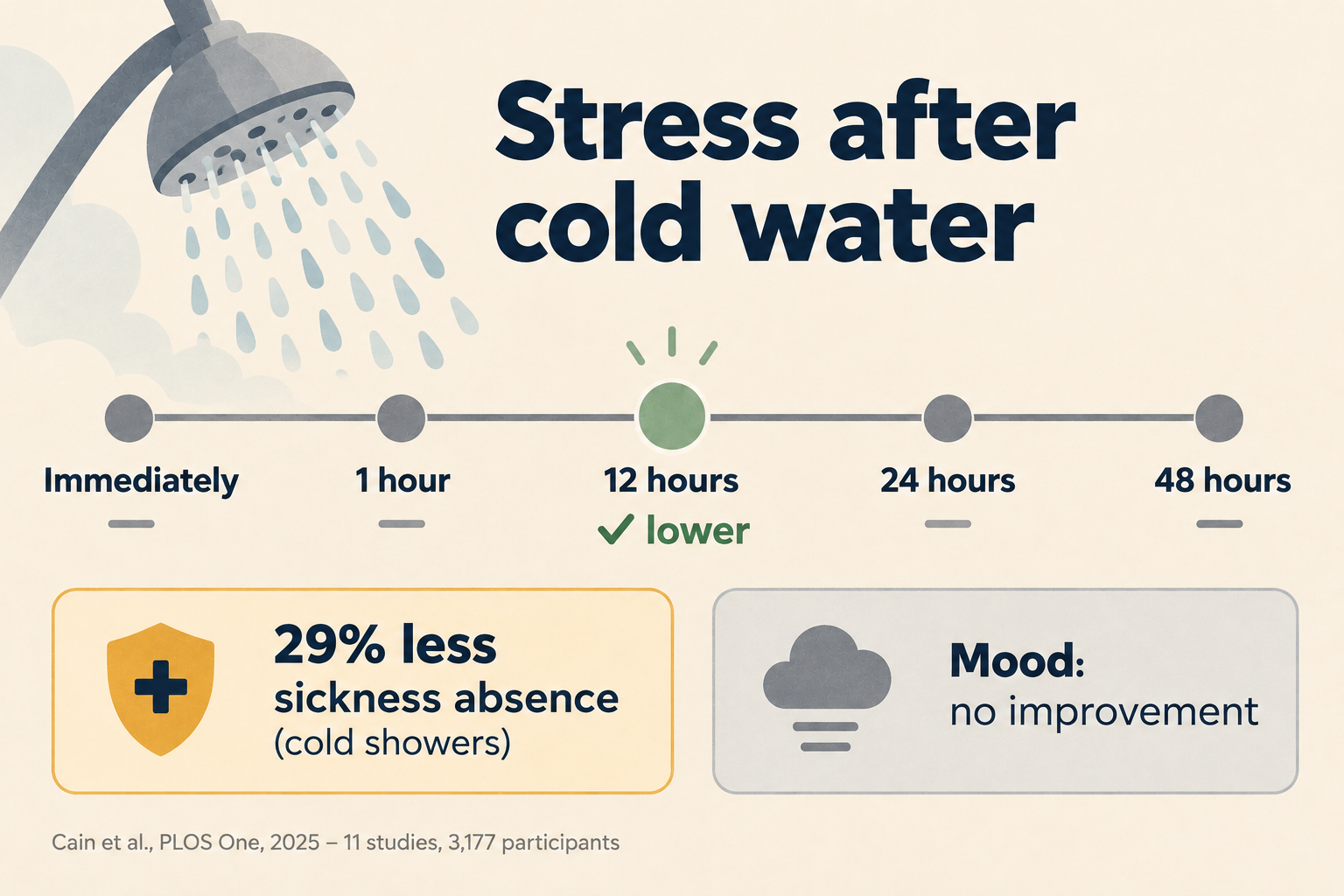
Today the most popular version is the cold shower, so it’s worth knowing what the evidence actually says. A January 2025 systematic review and meta-analysis in PLOS One by Tara Cain, Ben Singh and colleagues at the University of South Australia included 11 studies with 3,177 participants. In the Cain et al. 2025 cold-water immersion review, stress was lower 12 hours after cold immersion, but not immediately, at one hour, or at 24 or 48 hours. One large trial found 29% less sickness absence among people taking cold showers. Mood didn’t improve, inflammation rose briefly, and the authors warn that people with health conditions should be careful.
So the cold isn’t a mood pill. Its Stoic value is elsewhere: you practise choosing mild discomfort calmly, which makes unchosen discomfort less frightening.
Start small: end tomorrow’s shower with 30 seconds of cold water, or leave your phone at home for one short errand. The second one is a gentle doorway into digital minimalism.
10. Review your day at night
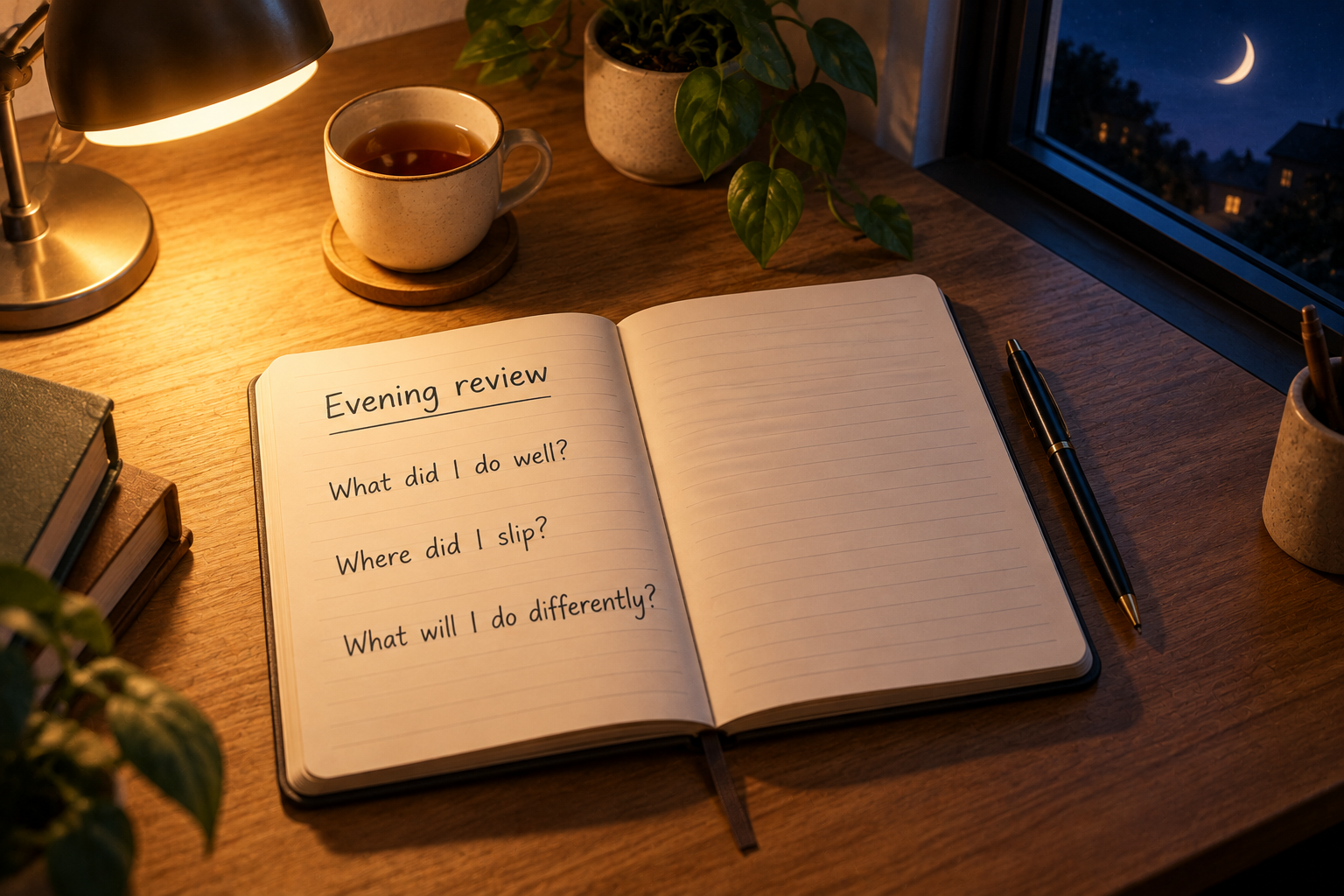
Seneca described sitting down each evening, once the lamp was out, to examine his day. What did I do well? Where did I slip? What will I do differently? He said he hid nothing from himself and forgave himself the small things.
Tim LeBon, a CBT therapist in the NHS and research director of Modern Stoicism, argues that this kind of reflection sits at the heart of what makes Stoicism useful. Writing in Psychology Today in September 2025, he described the newly validated Stoic Attitudes and Behaviours Scale, which he led, and its seven dimensions. One of them, Stoic Mindfulness, means watching your judgments and using daily reflection to catch unhelpful patterns. His point is practical: many people understand the Stoic principles but still react on autopilot, and regular review is how understanding turns into habit. He also suggests Stoicism fills a gap he sees in CBT, which treats specific problems well but often skips questions of meaning.
The Stoic Week 2025 data fits his view, at least as a correlation. Of the seven dimensions, Stoic Mindfulness and reflection had the strongest link to vitality (r = .43) at the start of the week. That shows association, not cause.
Give it a go: tonight, answer Seneca’s three questions in three lines, no more. Keep the tone kind; an honest review is different from beating yourself up, and if that line blurs for you, read about how to stop hating yourself.
11. Pay attention to your attention
The Stoics had a word, prosoche, for steady attention to what you’re doing and thinking right now. Epictetus treated it as the skill underneath all the others. If you’re not paying attention, you can’t catch a judgment or choose a response.
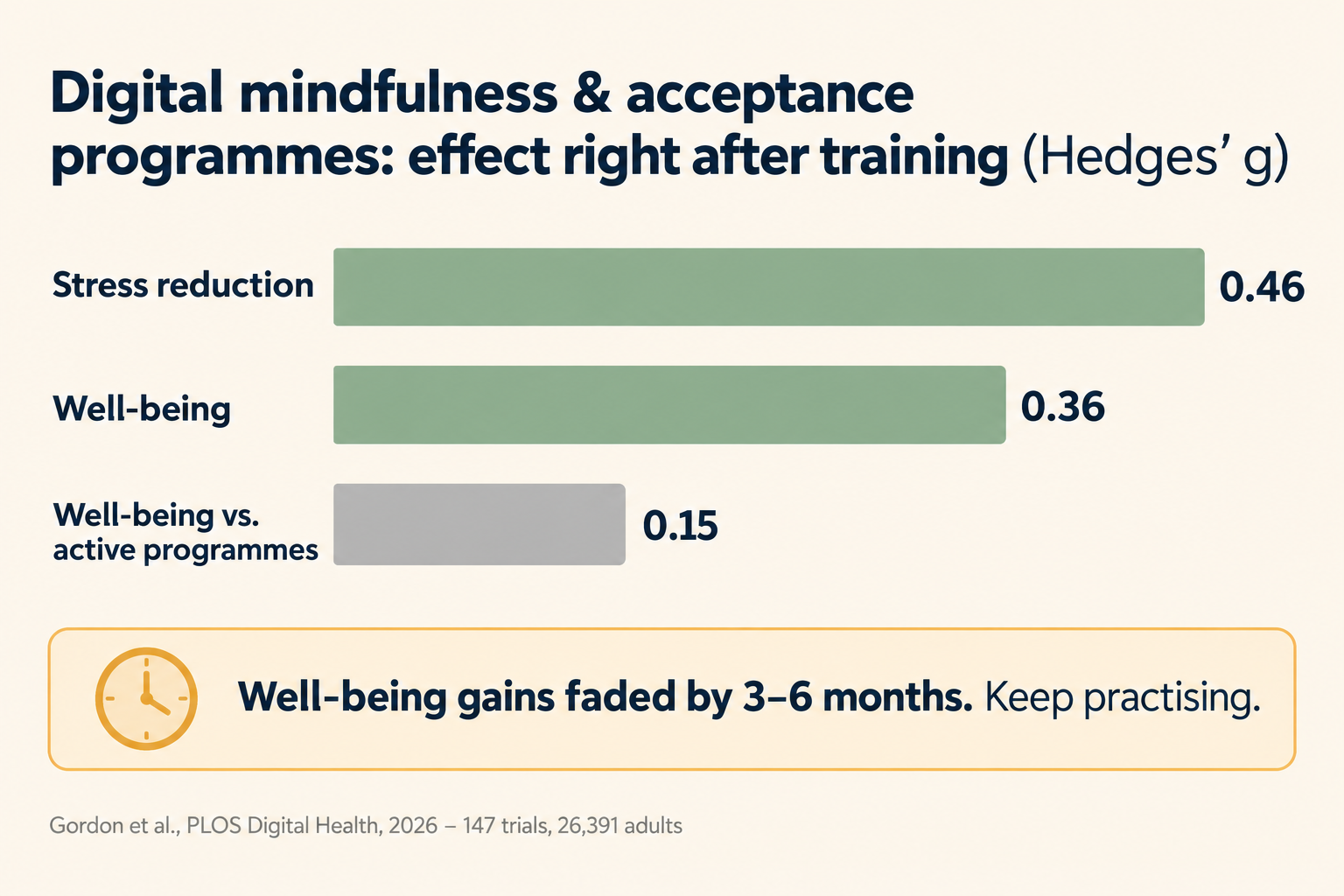
The closest modern match is mindfulness and related “third-wave” approaches. On 1 October 2026, Tom Gordon, Andrew Kemp, Darren Edwards and colleagues at Swansea University published a meta-analysis in PLOS Digital Health of 147 randomized trials with 26,391 adults, all testing digital programmes built on mindfulness, acceptance or compassion. Immediately after the programmes, well-being improved (g = 0.36) and stress fell (g = 0.46), with similar gains for anxiety and depression.
Two honest caveats came with it. Effects were much smaller against active comparison programmes than against waitlists (for well-being, g = 0.15). And the well-being gains weren’t reliably sustained at three to six months, which suggests the practice has to keep going to keep working.
Set a reminder on your phone for three random times tomorrow, and each time it buzzes, notice what you’re doing, what you’re thinking, and whether you chose either. For more on this, see how to stop living on autopilot.
12. Remember that you will die
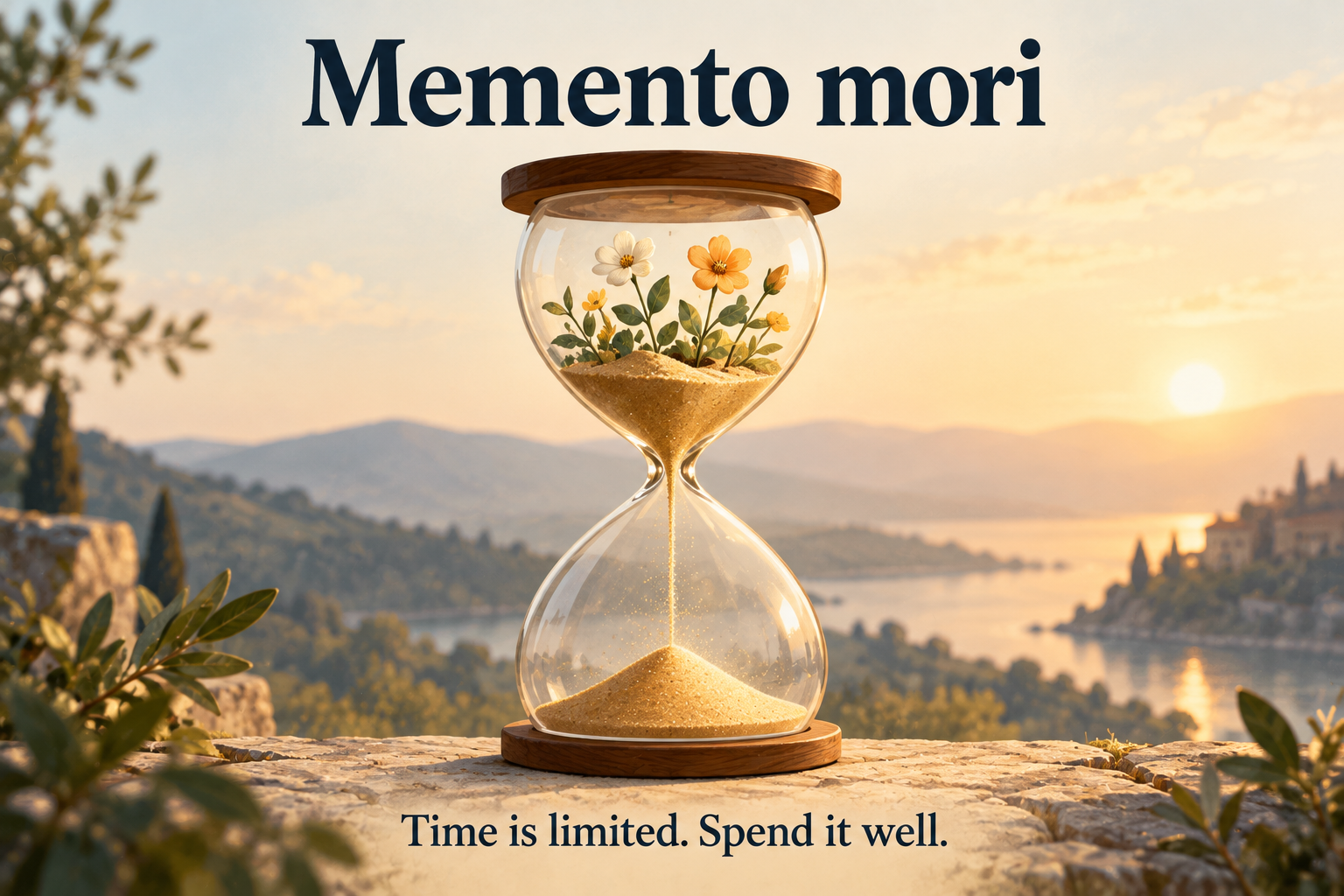
Memento mori sounds morbid. The Stoics used it the opposite way, as a reminder that time is limited and shouldn’t be wasted on grudges or trivia. Marcus reminded himself often that he could leave life at any moment and should act accordingly.
A 2024 field experiment tested a modern, intense version. Enny Das and Marieke Fransen of Radboud University and Mary Beth Oliver of Penn State published it in Frontiers in Psychiatry in November 2024. Visitors to an Amsterdam art installation sat alone and listened to a 30-minute guided meditation on the decay of their own body. They were compared with people who did a standard written death reflection and a neutral group who wrote about watching TV (229 people in total). The installation group felt more moved and more connected at the time. Two weeks later, among the 105 who replied, they were still reflecting on the experience more often, and that lingering reflection predicted greater appreciation of life. Both death-reflection groups appreciated life more than the TV group.
The study has limits: participants chose to sign up for a death meditation, the installation group wasn’t randomly assigned, and fewer controls answered the follow-up.
One small step: write today’s date and one sentence on what you’d regret leaving undone if this were your last year. If the answer is a task you keep postponing, these strategies on how to stop procrastinating will help you start.

13. Do one kindness on purpose
Stoicism isn’t a solo sport. Marcus wrote that we’re made to work together, like hands, feet and eyelids, and the Stoics believed caring for others was part of living well, not a distraction from it.
The evidence on whether kindness helps the giver is fairly solid, if not recent. A 2018 meta-analysis in the Journal of Experimental Social Psychology by Oliver Scott Curry and colleagues at the University of Oxford reviewed 27 studies with 4,045 participants. Performing acts of kindness raised the actor’s well-being with a small-to-medium effect (δ = 0.28), and the effect held regardless of age, sex or type of kindness. I couldn’t find a newer meta-analysis focused on the same question, so that’s the best figure available.
Picture this: you’re stuck in a queue that’s going nowhere, irritated, and you let the stressed parent behind you go first. The queue is exactly as slow as before, but your attention has moved off your own annoyance. That shift is a big part of why small kindnesses calm the person doing them.
Your move: pick one specific person and one specific kind act for tomorrow, and do it without mentioning it. These ideas on how to be friendly and kind can give you a starting list.
14. Love what happens, then act on what’s left
Nietzsche coined the phrase amor fati, love of fate, but the idea is older. Epictetus advised wanting things to happen exactly as they do happen. That can sound passive. It isn’t, once you see the cause and effect underneath.
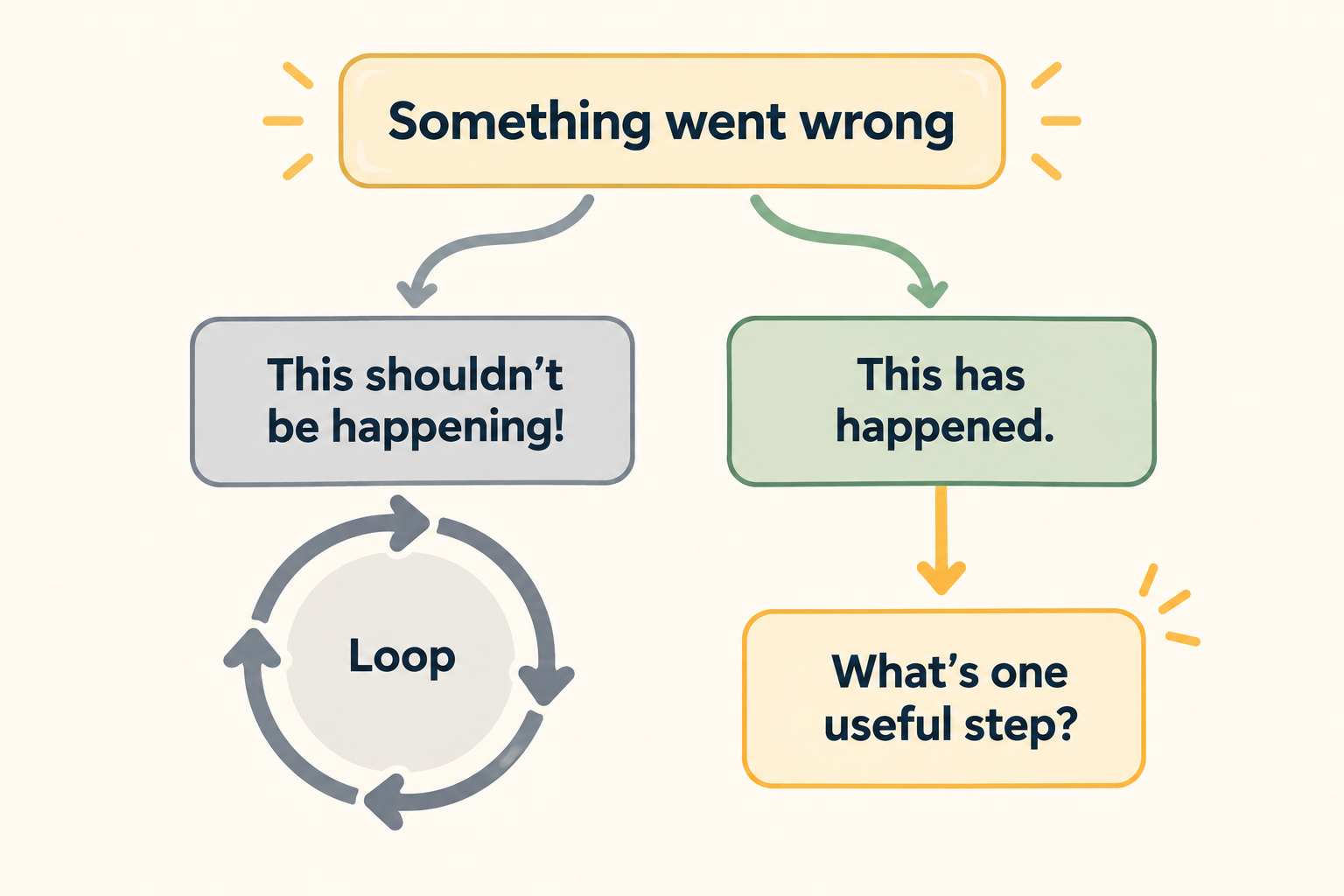
When something bad has already happened, you get two problems: the event itself and your fight against the fact that it happened. The second problem drains energy and keeps the pain fresh. Acceptance removes it. With the “this shouldn’t be happening” loop switched off, your attention is free for the question that actually matters: what’s my next move? That’s why the Stoics paired acceptance with action. You accept what can’t be changed and work on what can, as the Boostani team also stressed in their 2026 discussion of Stoic training.
Modern research measures something similar under the name psychological flexibility: staying in contact with difficult thoughts and feelings while still acting on your values. In the 2026 Swansea meta-analysis from item 11, which included 64 acceptance and commitment therapy trials, digital programmes improved psychological flexibility (g = 0.41) right after training, though the gains faded by the medium term. That’s a related construct, not a direct test of amor fati, so take the link as supportive rather than proof.
When something goes wrong this week, say “this has happened” out loud before you say anything else, and then ask what one useful step remains. It’s the same move that helps people handle job loss and get back on their feet.
15. Practice with other people
The ancient Stoics learned in schools. Epictetus taught in a classroom, and Seneca wrote letters to a friend. Practising alone is fine, but structure and company help.
A real example comes from UK medical education. In 2022, Megan Brown, Alexander MacLellan, Tim LeBon, Gabrielle Finn and colleagues published a mixed-methods study in BMC Medical Education on a Stoic training programme called SeRenE, designed to protect medical students from burnout and the slow loss of empathy common in clinical training. Students completed the Stoic Attitudes and Behaviours Scale, the Brief Resilience Scale and the Jefferson Scale of Empathy before and after. Stoic attitudes, resilience and empathy all rose after training, and resilience and empathy tended to climb together. Without a randomized control group it can’t prove cause, but it shows the approach working inside a demanding real institution.
Feedback from the Stoic Week 2025 report points the same way. Participants mentioned the value of a community, of having someone to talk the ideas through with, and of structured daily prompts.
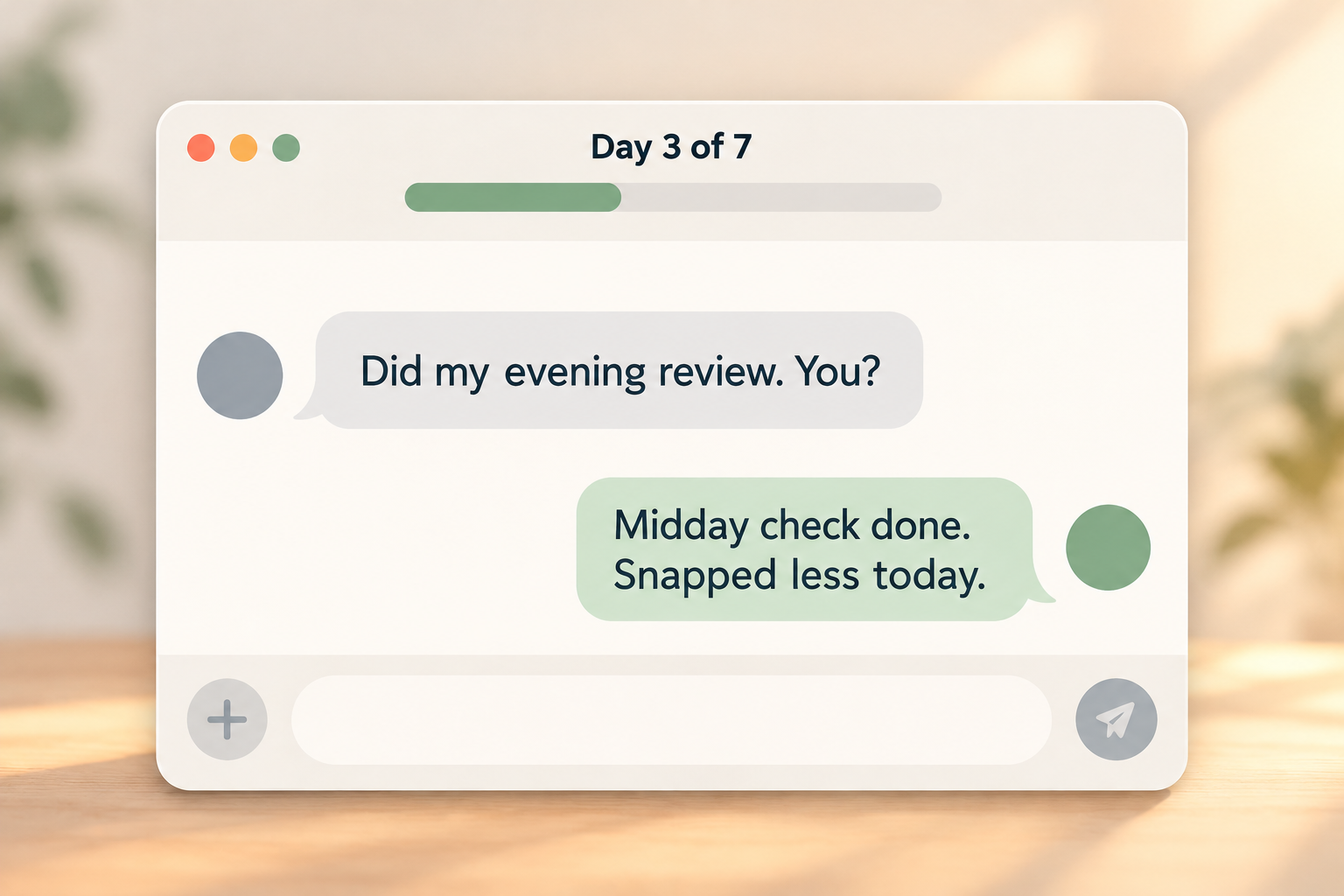
Test it this week: invite one friend to try a single exercise from this list with you for seven days, and swap a two-line message each evening. Doing it together also exercises the social skills that make shared practice easier.
16. Run a midday STOIC check
Mornings and evenings are covered. The middle of the day is where most of us lose the thread.
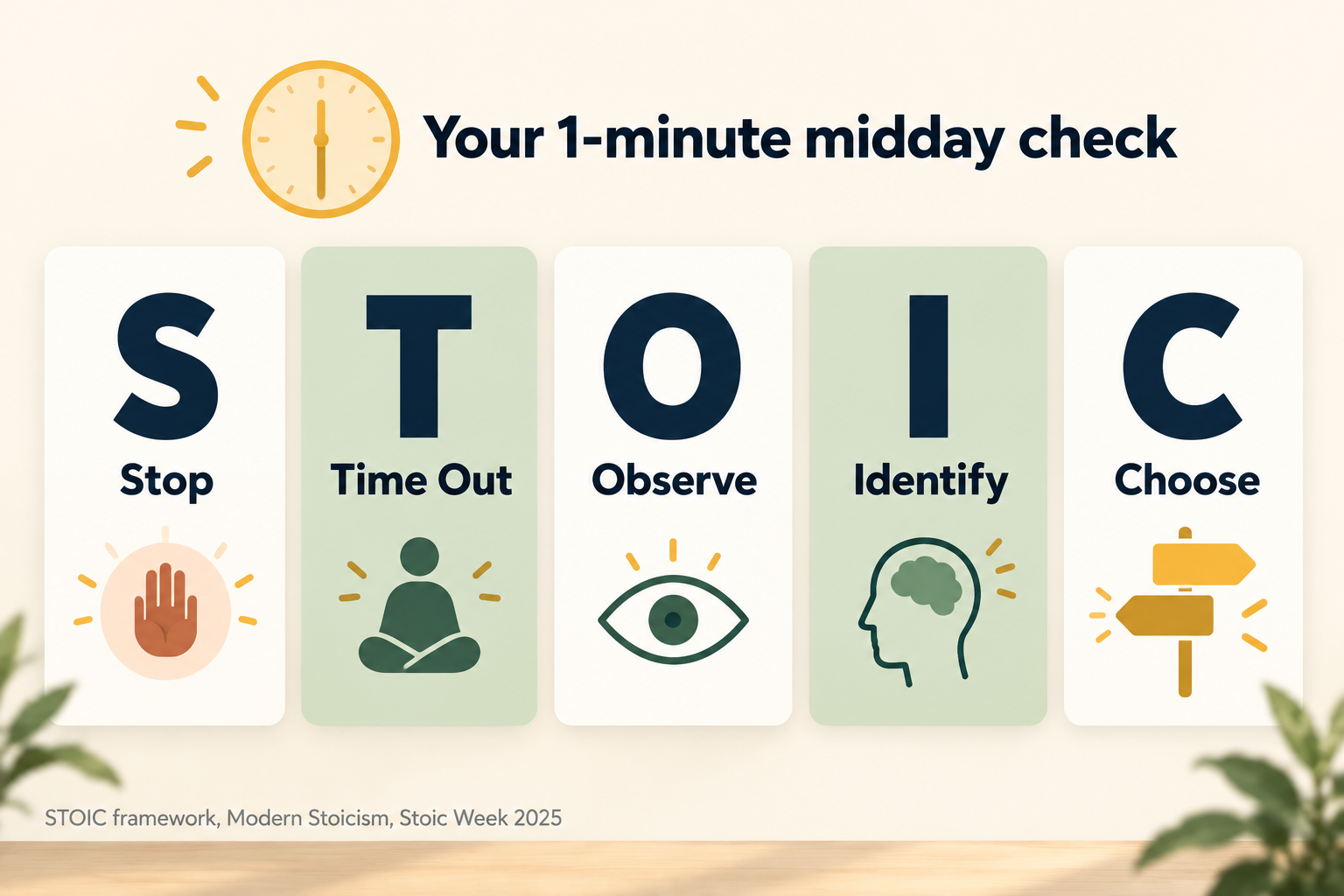
Modern Stoicism added a tool for exactly this to its Stoic Week materials, and its October 2025 course announcement describes it. The STOIC framework is five steps: Stop, Time Out, Observe, Identify, Choose. The organisation presents it as a Stoic evolution of STOPP, a quick technique used in cognitive behavioural therapy. You stop, step back, observe what’s happening and what you’re telling yourself, identify which part is up to you, and choose a response that fits the person you want to be. The 2025 course also gave participants one key Stoic quote per day and a single takeaway to remember, rather than a pile of ideas.
Participant comments in the 2025 report suggest the midday version sticks. One person described using the STOIC framework to handle a stressful situation that came up daily. Another said the lunchtime reflections were the part they planned to keep, with a few default questions about how the day was going and how they were treating people. These are individual testimonials, not data, but they show how people actually use it.
Before you close this tab, put a recurring lunchtime reminder in your calendar that just says “S-T-O-I-C,” and when it pops up, take one minute to run the five steps.
What to do when you slip
You will forget these exercises. You’ll snap at someone, skip the evening review for a week, and catastrophize your way through a Tuesday. That isn’t failure. It’s what learning looks like.
The research on habits is reassuring here. In December 2024, Ben Singh and colleagues at the University of South Australia published a systematic review in Healthcare on how long new health habits take to form. The studies that measured timing reported medians of 59 to 66 days, with individual times ranging from 4 to 335 days. In other words, the old “21 days” rule is a myth, and a few lapses early on are normal. Singh’s practical advice in an interview with Gizmodo was simple: “missing a day doesn’t mean failure,” as long as you pick the habit back up the next day.
The Stoics would agree. Epictetus called his students prokoptontes, people making progress, not people who had arrived. Seneca’s evening review included forgiving himself for the day’s small failures.
So when you slip:
- Name it plainly (“I lost my temper in that meeting”) without adding a verdict about your character.
- Ask which exercise would have helped, and attach it to something you already do tomorrow.
- Shrink it. If the evening review felt like too much, do one line instead of three.
- Restart the next day, not next Monday.
If the whole day went sideways, start with these steps to turn a bad day around, then come back to one practice tomorrow.
Conclusion
Stoicism was never about feeling nothing. It’s a set of drills for feeling things without being run by them: rehearse in the morning, sort what’s yours, catch your judgments, calm your body, and review honestly at night. The science on these practices is promising but young, with a few genuine trials and plenty of supportive research on related techniques.
You don’t need sixteen new habits. Choose one exercise from this list, give it two months, and notice what changes. For more practical ways to build a calmer, steadier life, browse our self-improvement guides.