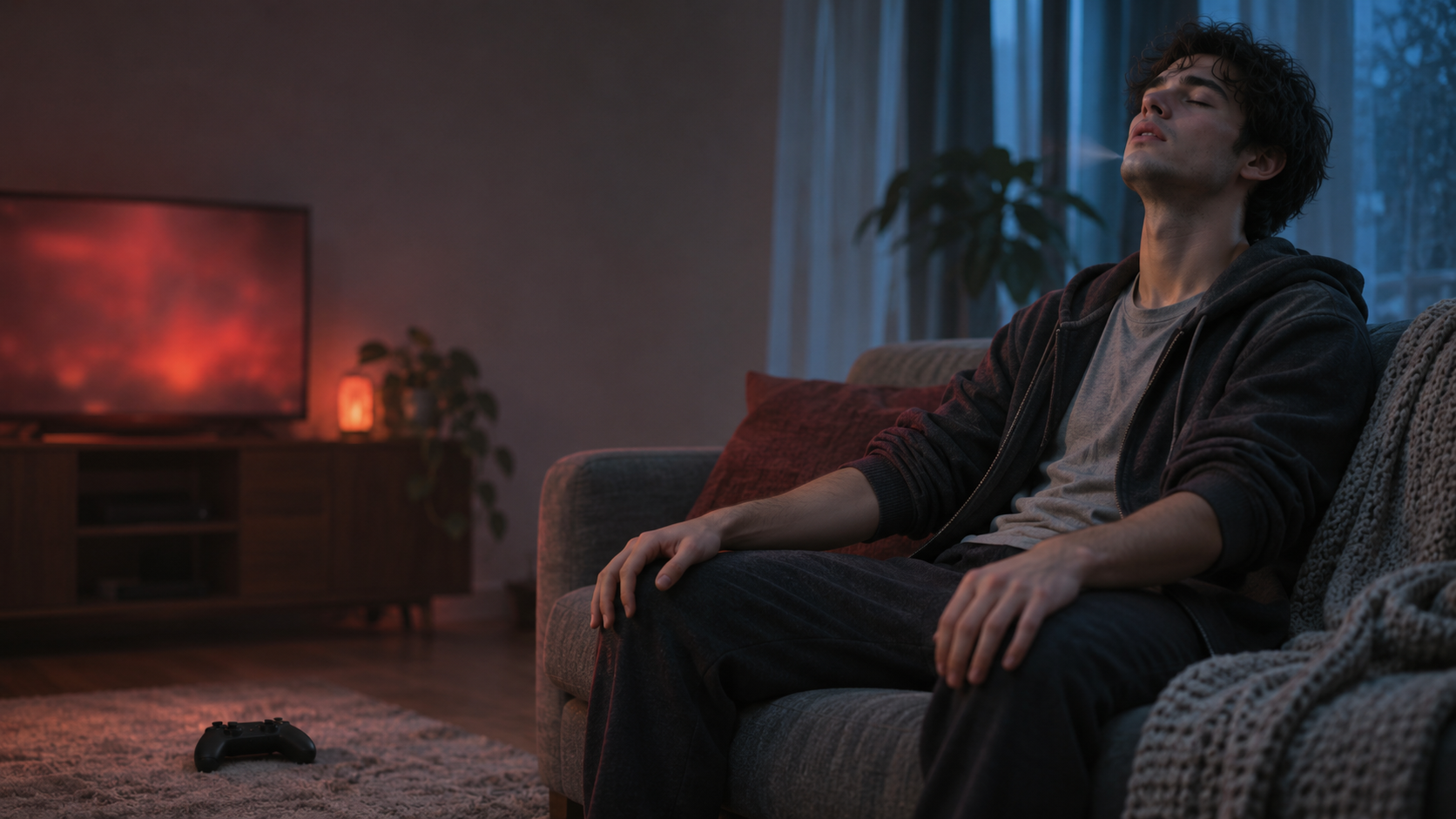
You lose the round. Then the next one. Somebody on your team types something you’d never say to a stranger’s face, and suddenly your jaw is tight, your thumbs are pressing harder than they need to, and the controller feels like it weighs nothing at all.
Gaming anger is common, and it isn’t a character flaw. It’s also not something you have to white-knuckle through. Psychologists have spent years working out why games get under our skin and what actually brings the temperature back down. Some of the answers are obvious. Others, like the finding that a quick run can make anger worse, are not.
Below are 17 ways to handle it, each tied to research, surveys or reputable institutions. Use the ones that fit how you play.
1. Figure out what’s really fuelling the rage
Most people assume violent games are the problem. The research points somewhere less dramatic: failure.
In 2025, Nuran Öze and Görkem Esengöl published a study in the Çukurova University Journal of Social Sciences that asked 136 players how they react when a game frustrates them. Almost half, 49%, described aggressive responses while playing. That’s a small, self-reported sample, but it fits a much older line of evidence. In a 2014 paper in the Journal of Personality and Social Psychology, Andrew Przybylski, Richard Ryan and colleagues ran seven studies with roughly 600 participants. They manipulated controls and difficulty in custom games and found that feeling incompetent, not violent content, predicted aggressive feelings and behaviour. In one experiment, people who’d played a hard version of Tetris assigned a stranger about 10 seconds longer with their hand in painfully cold water than people who’d played an easy version.
So the trigger is usually a blocked sense of competence. Clunky controls, unfair-feeling deaths, a boss you can’t crack.
Next time, do this: after a session that left you fuming, write one line about the moment it turned. “Died to the same jump six times” tells you far more than “this game sucks”.
2. Learn your personal tilt signals
Gamers call it tilt: the state where frustration starts steering your play. The mechanism is a loop. A mistake makes you angry, anger narrows your attention, narrowed attention causes more mistakes, and more mistakes feed more anger. Each lap makes the next one easier.
A 2025 qualitative study by Sarah Cregan, Adam Toth and Mark Campbell at the University of Limerick, published in Cyberpsychology, Behavior, and Social Networking, described tilt as more than a bad mood. Players reported negative emotions, changes in behaviour, impaired thinking and worse in-game performance, all bundled together. Because the study was qualitative, it maps the experience rather than measuring how often it happens.
The useful part is that loops have early stages. If you can focus on one thing at a time, the one thing should be your body for a few seconds after each death. Typical early tells: a clenched jaw, faster breathing, gripping the controller harder, muttering at the screen.
Start small: pick your two most reliable signals and treat either one as a yellow card.
3. Put the controller down and turn the heat down
Smashing a desk feels like release. It isn’t.
In 2024, Sophie Kjærvik and Brad Bushman of Ohio State University published a meta-analysis in Clinical Psychology Review covering 154 studies and 10,189 participants. Activities that lower physical arousal, like slow breathing, progressive muscle relaxation, mindfulness and simply taking a timeout, reliably reduced anger and aggression. Activities that raise arousal were ineffective overall, and venting did not help. The results held across ages, genders, cultures, and lab and real-world settings.
The popular picture of anger is a pressure cooker: let the steam out and the pressure drops. The analogy gets one thing right. Anger does build, and it does feel physical. Where it breaks down is the idea that anger is a fixed amount of steam. Blowing up doesn’t empty a tank. It rehearses the reaction, and your body stays revved.
Here’s a simple way in: the moment you notice a tilt signal, set the controller on the floor, not the couch. The extra distance makes picking it back up a decision rather than a reflex.
4. Breathe out longer than you breathe in
You don’t need a course or a therapist to start calming down. Kjærvik, then at Virginia Commonwealth University, made exactly that point when the meta-analysis came out: a free app or a guided video can be enough. Bushman put the rule plainly: “To reduce anger, it is better to engage in activities that decrease arousal levels.”
One specific technique has decent evidence behind it. In a remote randomised trial published in Cell Reports Medicine in January 2023, Melis Yilmaz Balban, Andrew Huberman and colleagues at Stanford compared three five-minute daily breathing exercises with mindfulness meditation over a month. Cyclic sighing, which stretches the exhale, improved mood and lowered breathing rate more than meditation did. Two caveats: the trial measured mood and anxiety rather than anger, and most participants were young adults recruited around a university.
Give it a go: two quick inhales through the nose (one full, one small top-up), then a long, slow exhale through the mouth. Repeat for one minute while the respawn timer counts down.
5. Mute first, think later
If other players are the problem, you’re in large company.
The Anti-Defamation League’s most recent annual Hate Is No Game survey available, the 2023 edition released in February 2024, found that 76% of US adult online multiplayer gamers had experienced harassment in the previous six months. A smaller ADL study published in January 2025, Playing with Hate, had 15 young adults play 249 one-hour sessions of Valorant, Counter-Strike 2, Overwatch 2 and Fortnite. Harassment showed up in 49% of sessions, and 22% were definitely identity-based. The sample is tiny, so treat the exact percentages as a snapshot, not a national rate.
ADL’s own recommendation to game companies is telling: it wants players to be able to block several harassers at once. In other words, muting and blocking are meant to be front-line tools, not a last resort. Arguing with someone who wants a reaction works about as well as dealing with people who always think they’re right in any other setting. You won’t win, and your heart rate will lose.
Your move: set chat to friends-only before you queue, so muting isn’t a decision you have to make mid-fight.
6. Drop the difficulty, or switch to something you’ve mastered
If the anger comes from feeling incompetent, the fix is to give your brain some competence back. Self-determination theory, the motivation framework behind the 2014 Przybylski study, treats competence as a basic psychological need. When a game blocks it repeatedly, frustration rises. When a game feeds it, frustration eases.
A 2024 lab experiment by Gary Wagener and André Melzer at the University of Luxembourg, presented as a peer-reviewed poster at the International Society for Research on Aggression meeting, tested this directly. They frustrated 55 participants with a difficult cognitive task, then had them play 25 minutes of Battlefield 1. Self-reported frustration dropped in the frustrated group, heart rate variability rose (a sign of physiological relaxation), and aggression didn’t increase. It’s a small study and only a poster, so it’s suggestive rather than settled.
Lowering the difficulty isn’t cheating. It’s how you get back into the zone where challenge and skill match, which is the sweet spot for entering a flow state instead of a rage spiral.
A quick experiment: when a level has beaten you three times, play 15 minutes of a game you’re already good at, then come back.
7. Don’t play ranked on four hours’ sleep
Tired gamers are angrier gamers, and the data on this is unusually strong.
In a meta-analysis published in Psychological Bulletin (online December 2023, in print April 2024), Cara Palmer of Montana State University and colleagues pooled 154 experimental studies with 5,717 participants. Every type of sleep loss they looked at, from staying up all night to shortened sleep to broken sleep, reduced positive emotions and increased anxiety symptoms. Even an hour or two of lost sleep made a difference.
Anger specifically? Zlatan Krizan’s team at Iowa State University reported in a 2020 conference abstract in the journal Sleep that 147 adults who cut their sleep by about five hours across two nights grew angrier when exposed to irritating noise, while well-rested people adapted. A related experiment using an online competitive game found similar results. Abstracts are less vetted than full papers, so weigh that part lightly.
Late-night grinding often comes paired with a racing mind afterwards. If that’s you, these tips on how to stop overthinking at night help break the cycle.
Test it this week: no competitive matches after midnight. Casual modes only.
8. Eat before you queue
“Hangry” sounds like a joke word. It has data behind it.
Viren Swami of Anglia Ruskin University and colleagues followed 64 adults in Central Europe for 21 days, prompting them five times a day to rate their hunger and mood. Across 9,142 responses, published in PLOS ONE in July 2022, hunger was associated with 34% of the variance in anger, 37% in irritability and 38% in pleasure. The study is correlational, the sample was mostly women, and it’s over three years old, so it shows a link rather than proving hunger causes rage.
Swami’s own suggestion is interesting: simply recognising that you feel angry because you’re hungry may weaken the effect. That’s the same principle behind the next tip.
Start small: keep a proper snack near your setup, and eat it before a long session rather than after the third loss.
9. Say the feeling out loud
Naming an emotion sounds too simple to matter. The evidence says it does, with limits.
A systematic review by Jooyeon Shin of Inha University, published in the Korean Journal of Health Psychology in July 2026, pulled together studies on affect labeling, the technical name for putting feelings into words. Labeling consistently reduced or stabilised emotional reactivity on physiological and behavioural measures. Its effect on how people said they felt was less consistent, and it worked better for some people than others. So it calms the body more reliably than it changes the mood.
Picture this: you die to a sniper for the fourth time. Instead of a stream of swearing, you say, “I’m frustrated because I keep peeking the same angle.” It’s a hypothetical, but notice what happens in it. You’ve named the feeling and the cause in one sentence, and the cause is something you can fix.
This is a core skill in improving emotional intelligence, and games give you dozens of chances to practise it every evening.
Here’s a simple way in: finish the sentence “I’m ___ because ___” before you hit the requeue button.
10. Set a stop-loss rule before you start
Traders use stop-losses: a price, chosen in advance, at which they sell automatically. The point is to make the decision while calm, because the person watching the market crash is the worst person to decide what to do next. Poker players apply the same idea to tilt.
The analogy holds well for gaming. It breaks down in one place: a trader’s loss is real money, while yours is rank points, so the stakes can feel smaller than they are emotionally. That’s exactly why a rule helps.
The research supports the timing. Iván Bonilla and colleagues, in a 2024 study in Frontiers in Psychology that interviewed 27 pro, semi-pro and amateur players and coaches and then surveyed 488 gamers, identified losing streaks and repeated mistakes, your own or a teammate’s, as major tilt triggers. They described tilt as typically lasting around 30 minutes, though it can range from seconds to hours. Continuing to queue on tilt is, quite literally, self-sabotage.
Your move: decide now. Two losses in a row means a 30-minute break, no exceptions, no “one more to win it back”.
11. Ask what the loss actually means
Anger depends partly on the story you tell about what happened. “My team is throwing on purpose” lands very differently from “we’re all having an off game”.
Reappraisal, deliberately reinterpreting a situation, is one of the best-studied ways to change that story. In a study published in Anxiety, Stress & Coping in January 2026, Tsekova, Antony and colleagues showed 91 participants films with rejection-heavy content. When instructed to use reappraisal, both people high and low in social anxiety showed a significant drop in state anger, and the drop was similar in size for both groups. It’s a single study with film clips rather than games, but the takeaway carries: reappraisal is a skill people can switch on when told how.
Say you get matched with a teammate who seems lost. One reading: they’re useless. Another: they’re new, it’s 1 a.m., and they’re probably as annoyed as you are. Neither story changes the scoreboard. Only one of them leaves you calm enough to play well.
The same move sits at the heart of radical acceptance: stop arguing with what already happened and decide what to do next.
Give it a go: after a bad loss, come up with one alternative explanation that doesn’t involve anyone being an idiot.
12. Play for fun at least some of the time
Why you play shapes how you lose. When rank becomes a measure of your worth, each loss feels like a verdict. That’s a threat to your sense of self, and threats provoke defensive anger. Remove the verdict and the threat shrinks.
Cregan, Toth and Campbell tested this kind of factor in a 2024 online study of 1,007 gamers in Frontiers in Psychology. Players with competitive motives for gaming, higher trait anger and more hours of play were more likely to experience tilt. More years of gaming experience and more use of adaptive emotion regulation strategies were linked to less of it. These are associations from one survey, so they don’t prove that switching motives will cure tilt, but the pattern is consistent.
You don’t have to give up ranked. Just don’t let it be the only way you play.
A quick experiment: for one week, alternate every ranked session with an unranked or co-op one, and note which leaves you in a better mood afterwards.
13. Check how gaming fits into your life
Hours aren’t the main issue. Fit is.
In March 2025, Nick Ballou, Andrew Przybylski and colleagues at the Oxford Internet Institute published a study in Royal Society Open Science using real play data from Nintendo. They tracked 703 US adults across 150 Switch games and more than 140,000 hours of play. Time spent playing didn’t predict well-being, but how players felt gaming fit into their lives did, a measure the team called “gaming life fit”. The data came from casual adult players and the analysis is correlational, so it says little about teenagers or heavy competitive players.
Still, it changes the question you ask yourself. Not “am I playing too much?” but “is this making my life better or crowding out things I care about?”. If gaming is the only place you go to decompress, every loss lands harder. A few other good habits to have spread that load around.
Test it this week: rate each evening’s play out of 10 for how much it added to your day. Look for the sessions that consistently score low.
14. Move, but make it play, not punishment
Lots of people go for a hard run to burn off rage. It’s good for your heart. It’s not great for your anger, at least not right away.
Bushman put it directly when the 2024 meta-analysis came out: arousal-raising exercise may help cardiovascular health, but it isn’t the best way to reduce anger. In Kjærvik and Bushman’s data, jogging was the activity most likely to increase anger. Ball sports and playful physical activity went the other way, possibly because they bring positive emotions with them.
Not every institution draws the line in the same place. The NHS lists running alongside walking, swimming and yoga as exercise that can help you relax. The two views fit together if you separate timing: regular exercise is good for stress over weeks, while in the hot minute after a loss, calmer movement is the safer bet.
Next time, do this: if you need to move after a rage moment, walk, shoot some hoops or kick a ball around. Save the intervals for when you’re not still replaying the last match.
15. Know where a hobby turns into a disorder
Most gaming anger is just gaming anger. Occasionally it’s a sign of something bigger.
The World Health Organization’s ICD-11 defines gaming disorder by three features: impaired control over gaming, giving gaming increasing priority over other interests and daily activities, and carrying on despite negative consequences. The pattern has to significantly damage personal, family, social, educational or work life, and would normally be visible for at least 12 months. WHO notes that it affects only a small proportion of people who play.
How small? A systematic review and meta-analysis of 93 studies by Júlia Gisbert-Pérez and colleagues, published in Addictive Behaviors in late 2025, covered 149,601 people aged 18 to 35. The pooled prevalence of internet gaming disorder was 6.1%, rising to 8.1% in samples made up only of gamers. Studies with smaller samples or higher risk of bias tended to report higher numbers, so the true figure may be a little lower.
Anger is one listed symptom (irritability when you can’t play), but it isn’t the core of the diagnosis. Loss of control and real-life harm are.
If you’re unsure which side of the line you’re on, ask someone who knows you well whether gaming has pushed out sleep, work, school or people in the past year, and listen to the answer without arguing.
16. Play with people who make it fun
Who you queue with affects how often you get provoked.
That same ADL Playing with Hate study didn’t only count harassment. About half of the 249 sessions also included positive play, such as encouragement and teamwork, and the gap between games was striking. Overwatch 2 sessions had positive interactions 69% of the time, compared with 55% for Counter-Strike 2, 40% for Fortnite and 36% for Valorant. Again, 15 players can’t represent every lobby, but the spread suggests that community and game design matter.
| Game (ADL, Playing with Hate, Jan 2025) | Sessions with positive interactions |
|---|---|
| Overwatch 2 | 69% |
| Counter-Strike 2 | 55% |
| Fortnite | 40% |
| Valorant | 36% |
The logic is simple. Fewer hostile messages mean fewer spikes of arousal, and friends who laugh off a loss model the reaction you’re trying to learn. If the angry person in your lobby is a friend, these strategies for dealing with angry people work just as well over voice chat.
Build a short list of two or three people you enjoy playing with, and make queuing with them your default rather than the exception.
17. Get proper help if the anger turns physical
Sometimes self-help isn’t enough, and that’s worth saying plainly.
The NHS, in guidance reviewed in August 2026, advises seeing a GP if you’re struggling to cope with anger, if self-help isn’t working, or if you’re acting abusively or violently. A GP can refer you to an anger management programme or counselling. These programmes usually combine one-to-one sessions with group work, and most include cognitive behavioural therapy. In England you can also self-refer to NHS talking therapies without going through a GP, and under-18s have dedicated services. Outside the UK, a doctor or licensed therapist is the equivalent first step.
Signs it’s time: you’ve broken things or hit something more than once, people around you seem scared of your reactions, or the anger has started showing up far from the screen.
Asking for help here isn’t an overreaction. It’s the most practical move on this list.
What to do when you slip
You will lose your temper again. Probably at a game that doesn’t deserve it. What matters is what you do in the 10 minutes afterwards.
The instinct is to beat yourself up. Two lines of research say that’s the wrong instinct. A 2025 meta-analysis by M. I. Fraser, Joseph Ciarrochi and colleagues in the Journal of Contextual Behavioral Science looked at 31 studies (3,370 participants) that tracked self-compassion in daily life. Moments of higher self-compassion went with moderately higher well-being and lower distress. In a different context, Charlotte Hagerman’s team at Drexel University found in a study published in Appetite (reported in January 2024) that people who responded to diet lapses with self-compassion had better mood and more self-control in the following hours. Dieting isn’t gaming, but the pattern of lapse, judgement and recovery is similar.
So when you slip, try this sequence:
- Step away from the game for at least 20 minutes.
- Name what happened without labels like “pathetic”: “I got angry after three losses and threw my headset.”
- Repair anything that needs repairing, whether that’s an apology to someone in the room or a message to a teammate.
- Pick one tip from this list to try next session.
One blow-up doesn’t erase progress. If the whole day went sideways, here’s how to turn a bad day around. And if the inner voice gets cruel after a slip, learning to stop hating yourself matters more than any gaming technique.
Conclusion
Gaming anger mostly comes from blocked competence, tired or hungry bodies, toxic lobbies and a loop that feeds itself once it starts. The good news is that every part of that loop has a handle: lower your arousal instead of venting, change the difficulty, protect your sleep, mute early, and set your stop-loss before the first match.
You don’t need all 17. Pick two that match your worst moments, the ones from this week, and try them for your next five sessions. Then come back for two more.
Gaming is only one part of how screens shape your mood. For more practical, evidence-based ideas on using games, apps and devices on your own terms, browse our Technology guides.