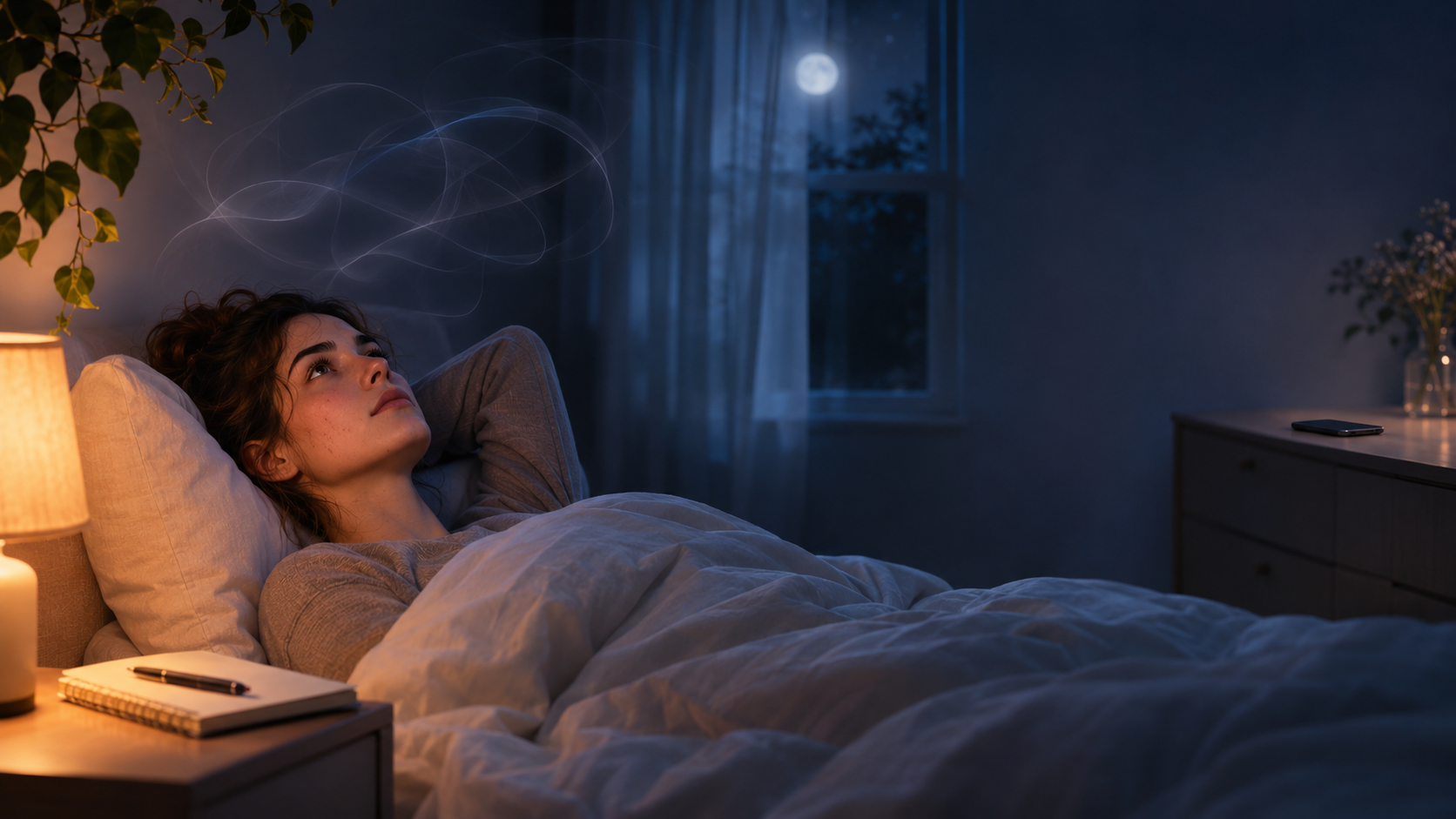
It’s 1:12 a.m. The house is silent. Your brain, apparently, did not get the memo.
It’s replaying a slightly awkward thing you said in a meeting on Tuesday. Then it moves on to your bank balance, a weird twinge in your knee, and whether you ever replied to that email from your landlord. You were tired an hour ago. Now you’re wide awake and annoyed about it, which makes sleep even less likely.
If that sounds familiar, you have plenty of company, and your brain isn’t broken. Night is often the first quiet moment of the day, so whatever you pushed aside since morning finally gets the floor. Luckily, racing thoughts at bedtime respond well to fairly simple changes. Some work in the evening, some work in the moment, and a few work best when you’re not in bed at all.
Below are 14 approaches, each tied to real research or named experts. You don’t need all of them. Read through, pick two or three that fit your life, and give them a fair run.
1. Write tomorrow’s to-do list before lights out
A lot of night-time overthinking isn’t deep worry. It’s admin. Your brain keeps circling unfinished tasks because it’s afraid you’ll forget them, so it rehearses them on a loop.
Getting them onto paper seems to break that loop. In a sleep-lab experiment published in January 2018 in the Journal of Experimental Psychology: General, Michael Scullin’s team at Baylor University asked 57 healthy adults aged 18 to 30 to spend five minutes writing before bed. Half wrote a to-do list for the coming days. The other half wrote about tasks they’d already finished. Brain-wave recordings showed the to-do group fell asleep in roughly 15 minutes, compared with about 25 minutes for the other group, and people who wrote more detailed lists tended to drift off faster still.
Two caveats are worth knowing. There was no group that didn’t write at all, and none of the volunteers had a sleep problem. It’s also an older study, and I couldn’t find a newer replication. Still, it’s cheap to try, and the American Academy of Sleep Medicine (AASM) gives the same practical advice in its August 2025 guidance: keep a notepad by the bed so thoughts leave your head and you’ll still have them in the morning.
If part of the spinning comes from too many open choices, our piece on decision fatigue helps you shrink tomorrow’s list before it starts shouting at you.
Tonight, do this: set a five-minute timer, write every task for tomorrow and the day after, and be specific. “Email Sam about the invoice” beats “work stuff.”
2. Park your phone out of arm’s reach
You know the routine. You get into bed and check one thing. Forty minutes later you’re deep in someone’s renovation video, and your mind is buzzing.
The numbers on this are hard to ignore. In a March 2025 study in Frontiers in Psychiatry, Hjetland and colleagues analysed data from more than 45,000 Norwegian university students aged 18 to 28, taken from the national SHOT2022 health survey. The Norwegian student study found that each extra hour of screen use after going to bed was linked to 59% higher odds of insomnia symptoms and about 24 minutes less sleep.
Interestingly, scrolling social media wasn’t clearly worse than watching films or browsing. The link held across screen activities, which points at the time spent in bed on a screen, whatever you happen to be doing on it. The design was cross-sectional, so it can’t prove the phone causes the insomnia (restless sleepers may grab the phone because they can’t sleep). It’s a strong signal all the same, and late-night scrolling also shows up in our list of habits that are bad for your brain.
Start small: charge your phone on the other side of the room or outside the bedroom tonight, and use a cheap alarm clock if you need one.
3. Give your worries an earlier appointment
Worry tends to show up at night because there was no space for it during the day. So give it space, deliberately, a few hours before bed.
This technique is called worry postponement, and a randomised trial from the University of Leeds, published online in December 2025 in Psychology & Health, tested it properly. Dane McCarrick, Daryl O’Connor and colleagues assigned 186 adults to one of four groups for 14 days. Two groups were told to postpone any worry to a 20 to 30 minute window in the early evening, roughly four to five hours before sleep. One of those groups also made an “if-then” plan linking the window to a routine moment, such as right after dinner. That planning group logged about 30 minutes of worry a day, against about 48 for those who only postponed. In the 2025 worry postponement trial, though, neither approach improved sleep onset, night awakenings or sleep quality compared with the control groups.
So be realistic. A worry window shrinks the worrying. It probably won’t fix your sleep on its own, which is why it pairs well with the other steps here. And once you have a set time for problems, you can use it to take one small step on the biggest one, since action quiets a worry faster than rehearsal does. Our guide on how to stop hesitating and start acting covers that part.
Your move: pick a 20-minute slot after dinner, attach it to something you already do, and when a worry pops up at 11 p.m., tell it, “Tomorrow, 7:30.”
4. Shuffle your thoughts on purpose
This one sounds slightly silly. Lots of people swear by it anyway.
Cognitive shuffling was developed by Luc Beaudoin, a cognitive scientist and adjunct professor of education at Simon Fraser University in Canada. Speaking to CNN in April 2025, he explained the reasoning: as you naturally fall asleep, your thoughts become fragmented and dreamlike, jumping between unrelated images. The technique, in his words, “resembles in critical respects natural sleep onset.” Feeding your brain random, emotionally flat images crowds out the worried, logical chain of thought that keeps you alert. Beaudoin also co-founded companies that sell products based on this work, so keep that in mind.
The evidence is thin but promising. CNN reported on a 2016 study by Beaudoin’s team in which 154 university students were randomly assigned to cognitive shuffling, a standard pre-bed routine, or both. The shuffling group reported better sleep quality and less trouble falling asleep. It’s one small study in a student sample, and I haven’t been able to open the original paper, so treat it as an encouraging start.
A quick experiment: pick a neutral word, say “planet.” For P, picture as many things as you can (a pear, a piano, a parrot), spending a few seconds on each. When P runs dry, move to L. Keep the images random. If you catch yourself building a story, you’re doing it too carefully.
5. Hide the clock and give your tracker the night off
Checking the time at 2:47 a.m. starts a little calculation. “If I fall asleep now, I’ll get four hours and 13 minutes.” That maths comes with a jolt of stress, and stress is the opposite of what you need.
Sleep trackers can feed the same habit. The AASM’s 2025 Sleep Prioritization Survey, released in January 2026, polled 2,007 US adults in June 2025. It found that 48% had used a sleep-tracking device, up from 35% in 2023, and 55% were changing their behaviour based on the data. Most striking, 76% said they had lost sleep because of worries about sleep problems. Shalini Paruthi, an AASM spokesperson, said trackers can raise awareness but shouldn’t become a source of stress.
Earlier research points the same way. A study led by Spencer Dawson of Indiana University, published in May 2023 in The Primary Care Companion for CNS Disorders, looked at nearly 5,000 sleep clinic patients. People who monitored the time more while trying to fall asleep had worse insomnia, which in turn was tied to more use of sleep medication. That’s an association from questionnaires, so it doesn’t prove clock-watching causes insomnia.
Checking your score every morning can turn into a quiet form of self-sabotage if a bad number puts you on edge for the next night. Turn the clock to face the wall, keep the phone out of reach, and look at your tracker data once a week at most, never in bed.
6. Stop trying so hard to fall asleep
Sleep is one of the few things in life that gets worse the harder you work at it.
The mechanism goes like this. Falling asleep depends on your nervous system winding down, and that isn’t something you can do on command. When you try to sleep, you start monitoring yourself: Am I drowsy yet? Why is my heart beating so loudly? That monitoring is a form of vigilance, and vigilance raises arousal. Higher arousal makes sleep less likely, which makes you try harder. Sleep researchers call this “sleep effort,” and the loop is a working model with growing support, not a fully settled fact.
There’s some evidence that easing off helps. In a 2024 doctoral thesis at the University of East Anglia, Henry Bristowe pooled six randomised trials and found that cognitive behavioural interventions reduced sleep effort by a medium amount. In his own trial of paradoxical intention, where people with insomnia gently tried to stay awake in bed, participants reported less sleep effort and falling asleep faster, though their objective sleep measures didn’t change. It’s a thesis rather than a peer-reviewed paper, and a Swedish pilot trial of paradoxical intention is only now under way, so keep expectations modest.
If you notice you’re fighting the night, the idea behind radical acceptance is a good fit: you stop arguing with the fact that you’re awake.
Give it a go: next time you’re lying there wired, keep the lights off, open your eyes, and quietly aim to stay awake a bit longer. No phone, no book. Just stop chasing sleep.
7. Get out of bed when it isn’t working
This sounds backwards. When you can’t sleep, getting up feels like giving in. Yet it’s one of the best-supported moves in insomnia treatment.
The technique is called stimulus control. The rules: use your bed only for sleep and sex, go to bed only when you’re sleepy, and if you can’t sleep, get up and go somewhere else until you feel drowsy. Over time your brain stops linking the bed with lying awake and churning.
A large network meta-analysis by Lisa Steinmetz, Kai Spiegelhalder and colleagues, published in Clinical Psychology Review in December 2024, pooled 80 studies with more than 15,000 participants to see which parts of cognitive behavioural therapy for insomnia (CBT-I) actually do the work. Sleep restriction came out strongest. Stimulus control was the other standout, improving total sleep time on both self-reported and objective measures. Relaxation and cognitive therapy, on their own, didn’t show significant effects. That doesn’t make them useless, but it does put getting out of bed near the top of the list.
How long should you wait? Kami McManus, a sleep psychologist at Penn Medicine, told CNN in 2025 that if you’re still awake after around 20 minutes, or getting frustrated, you should get up and do something calm elsewhere for 20 to 30 minutes before trying again. Just don’t time it with a clock. Go by feel.
Next time, do this: set up a “landing spot” now, before you need it. A chair, a dim lamp, a dull book, a blanket. When you can’t sleep, go there and come back only when your eyelids get heavy.
8. Switch off the news an hour before bed
Some of what keeps you up isn’t personal at all. It’s the world.
The AASM’s August 2025 release of its Sleep Prioritization Survey, based on 2,007 US adults surveyed in June 2025 by Atomik Research, asked what people had lost sleep over:
| Worry | Share who lost sleep over it |
|---|---|
| Money and finances | 78% |
| Work | 65% |
| Crime or violence | 61% |
| Job security | 56% |
| Politics | 56% (up from 46% in 2024) |
Look at that last row. Politics jumped ten points in a single year. Much of that worry gets topped up by headlines checked late in the evening, in between other things, which leaves bedtime as the first real moment to process it all. The academy’s practical advice is simple: step away from news and social media about an hour before bed so your mind has time to move on.
If job worries are at the top of your own list, our guide on dealing with job loss and unemployment has practical steps for the daytime, when you can actually act on them.
Test it this week: set a recurring “news off” alarm for an hour before bed. After it goes, no headlines, no doomscrolling, no “just checking.”
9. Breathe slower than feels natural
Slow breathing works through your body rather than your thoughts, which is handy when your thoughts aren’t cooperating.
The latest overview comes from a 2026 systematic review in Sleep Medicine Reviews by Elisabeth Myrlid Eide, Håkon Misund Hernes and Janne Grønli. They found nine studies with 457 participants that tested slow breathing before bedtime. Seven studies using self-reported measures found that sleep quality and sleep duration improved. Six that measured heart rate variability found the breathing shifted activity in the nervous system, including the “rest and digest” branch. Studies using objective sleep measures (actigraphy and lab recordings) were inconclusive, but those mostly lasted a single night, while the self-report studies ran for about a month.
Put plainly, people feel they sleep better after a few weeks of slow breathing, and their bodies show measurable calming. Whether it changes sleep on an EEG is still an open question. You don’t need the famous 4-7-8 count either. Slowing down is what matters.
Here’s a simple way in: in bed, breathe in through your nose for a count of four, then out through your mouth for a count of six. Make the exhale longer than the inhale. Keep going for five minutes, and do it nightly for a month before judging it.
10. Watch your thoughts pass
Think of overthinking as a busy road outside your bedroom window. Cars go by all night. You can lie there listening to the traffic, or you can get up, go outside and argue with every driver. Mindfulness is basically learning to stay in bed and let the cars pass.
The analogy has limits. Traffic is outside you, whereas your thoughts feel personal and urgent, which is precisely why they’re harder to ignore. But the skill being trained is the same: noticing without engaging.
And it’s a trainable skill, judging by a randomised trial published in February 2026 in Nature and Science of Sleep. Zixuan Zeng and colleagues gave 82 adults with chronic insomnia either eight weekly online sessions of mindfulness-based cognitive therapy for insomnia or a single online session on sleep hygiene. After eight weeks, 56% of the mindfulness group no longer met the threshold for clinical insomnia, compared with 17% of the comparison group, and the gap mostly held at 20 weeks (49% versus 17%). The trial was small, open-label and run at one centre, and the comparison group got far less contact time. It’s a good result, but not the final word.
If you find yourself running on mental autopilot most of the day, our article on how to stop living on autopilot is a gentle way to start building this kind of awareness when you’re not lying in the dark. At night, the practice is short. When a thought shows up, silently note “thinking,” and bring your attention back to the feel of your breath or the weight of the blanket. Do that 50 times if you have to. Each return counts.
11. Move your body earlier in the day
A body that’s been sitting all day can feel tired and wired at the same time, and a restless body makes it easier for your mind to start racing.
Exercise is one of the better-tested non-drug options for sleep. A network meta-analysis led by Bu and colleagues, published in 2025 in BMJ Evidence-Based Medicine, pooled 22 randomised trials with 1,348 people with insomnia. Compared with existing approaches such as usual care, yoga was linked to nearly two hours more total sleep and falling asleep about 30 minutes faster. Tai chi improved sleep quality scores by more than four points and cut time to fall asleep by about 25 minutes. Walking or jogging was associated with a large drop of nearly ten points on the Insomnia Severity Index. The caution: 15 of the 22 trials had design flaws, and the exact effect sizes come with real uncertainty.
You don’t need to pick the “winning” sport. Any regular movement you’ll actually keep up beats the perfect plan you quit in week two. Building it in as one of your daily good habits is the goal. Save the intense sessions for earlier in the day, though, since the AASM advises against vigorous workouts right before bed.
Start small: a brisk 20-minute walk after lunch or after work, five days a week. Add a short yoga video in the evening if you enjoy it.
12. Aim for a quieter mind, not an empty one
Part of what fuels overthinking at night is a hidden rule: “I can’t sleep until my head is clear.” That’s a standard nobody meets.
Andrew Spector, a sleep medicine physician and spokesperson for the American Academy of Sleep Medicine, made this point in the academy’s August 2025 advice. He suggested setting reasonable expectations: accept that your mind won’t go completely silent, and gently steer unwanted thoughts towards more pleasant ones instead of fighting them. The skill he describes is learning to “compartmentalize your worries”, so they stay in their box at night without needing to vanish.
Say you’re lying in bed and a thought about your sister’s birthday plans floats in. The old you would chase it: Did I book the restaurant? What if she’s upset? The new you notices it, thinks “that’s for the morning,” and shifts attention to something pleasant and low-stakes, like the route of a favourite walk. The thought may come back. That’s fine. You’re aiming to stop wrestling with it, and it doesn’t have to disappear.
Stoic philosophers practised a version of this a long time before sleep science existed, separating what you can act on from what you can’t. A few of the Stoic exercises for daily calm work nicely as an evening wind-down.
One thing to change: drop the goal of “no thoughts.” Replace it with “fewer arguments with my thoughts.”
13. Let your body relax first
Your mind and body run a feedback loop. Tense shoulders and a clenched jaw tell your brain there’s something to deal with, and your brain obliges by looking for it.
That loop is common. In the AASM’s 2024 Sleep Prioritization Survey, released in May 2025 and based on 2,006 US adults polled in May 2024, 74% said stress disrupted their sleep at least sometimes, 68% said anxiety did, and 55% said depression did. (That’s the most recent edition I found that reports these figures.) Among the academy’s recommendations for people in that situation: relaxation practices before bed, such as deep breathing, meditation or journaling.
A fair warning, though. In the Steinmetz network meta-analysis from item 7, relaxation on its own didn’t significantly reduce insomnia severity. So progressive muscle relaxation is best treated as a way to calm down on a given night, not as a cure for long-term insomnia. Paying attention to where stress sits in your body is also a useful emotional intelligence skill in general, because you notice feelings earlier and name them more accurately.
A quick experiment: lying down, tense your feet for five seconds as you breathe in, then let go as you breathe out. Move up through your calves, thighs, stomach, hands, shoulders and face. Notice the difference between tight and loose in each spot.
14. Get proper help if it keeps happening
Everyone has the odd night of churning. But if you’ve been lying awake most nights for months, tips alone may not cut it, and there’s a well-tested treatment designed for exactly this.
The 2025 update of the US Department of Veterans Affairs and Department of Defense clinical practice guideline on chronic insomnia (version 3.0, September 2025) recommends cognitive behavioural therapy for insomnia (CBT-I) as first-line treatment and suggests it over sleeping pills. It also advises against relying on sleep hygiene education alone. In other words, a list of sleep tips (yes, including articles like this one) isn’t treatment for chronic insomnia. CBT-I is.
Access is better than it used to be. A March 2025 meta-analysis in npj Digital Medicine by Ji Woo Hwang and colleagues covered 29 randomised trials with 9,475 participants and found that fully automated digital CBT-I programmes had moderate to large effects on insomnia severity compared with control groups. They worked less well than therapist-supported CBT-I, and sticking with the programme mattered. The VA also lists two free tools, the Path to Better Sleep online course and the CBT-i Coach app.
If worry is spilling well beyond bedtime, talk to your doctor or a therapist about anxiety too. A GP or sleep clinic can tell you whether CBT-I, something else, or both makes sense for you, and asking for help is a sensible next step after this many bad nights.
What to do when you slip
You’ll have bad nights. Probably a lot of them at first, and sometimes right after a good week. That’s normal.
New routines take longer to stick than most people expect. A systematic review and meta-analysis by Ben Singh and colleagues at the University of South Australia, published in Healthcare in December 2024 and covering more than 2,600 participants, found that health habits took a median of 59 to 66 days to form, with individual times ranging from four days to almost a year. So if your phone ends up back on the pillow in week three, that’s an ordinary bump.
A few things help after a rough night:
- Get up at your usual time anyway. Sleeping in or a long afternoon nap takes the edge off tomorrow night’s sleepiness, which feeds the cycle. The Steinmetz meta-analysis found that limiting time in bed (sleep restriction) was the single most effective part of insomnia treatment.
- Don’t treat one bad night as proof. It’s just a bad night, and catastrophising about it is overthinking with a new topic.
- Go back to one or two steps. Don’t try to restart all 14. The to-do list and the phone rule are the easiest to pick up again.
For the morning after, our guides on how to fight sleepiness at work and how to turn a bad day around will help you get through without reaching for a fourth coffee.
The bottom line
Overthinking at night usually comes from a day with no room for your thoughts, plus a bedtime that turns into a performance test. The fixes work on both ends. In the evening, you give worries a place to go: a list, a worry window, the news switched off, the phone out of the room. In bed, you stop pushing: no clock, no forcing, shuffling or slow breathing instead, and getting up when it isn’t working.
Pick two to try this week. One evening habit, one in-bed habit. Give them a month before you decide anything. If you’ve been stuck for months, go straight to CBT-I.
For more practical, evidence-based ideas on calmer days and better habits, browse our self-improvement articles.