Want to know how to stop overstimulation? Then you’re in the right place.
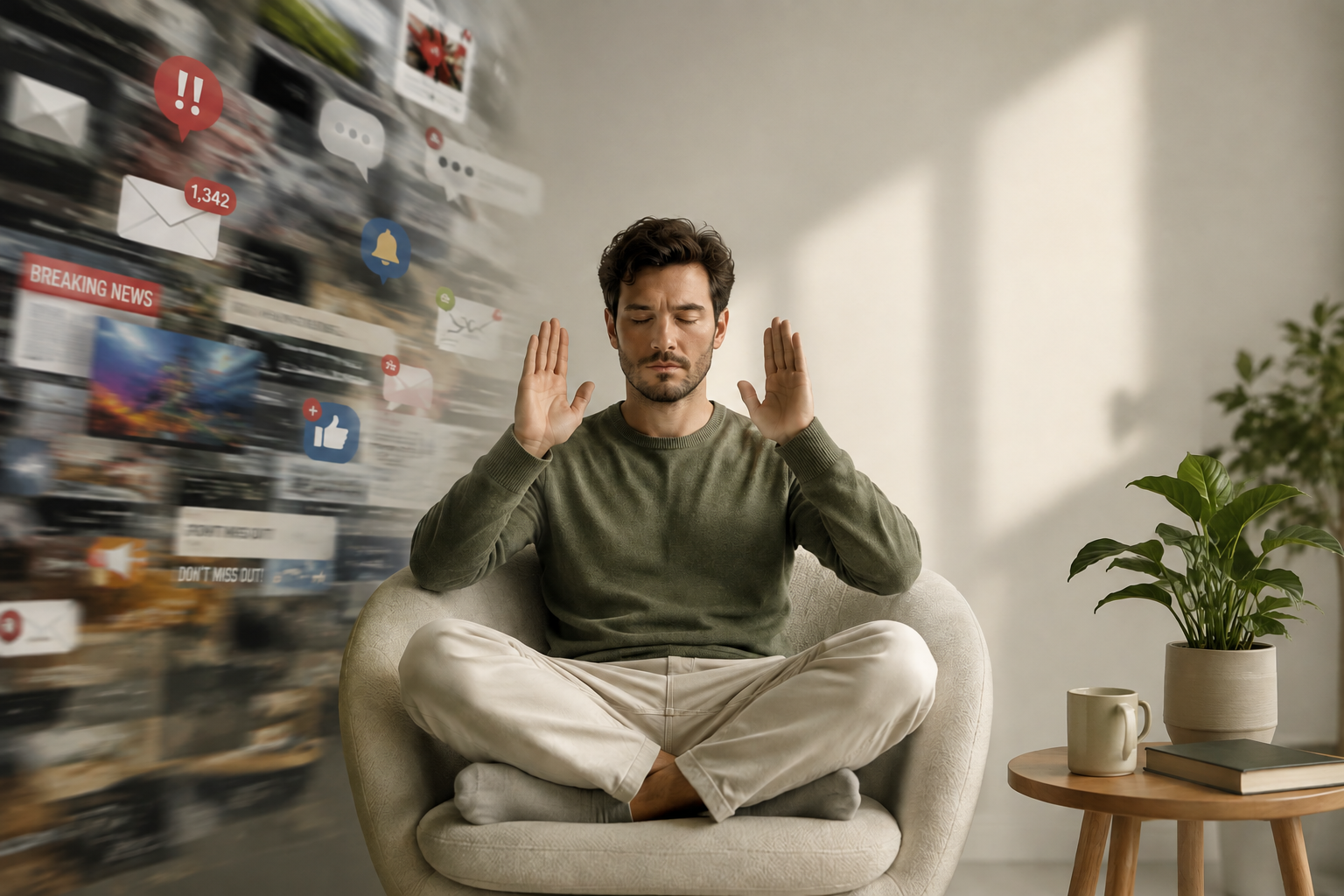
You know the feeling. The kitchen is loud, a notification buzzes, someone asks you a question, and suddenly your skin feels two sizes too small. Nothing dramatic happened. Your brain just ran out of room.
That’s overstimulation: more input than your nervous system can sort through comfortably. Sound, light, touch, smell, a phone full of unread messages, a head crowded with half-finished thoughts. Any of it can tip you over, and it’s usually the pile-up that does it rather than one single thing. Your heart speeds up, your patience drains away, and there’s a strange urge to leave the room, the party or the conversation right now.
The reassuring part is that this is common and it’s manageable. Some people feel it more than others. A 2014 fMRI study by Bianca Acevedo and colleagues describes sensory processing sensitivity, a trait found in roughly 20 percent of people, as a stronger response to what’s going on around you. Everyone else still gets overloaded. They just hit the wall a little later.
Below are 14 ways to turn the volume down, some for the moment it’s happening and some for the long game. You don’t need all of them. Pick two or three that fit your life and ignore the rest. And if your overload is mostly informational, the kind that comes from a news cycle you can’t keep up with, our guide on how to deal with AI anxiety covers one very modern source of it.
1. Leave the room
When you’re flooded, the fastest fix is less input. Not a little less. Much less. Walking out of a loud, bright, crowded space gives your nervous system a chance to stop reacting and start settling, and no amount of willpower does that job while the noise keeps coming.
Where you go matters less than people think. A bathroom stall works. So does a stairwell, a parked car, a quiet corner of the garden. What you want is a place with fewer people, less sound and nobody expecting anything from you for a few minutes. If being alone with your thoughts feels uncomfortable, this guide on how to enjoy being alone can make those few minutes feel less awkward.
Don’t wait until you’re at your limit, either. Leaving at 70 percent is far easier than leaving at 100. Next time, do this: excuse yourself the moment you notice your jaw tightening, and give yourself five minutes somewhere quiet.
2. Turn the noise down
Sound is the sneakiest trigger, because we get used to it. A television murmuring in the next room, a radio in the kitchen, a fridge that hums, a neighbour’s drill. You stop hearing it consciously, but your body keeps paying the bill.
The World Health Organization takes noise seriously enough to have set guideline levels for it. Its 2018 environmental noise guidelines for Europe recommend keeping average road traffic noise below 53 decibels, because exposure above that is linked with adverse health effects. That guideline is about long-term exposure, not a bad afternoon, but it makes a useful point: background noise isn’t neutral.
So take away what you can. Switch off the screen nobody is watching. Close a window that faces the street. If you can’t control the soundscape, earplugs or noise-cancelling headphones do it for you, and nature sounds or soft instrumental music can fill the gap without adding demands. Tonight, walk through your home and switch off every sound source you aren’t actively using.
3. Dim the lights and clear the view
Eyes get tired too. Bright overhead lights, a cluttered desk, three screens, a wall of posters, a shelf of books with loud spines. Each one asks for a sliver of attention, and the slivers add up.
There’s no famous study to hang this one on, so I’ll just say that it matches what many people report: a dim, plain space feels like exhaling. Turn off the main light and use a lamp. Draw the curtains. If you can’t change the room, an eye mask or even a hand over your eyes for sixty seconds gives your vision a rest.
The longer-term version is reducing visual noise where you spend most of your time. A tidier workspace helps, and these tips on how to be more organized at work are a decent place to start. A quick experiment: for ten minutes this evening, sit with only one lamp on and nothing in your hands.
4. Breathe out for longer
Slow breathing is the advice everyone gives, and for once there’s decent evidence behind it. In a 2023 randomized trial in Cell Reports Medicine, Melis Yilmaz Balban and colleagues at Stanford compared three daily five-minute breathing exercises with mindfulness meditation over a month. Breathwork improved mood more than meditation did, and the exhale-focused technique called cyclic sighing was the standout, with the biggest drop in resting breathing rate.
Note what the study did and didn’t test. People practised daily for a month. It didn’t measure what happens when you do it once, mid-meltdown in a supermarket. Still, a longer exhale is a well-known way to nudge the body toward calm, and there’s no downside to trying it.
The version most people use: breathe in through your nose, take a second short sip of air on top, then let it all out slowly through your mouth. That’s one round. Give it a go: do five rounds, and make the exhale last longer than the inhale.
5. Ground yourself with your senses
When everything is rushing at you, the trick is to pick one thing and let the rest recede. Grounding does exactly that. The classic version is five things you can see, four you can touch, three you can hear, two you can smell and one you can taste.
I’ll be straight about the evidence: this particular drill hasn’t been tested much in trials, and the research is stronger for slow breathing and for mindfulness more broadly. But the logic is sound. You can’t ruminate on tomorrow’s deadline while you’re busy noticing the texture of your sleeve. It gives a racing mind a job, and that’s often enough.
Make it concrete. Name the colours in the room. Pick out one sound at a time instead of hearing the lot as a wall. Press your feet into the floor. Your move: next time you feel the swirl, run the five-four-three-two-one list silently, and stop when you feel even slightly steadier.
6. Learn your own triggers
Most advice skips this part. Overstimulation isn’t the same for everyone. One person is wrecked by a restaurant with a loud playlist, another by a day of back-to-back video calls, another by scratchy fabric and a to-do list at the same time. Cleveland Clinic’s advice on sensory overload points out that tracking when it happens is the first step to understanding what sets it off.
So treat it like detective work. After a rough moment, jot down a few lines: where you were, what was going on, how long you’d been there, what you’d eaten and slept. Within a couple of weeks patterns show up, and patterns are fixable. Maybe it’s always the third meeting in a row. Maybe it’s always after a poor night’s sleep.
Naming what you feel also takes some of the sting out of it, which is a core idea in this piece on how to improve emotional intelligence. Start small: for one week, write one line after every overloaded moment, and read the lines back on Sunday.
7. Take a walk, ideally somewhere green
Walking shakes things loose. Walking among trees does something extra. In a well-known 2015 experiment published in PNAS, Gregory Bratman and colleagues at Stanford sent 38 healthy adults on a 90-minute walk, half through a grassy area with oak trees and half along a busy road. Afterwards, the nature walkers reported less rumination, that loop of repetitive negative thinking, and their brain scans showed lower activity in a region linked to it. The roadside walkers saw no such change.
Ninety minutes is a big ask on a Tuesday, and the study was small. It doesn’t tell us that a ten-minute stroll fails, only that the longer one worked. My own reading is simple: green and quiet beats grey and loud, and some time beats none.
You don’t need a forest, either. A park, a tree-lined street, a patch of grass behind the office. Choose the quietest route you can find and leave your headphones at home, or keep them on low with something calm.
8. Put your phone in another room
Phones are small, bright and endlessly interesting, which makes them near-perfect overstimulators. In 2017, Adrian Ward and colleagues reported that simply having your own smartphone on the desk reduced available cognitive capacity, even when it was face down and switched off. It became a famous result.
It also became a contested one. A pre-registered replication by Ana Ruiz Pardo and John Minda, published in 2022, found no difference between phone locations, and the broader evidence is mixed at best. So I wouldn’t promise you a brain boost from banishing your phone. What I’d say is that nobody has ever regretted a quiet hour, and the phone is the easiest thing to remove.
If you catch yourself reaching for it on autopilot, this guide on how to stop doomscrolling has some practical ways to break the habit. Test it this week: for the first hour after you get home, leave the phone in a different room and see how your shoulders feel.
9. Silence the notifications
Even a phone you aren’t touching can talk to you. Cary Stothart, Ainsley Mitchum and Courtney Yehnert (2015) gave people an attention-demanding task and sent them calls and texts they weren’t allowed to answer. Those who got the alerts made more mistakes than a control group. The buzz alone was enough, probably because it set off task-unrelated thoughts and pulled people into mind-wandering.
Think about what that means for a day full of pings. Every one is a tiny interruption you didn’t choose, and your brain has to process it whether or not you pick the phone up.
Most notifications don’t deserve the access they have. Email can wait for set times. Shopping apps, news alerts and group chats you don’t care about can go quiet entirely. If you’d like to take a bigger swing at the problem, there’s a full walkthrough on how to do a dopamine detox properly. Here’s a simple way in: go through your settings once, and keep alerts on only for calls and the three or four people you’d actually want to hear from.
10. Build breaks into the day before you need them
Most of us rest only after we’ve crashed. The smarter move is to schedule it, the way you’d schedule a meeting, so the pressure never climbs that high in the first place.
A 2022 meta-analysis in PLOS ONE by Patricia Albulescu and colleagues pooled 22 studies on micro-breaks of ten minutes or less. The effects were small but consistent: more vigour and less fatigue. Performance didn’t improve across the board, so don’t expect a break to turn you into a machine. Expect to feel a bit less frayed.
What counts as a break? Something that isn’t more input. Stretch. Stare out of a window. Make tea and drink it without a screen in the other hand. If you want to look at the bigger picture of how you divide your day, this article on how to find and maintain a good work-life balance is worth your time. Put a ten-minute gap between meetings tomorrow, even if you have to block it in your calendar as a fake appointment.
11. Do one thing at a time
Switching between tasks feels productive. It rarely is. Every switch makes you reload context, and the more windows you have open, the more your head fills up with the leftovers of each. By mid-afternoon you can feel it as a fuzzy, irritable hum.
Single-tasking is the antidote, and it’s more pleasant than it sounds. Choose one thing. Close the other tabs. Put a note beside you for stray thoughts so you can park them without acting on them. When you work this way, you may find yourself drifting into the absorbed state described in this guide to entering the flow state, which is about as far from overstimulation as you can get.
For today: pick the single most important task, set a timer for 25 minutes, and don’t touch anything else until it rings.
12. Check your caffeine
Caffeine is a stimulant. That’s the whole point of it, and it’s also why it can make an already busy nervous system feel worse. Jittery hands, a racing heart and a buzz of anxiety are easy to mistake for overstimulation from the outside world when part of the cause is in your cup.
The US Food and Drug Administration cites 400 milligrams a day as an amount not generally associated with negative effects in most adults, which it puts at roughly two to three 12-ounce cups of coffee. That’s a ceiling for the average person, not a target. Plenty of people feel wired long before they reach it. Energy drinks make that easier than you’d think, since one large can may hold well over half the daily limit.
If you suspect caffeine is part of your problem, cut back slowly. Mayo Clinic notes that quitting abruptly can cause withdrawal symptoms, and that decaf still contains a little caffeine. Next time, do this: swap your afternoon cup for something without caffeine, and keep that change for a week before you decide anything else.
13. Plan around crowds
Crowds hit every sense at once: noise, movement, smells, bodies that brush past you. If you know that’s a trigger, you don’t have to white-knuckle your way through it. You can design around it.
Go to the shop when it’s quiet. Order online or collect curbside when that’s an option. Arrive early to events, find a seat near an exit and agree on a time limit before you walk in. Bring headphones or earplugs and use them without apology. And allow yourself to skip the thing entirely sometimes. Plenty of people feel pressure to attend everything, and this guide on how to deal with FOMO is a good reminder that missing an event costs less than burning out at it.
Nobody’s asking you to avoid people for good. Arriving with some energy left is the goal. Tell whoever you’re with that you may need a breather halfway through, and then take it when you do.
14. Protect your evenings
Tiredness makes everything louder. Healthline’s guide to signs of overstimulation makes this point plainly, comparing it to hunger: when you’re depleted, the same environment feels harder to cope with. A bad night’s sleep followed by a packed day is a recipe for meltdown by five o’clock.
So guard the end of your day. Dim the lights an hour before bed and put screens away earlier than feels natural. Then fill the gap with something slow and analogue, like reading, stretching, a warm bath or a few lines in a notebook. If your evenings tend to dissolve into chores and scrolling, this piece on slowing down and finding balance offers a gentler rhythm.
Before bed tonight, set an alarm for screens-off. Then obey it.
What to do when you slip
You will slip. Everyone does. You’ll snap at someone, cancel plans, cry in a car park, or scroll until midnight after promising yourself you wouldn’t. None of that proves the strategies failed. You have a nervous system, and nervous systems have limits.
When it does, cut the input, and quickly. Leave the room, put the phone down, drop your shoulders, breathe out. Drink some water and eat something if it’s been a while. Don’t try to analyse what went wrong while you’re still raw, because your brain isn’t in a fair mood.
Later, when you’ve calmed down, apologise briefly if you need to, then go back to your trigger notes and add a line. What was the situation? What would have helped? That’s all the post-mortem you need. A rough day is also easier to shake off with a few small rituals, and this guide on how to get over a bad day has fourteen of them.
One more thing. If overstimulation is frequent, intense or getting in the way of work, relationships or sleep, talk to a doctor or therapist. It can be linked to conditions such as anxiety, ADHD, autism or sensory processing differences, and a professional can help you work out what’s behind it. Asking for help is a sensible way to get answers.
Where to go from here
Overstimulation says nothing bad about your character. It’s a signal that your senses and your mind have taken in more than they can handle, and the fix usually involves taking something away.
You don’t need to overhaul your life this week. Choose one tip from this list, the one that made you think “oh, that’s me”, and try it for seven days. Then add another if you feel like it.
If you want more ideas like these, browse our Self Improvement section for guides on stress, focus and habits that stick. And tomorrow, when the room starts to get loud, remember that you’re allowed to step out of it.