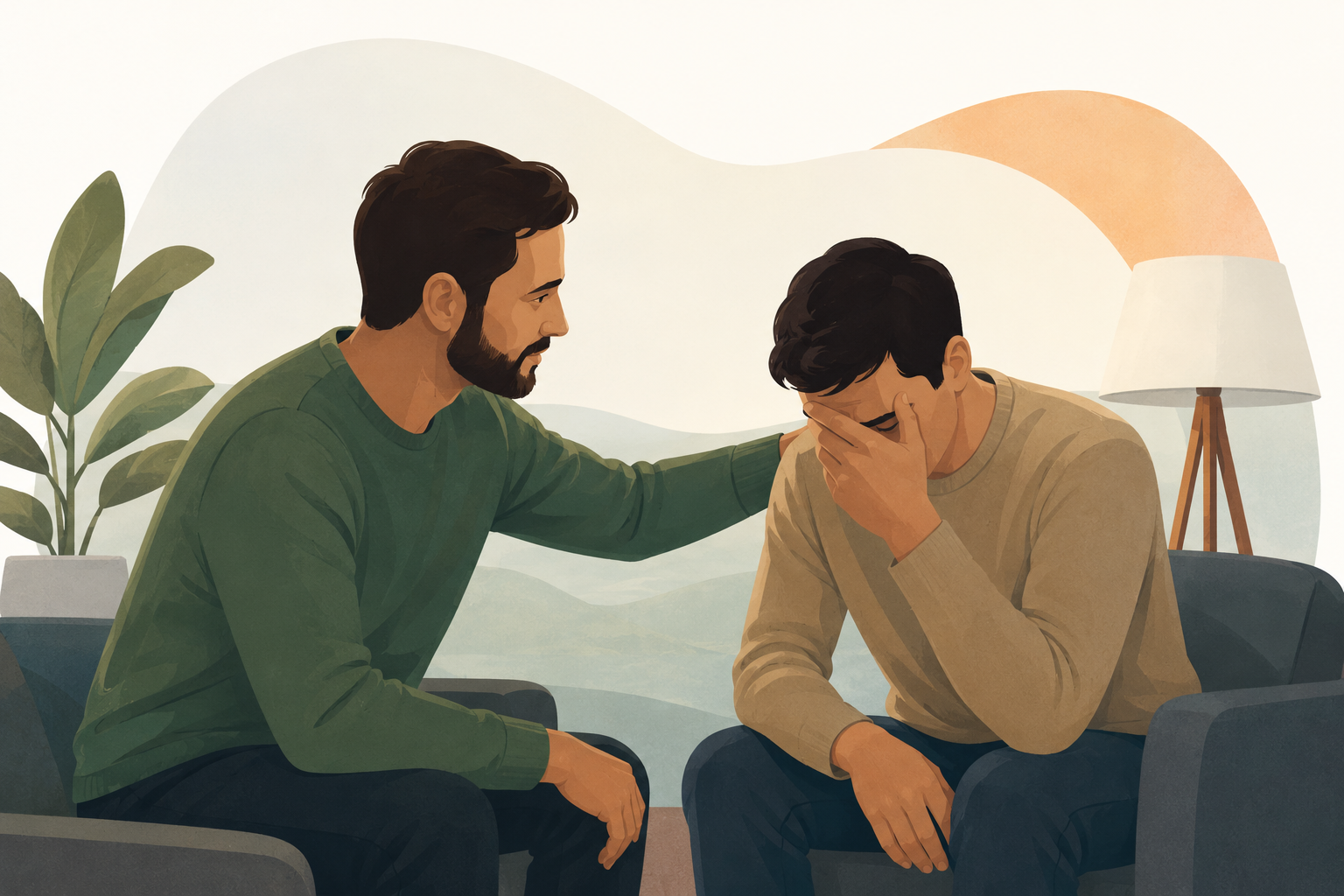
If you want to know how to show empathy to someone, you’ll love this article.
Most of us think we’re pretty good at empathy. We nod in the right places. We say “that sounds hard.” Then the other person walks away feeling, at best, politely processed.
Empathy isn’t a personality trait you either got or didn’t. It’s a set of small, visible behaviours, and the person in front of you only ever experiences the behaviour. Your good intentions stay invisible unless something you do carries them across.
There’s also some evidence that we’ve collectively gotten rustier at it. When Sara Konrath and her colleagues at the University of Michigan pooled 72 samples covering 13,737 American college students tested between 1979 and 2009, they found that empathic concern (feeling for other people) had dropped the most of any measure, with perspective taking close behind. The steepest decline came after 2000. Their 2011 paper in Personality and Social Psychology Review can’t tell us why, and it only covers students. Still, it’s a decent nudge to stop assuming this skill looks after itself.
Empathy also sits right at the centre of emotional intelligence, so working on one tends to lift the other. Below are twelve ways to show it, each with the reasoning behind it and something concrete to do.
1. Put your phone out of sight
Not face down. Out of sight.
It sounds trivial, but researchers have measured what a phone on the table does to a conversation. In a field study published in Environment and Behavior, Shalini Misra and her colleagues watched 100 pairs of people talk for ten minutes in cafés around Washington, DC. Some pairs talked about something light, others about the most meaningful events of their past year. An observer simply noted whether anyone placed a phone on the table or held one. Afterwards, people in the phone-free conversations reported higher empathic concern from their partner, about 5.85 on a 7-point scale against 5.51 when a device was visible. The drop was sharpest between close friends, which is uncomfortable, because those are exactly the conversations where it matters most.
To be fair to the phone, Misra’s 2014 iPhone-effect study was observational and the effects were modest. Maybe less engaged people reach for their phones more. Either way, removing it costs you nothing. If you find the pull hard to resist, it may be worth looking at how to stop doomscrolling more generally.
Give it a go: the next time someone says “can I talk to you about something?”, put the phone in a bag or another room before you answer.
2. Listen to understand, not to fix
When someone tells you about a problem, a little engine starts up in your head. Solutions, advice, that thing that happened to your cousin. Switch it off.
Guy Itzchakov of Ono Academic College and Avraham Kluger of the Hebrew University of Jerusalem have spent years studying what good listening does to the speaker. Writing in Harvard Business Review in 2018, they described lab and field experiments in which people paired with an attentive listener felt less anxious, became more self-aware and spoke about their situation with more nuance. In one study, people talking about their leadership skills to a good listener were more willing to look at their weaknesses as well as their strengths. Their practical advice for managers was blunt: hold back the feedback, ask constructive questions, and resist judging or handing over solutions.
That last part is hard. Advice feels like help. Often, though, it lands as “I’ve heard enough, here’s the answer.”
Picture this: a friend says her manager has been ignoring her ideas. You could reply, “You should email HR.” Or you could say, “That sounds really deflating. What happened this time?” The first answer ends the conversation. The second keeps it going, and she’ll probably get to her own solution faster. If you want to build the wider skill, our guide on how to have a good conversation with anyone goes deeper.
Next time, do this: before offering any advice, ask, “Do you want ideas, or do you mostly want to vent?” Then do whichever they pick.
3. Name the feeling you’re hearing
People often describe events while the real story is in the emotion underneath. Your job is to gently put a word on it. “That sounds frustrating.” “You seem pretty anxious about Monday.”
There’s a neat piece of brain research behind why words help. In 2007, Matthew Lieberman and colleagues at UCLA scanned 30 adults while they looked at photos of emotional faces. When people picked an emotion word for the face, like “angry” or “scared,” activity in the amygdala, the brain’s alarm system, went down. Picking a name for the face had no such effect. Labelling also lit up the right ventrolateral prefrontal cortex, an area linked to putting experiences into words, which seemed to act a bit like a brake. The study, published in Psychological Science, looked at people labelling photos rather than talking to a friend, so treat it as a clue rather than proof. Still, it fits what therapists have seen for decades: a feeling named is easier to hold.
You don’t have to be right, by the way. If you say “you sound angry” and they say “no, more like embarrassed,” you’ve still helped, because now they’ve named it themselves. So guess out loud and let them correct you.
4. Ask the second question
The first question is easy. “How was the trip?” Anyone can ask it. The second one is where empathy shows: “You said the meeting with your brother was tense. What happened?”
A 2017 paper in the Journal of Personality and Social Psychology by Karen Huang, Alison Wood Brooks, Francesca Gino and colleagues at Harvard put numbers on this. In one study, 430 people chatted online for 15 minutes. One partner in each pair was told to ask at least nine questions, the other to ask no more than four. The heavy questioners came across as more responsive and more likeable. When the team analysed the conversations with language software, follow-up questions turned out to be the type most likely to raise liking, because they prove you were actually listening. One interesting wrinkle: outside observers reading the transcripts didn’t like the question-askers more. The effect belonged to the person being asked. That’s empathy in a nutshell. It’s felt by the receiver, not admired from the outside.
The authors also flagged the obvious limit. Rapid-fire or nosy questions can backfire, so this isn’t an interrogation technique. (If small talk itself feels like a struggle, start with how to be good at small talk.)
Your move: in your next real conversation, find one detail the other person mentioned and ask about that, instead of moving on to your own news.
5. Pause before you react
Sometimes empathy is mostly about what you don’t say in the first ten seconds.
On 14 July 1863, a week and a half after the Battle of Gettysburg, Abraham Lincoln sat down and wrote a furious letter to General George Meade. Lee’s army had been trapped by a flooded river, and Meade, in Lincoln’s view, had let it slip away. “Your golden opportunity is gone,” Lincoln wrote, according to the American Battlefield Trust’s record of the draft. Then he put it away. He marked the envelope as never sent and never signed. Writing angry letters and filing them was one of his favourite ways of dealing with frustration. Meade, a general who had just won the war’s biggest battle and already felt criticised, never had to read it.
Lincoln kept the honesty and lost the damage. The mechanism is fairly plain: a strong emotion narrows your attention to your own grievance, and a delay gives you time to remember there’s another person with their own pressures. If your temper tends to flare, it helps to know how to calm your nervous system in the moment.
Start small: when a message makes your jaw tighten, write the reply in your notes app, wait an hour, and reread it before sending anything.
6. Pay attention to the voice
We put a lot of faith in faces. Maybe too much.
In 2017, Michael Kraus of Yale published five experiments with more than 1,800 US participants in American Psychologist. People watched, listened to, or both watched and listened to others interacting, then rated what those people were feeling. Across all five, those who only listened read emotions more accurately than those who could see faces, and even more accurately than those who had both. A computerised voice reading the same words did worst of all, so it’s the human voice carrying the signal, not just the content. Kraus suggested two possible reasons: we’re well practised at masking feelings with our faces, and doing two complex things at once, watching and listening, may weaken both. His summary, as reported in the APA’s write-up of Kraus’s voice-only empathy research, was short: “Listening matters.”
This is good news if your closest people live far away. A phone call can tell you more than you’d think.
A quick experiment: on your next call with someone you care about, stop multitasking and listen only for tone. Is their voice flatter than usual? Faster? Ask about what you hear.
7. Treat empathy as a skill you can grow
If you believe you’re “just not an empathetic person,” you’ll stop trying exactly when it gets hard. The evidence says the belief itself is part of the problem.
In 1996, a former kindergarten teacher named Mary Gordon piloted a programme called Roots of Empathy in two Toronto classrooms. The idea is simple and slightly charming. A local parent brings their baby into a class roughly once a month for a whole school year, and a trained instructor helps the children watch the baby, guess what it’s feeling and talk about why it might be crying. Over 27 sessions, the kids practise reading a person who can’t explain themselves in words. By the 2004-05 school year it was running in 1,141 Canadian classrooms, according to UC Berkeley’s Greater Good Science Center. It also stood up to outside testing. An evaluation led by Schonert-Reichl and colleagues at the University of British Columbia, published in School Mental Health in 2012, found teacher-rated aggression fell among participating children while it rose among children who didn’t take part. A later three-year randomised trial in Northern Ireland, led by Connolly and colleagues and published in 2018, found more helpful behaviour and fewer behaviour problems among 8- and 9-year-olds in the programme.
Adults respond to the same idea. Across seven studies published in 2014 in the Journal of Personality and Social Psychology, Karina Schumann, Jamil Zaki and Carol Dweck found that people who thought empathy could be developed tried harder when it was difficult. They spent longer listening to an emotional story from someone of a different race, and they were more willing to help cancer patients in effortful, face-to-face ways. This is correlational, but it’s consistent across studies.
So drop the “I’m not good at this” line. Treat it like any skill you’re still learning, the way you might build any of the good habits worth having, and notice small improvements.
8. Catch your snap judgments
Labels are efficient. They’re also where empathy goes to die.
On 5 April 1968, the day after Martin Luther King Jr. was assassinated, Jane Elliott walked into her third-grade classroom in Riceville, Iowa, and split her 28 white pupils by eye colour. She told the brown-eyed children they were cleaner and smarter. Blue-eyed children wore paper armbands and had to use paper cups at the water fountain. Within hours, brown-eyed children were belittling their blue-eyed classmates, and a blue-eyed girl who never struggled with multiplication started making mistakes, as Smithsonian magazine later reported. The next day, Elliott reversed the roles. The lesson became famous because it showed how fast a meaningless label turns into contempt, and how much it changes the person being labelled.
It’s worth adding that the exercise is controversial. Some scholars have called it unethical, since the children weren’t told the purpose beforehand, and formal evaluations of its effects have been mixed. It’s a historical demonstration, not a training method to copy.
The everyday version is quieter. “He’s just lazy.” “She’s dramatic.” Each one closes off curiosity before it starts.
Test it this week: whenever you catch yourself summing someone up in one word, add the question “what else might be going on for them?” and come up with at least two possible answers.
9. Read more fiction
Novels are a cheap rehearsal space for other people’s minds. You spend hours inside the head of someone with a different life, and nobody gets hurt when you misread them.
The effect is real but smaller than book lovers like to claim. In 2018, David Dodell-Feder and Diana Tamir published a meta-analysis in the Journal of Experimental Psychology: General, pooling 53 effect sizes from 14 studies. Reading fiction produced a small but statistically significant improvement in social cognition, the ability to understand what others think and feel, compared with reading nonfiction or nothing. The effect size was around g = 0.15. The authors were careful to say we still don’t know whether that lab gain carries over into real relationships.
So fiction won’t turn you into a saint. It’s a gentle, enjoyable workout, and it works best when the characters live very differently from you.
Here’s a simple way in: pick your next novel by an author from a country, generation or background you know little about, and as you read, pause once a chapter to guess what a character is feeling before the text tells you.
10. Show it in what you do, especially if you lead people
Empathy that stays in your head is just private sympathy. People notice it when it changes something: a deadline moved, a meeting skipped, a lift to the hospital.
This matters a lot at work. In a 2021 study, Catalyst researcher Tara Van Bommel surveyed nearly 900 US employees across industries for the report The Power of Empathy in Times of Crisis and Beyond. Among people whose senior leaders were highly empathic, 61% reported being innovative at work, compared with 13% of those with less empathic leaders. Engagement followed the same pattern: 76% versus 32%.
| Outcome | Empathic senior leaders | Less empathic senior leaders |
|---|---|---|
| Employees reporting innovation | 61% | 13% |
| Employees reporting engagement | 76% | 32% |
This was a self-report survey, so it shows a strong link rather than proof that empathy causes the gains. Engaged teams may also rate their bosses more kindly. Still, the gap is big enough to take seriously if you manage anyone, and it lines up with what we’ve written about the qualities of a good boss.
Outside work, the same rule applies. “Let me know if you need anything” sounds kind but puts the work back on the struggling person. Specific offers are easier to accept, and they’re one of the most practical ways to be friendly and kind in a way people remember.
Your move: replace one vague offer this week with a concrete one. “I’m at the shop on Thursday, can I pick up groceries for you?”
11. Practise compassion on purpose
This one might sound a bit soft, but the research is surprisingly hard-nosed.
In 2013, Helen Weng and colleagues at the University of Wisconsin-Madison’s Center for Investigating Healthy Minds gave healthy young adults guided audio sessions, 30 minutes a day for two weeks. One group practised compassion meditation: picturing people who were suffering and wishing them relief. A comparison group learned cognitive reappraisal, a technique for reframing negative thoughts. Afterwards, both groups played an online “redistribution game.” They watched one player give another an unfair split, $1 out of $10, and could spend up to $5 of their own money to even things out. The compassion group spent more. Brain scans also showed changes in regions tied to empathy and emotional control, and the people who changed most in the scanner tended to be the most generous. The findings appeared in Psychological Science. Weng compared the training to the gym: “It’s kind of like weight training.”
Seven hours in total is a small investment. It also comes with a useful bonus, as the next point explains.
Start small: tonight, spend ten minutes sitting quietly, picturing one person who’s having a hard time, and silently wishing them ease. Tomorrow, try it with someone neutral, like a cashier you saw today.
12. Feel for them, without drowning in it
Awkwardly, too much of the wrong kind of empathy can make you worse at helping.
Neuroscientists Tania Singer and Olga Klimecki laid out the mechanism in a 2014 review in Current Biology. When you fully take on someone else’s pain, the response can tip into what they call empathic distress. It feels bad, it’s focused on you, and it makes you want to pull away to protect yourself. Repeat that often enough, as nurses, doctors and carers often do, and it becomes a road to burnout. Compassion works differently. It means caring about the other person’s suffering and wanting to help, without mirroring it in full. In Singer’s training studies, empathy training raised participants’ negative feelings, while compassion training brought those feelings back down and engaged brain systems linked to reward and motivation. So the chain runs: total emotional mirroring, then personal distress, then withdrawal. Compassion breaks that chain at the second link.
Think of it like helping a friend carry a heavy box. You take one end. You don’t climb inside the box with them. The comparison has limits, since emotions don’t split neatly in half like weight, but it captures the stance: close enough to share the load, steady enough to keep walking.
That also means protecting yourself when “empathy” is being used against you. Caring about someone doesn’t oblige you to accept their version of events when it isn’t true, which is worth remembering if you ever need to respond to gaslighting. And if a heavy conversation leaves you buzzing and frazzled, take time to calm overstimulation before you go back in. When you notice you’re getting swept up in someone else’s feelings, shift your inner question from “how bad does this feel?” to “what would actually help them right now?”
What to do when you slip
You will get this wrong. You’ll check your phone mid-story, interrupt with advice, or snap at someone who was clearly having a worse day than you. Everybody does.
What matters is the next move. Most people either beat themselves up or brush it off. Kelly McGonigal, a health psychologist at Stanford, argued in a 2012 Psychology Today piece that self-criticism is the weaker motivator of the two, summing it up as self-compassion beating self-criticism “any day, and in every way.” She was drawing on research by Juliana Breines and Serena Chen at UC Berkeley, published that year in Personality and Social Psychology Bulletin. Across four experiments, people who spent a few minutes writing to themselves kindly about a failing were more motivated to make amends for a recent wrongdoing, more likely to see a weakness as fixable, and willing to study longer after failing a hard test. Being gentle with yourself didn’t make people complacent. It made them braver about facing what they’d done.
That’s especially relevant here, because repairing a lapse in empathy means going back to the other person, and shame makes that much harder. If your inner voice gets harsh after mistakes, our piece on how to stop hating yourself might help.
When it happens, do this: go back within a day and say something like, “I wasn’t really listening when you told me about your mum. I’m sorry. Can you tell me again?” Then put the phone away and listen.
Conclusion
Empathy shows up in small, unglamorous moments. A phone left in a bag. A second question. A pause before a sharp reply. None of it needs a special personality, and the research fairly consistently suggests it gets easier with practice.
You don’t need to try all twelve at once. Pick one, maybe the one that made you wince a little, and use it in your next real conversation. For more ways to build closer, steadier connections with the people around you, browse our Relationships section.