
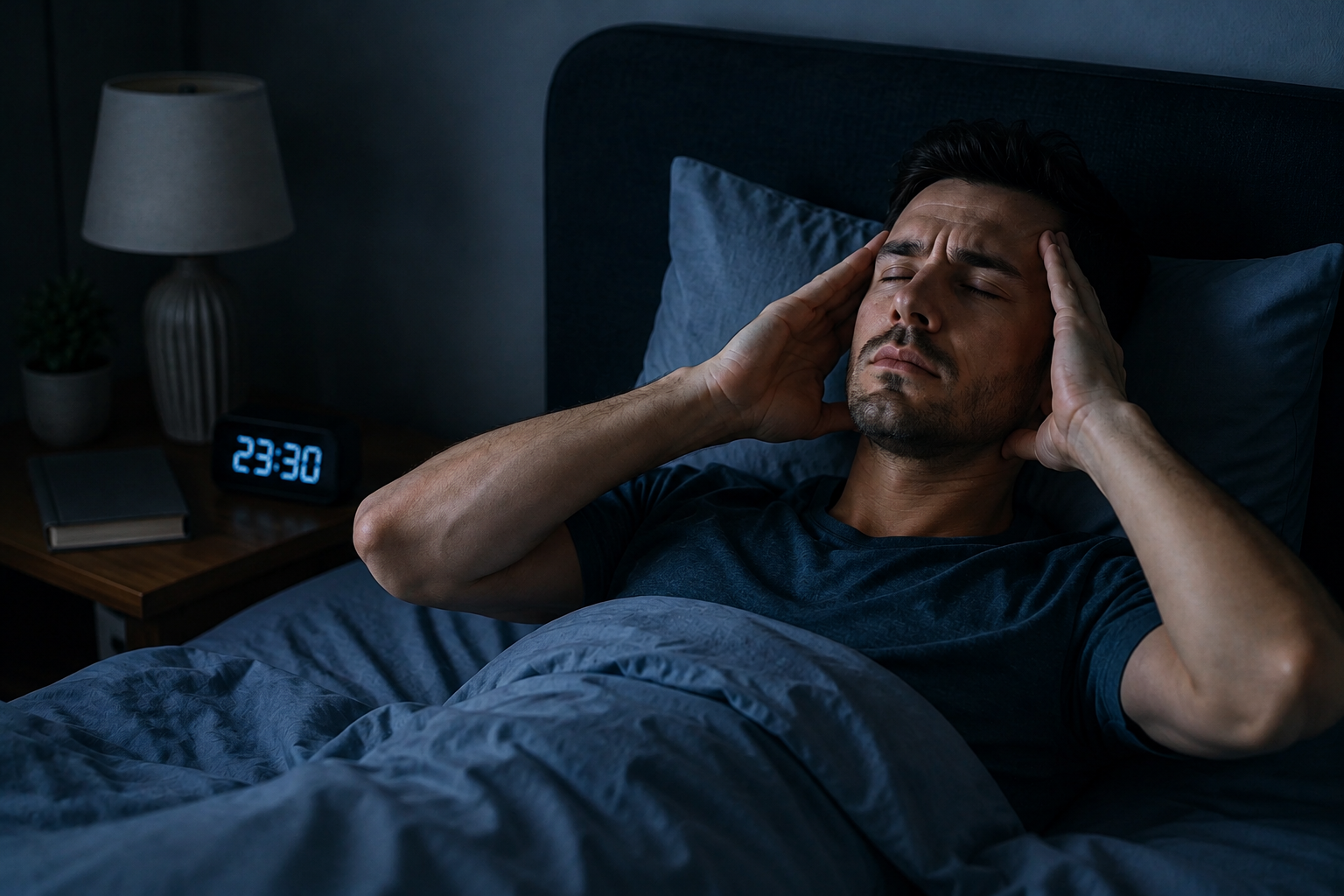
If you want to know how to get to sleep faster, you’ll love this article.
You climb into bed at a reasonable hour. Lights off, phone down, day over. Then your brain pulls up an awkward email from Tuesday and starts editing it.
Twenty minutes pass. Then forty. By the time you glance at the clock you’re doing arithmetic, working out how many hours you’ll get if you drop off right now.
It happens to nearly everyone sometimes. The Sleep Foundation puts a typical fall-asleep time at around 15 to 20 minutes, so one slow night is no crisis. Nor is under ten minutes a trophy, since that can hint at a sleep debt. A slow week is another matter. The day after a bad night is harder in most ways, and your memory usually notices.
This list sticks to methods that have been tested in studies, clinical guidelines or both, and skips the folklore. Some work within minutes. Others reshape your evenings over a couple of weeks. One warning before we start: many of these studies are small, and plenty of them used healthy volunteers rather than people with insomnia. Read the numbers as rough guides, not promises.
You won’t need all fifteen. Pick the ones that fit your evenings and ignore the rest.
1. Cool the room down
Falling asleep goes hand in hand with a drop in core body temperature, and a stuffy bedroom works against that drop. Okamoto-Mizuno and Mizuno, reviewing the research in 2012, described the thermal environment as one of the biggest influences on how people sleep.
Most recommendations for adults land between 15.6 and 19.4°C (60 to 67°F), according to the Sleep Foundation, which is quick to add that no single number suits everyone. That’s cooler than most people keep their bedroom.
Light and sound are the other two levers. For light, the Sleep Foundation suggests blackout curtains or a sleep mask. For noise you can’t control, it points to earplugs or a white noise machine. Bedding made from breathable fabrics such as cotton can also help you stay at a comfortable temperature through the night. None of it is glamorous. All of it is cheap to test, which matters when you’re not sure a change will pay off.
Start small: lower the thermostat by a degree or two tonight and crack a window. If you tend to wake up damp, the heavy duvet can go. And if the room is already chilly, don’t chase the range. Comfort beats the chart.
2. Dim the lights and park the bright screen
Does light from a screen matter that much? In one lab experiment, it did. Chang and colleagues (2015) had 12 healthy adults spend five evenings reading on a light-emitting tablet and five reading a printed book, for about four hours each night before bed. After tablet evenings, people took nearly ten minutes longer to fall asleep, made less melatonin, and their body clocks shifted later.
Four hours is a lot of screen, and most of us scroll for less. Still, the direction of the effect is clear enough that the Sleep Foundation suggests putting devices away 30 to 60 minutes before bed. If setting the phone down feels harder than it should, a structured dopamine detox is one way to reset the habit.
Dim the main lights about an hour before bed and switch to lamps. The last stretch of the evening can belong to a paper book or a podcast.
3. Take the clock and the feed out of bed
The clock is a worry machine.
Tang, Schmidt and Harvey (2007) ran two experiments on clock monitoring. In the first, people who checked the time while trying to sleep reported more pre-sleep worry and took longer to fall asleep, and that held for good and poor sleepers alike. In the second, 38 people with primary insomnia watched either a clock or a neutral digital display as they tried to sleep. The clock-watchers worried more and reported slower sleep onset than on their baseline night.
The phone is the clock’s accomplice. One more video, one more headline, and midnight arrives again. That pull toward doomscrolling at bedtime often has a cousin in procrastination: the day belonged to everyone else, so the night gets raided for free time. Some people call it revenge bedtime procrastination. The label is funny and the cost is real.
If the phone is also your alarm and you can’t bear to part with it, switch on airplane mode and leave it face down, out of arm’s reach. Reaching for it should take effort.
Your move: charge the phone across the room, turn the clock face to the wall, and if you want a firmer fix, buy a plain alarm clock that does nothing else.
4. Take a warm bath or shower, and time it
A 2019 meta-analysis by Haghayegh and colleagues at the University of Texas at Austin pooled 17 studies, drawn from more than 5,300 screened, and landed on a surprisingly specific recipe. Water around 40 to 42.5°C (104 to 109°F), roughly one to two hours before bed. On average, people fell asleep about ten minutes faster.
The mechanism looks backwards at first. Hot water pulls blood toward your skin, and once you step out you shed heat quickly, which mimics the cooling your body does anyway as night approaches. A bath taken too close to bedtime leaves you still warm. The researchers noted that fifteen minutes before bed was too soon, and that about ten minutes in the water was enough. The twenty-minute soak right before lights-out you may have read about isn’t what the evidence supports.
It’s also a decent excuse to slow the evening down. If you’d like more of that pace, the blog has a piece on the slow life approach.
Test it this week: three evenings, a bath or shower about 90 minutes before lights-out, comfortably hot but not scalding. Jot down roughly how long you lie awake each night.
5. Warm your feet
This sounds like grandmother advice, yet it has a sleep-lab pedigree. Kräuchi and colleagues reported in Nature in 1999 that the widening of blood vessels in the hands and feet, which lets heat escape from the extremities, was the best physiological predictor of how quickly volunteers fell asleep.
Odd as it seems, warm feet don’t make you hotter overall. They signal that blood is flowing out to the edges of your body, where heat can leave, and that outflow is part of how your core temperature drifts down toward sleep.
Read the fine print, though. That study found a link. It didn’t prove that socks work, and a small 2006 trial with 11 people found that warming the hands and feet before a sleep attempt made no difference to sleep latency. So bed socks are cheap, harmless and unproven. Thin cotton or wool pairs tonight, and off they come if you get too warm.
6. Write tomorrow’s to-do list
Few things wake a brain up like an unfinished task at 11 p.m.
Scullin and colleagues (2018, Baylor University) tested a fix in a sleep lab with 57 university students. Before lights-out, half spent five minutes writing a to-do list for the next few days, and the other half listed what they’d already done. The to-do group fell asleep about nine minutes sooner, according to press coverage of the study. The more specific the list, the faster sleep came. The completed-tasks list showed the opposite pattern: more detail, slower sleep.
Here’s the limit. Participants were healthy young adults, and the researchers themselves said they couldn’t know how well the result carries over to people with insomnia. If the list keeps growing because work leaks into every evening, that’s a boundary problem as much as a sleep one, and this guide to work-life balance is a good place to start.
A quick experiment: tonight, spend five minutes at the kitchen table, not in bed. Write every unfinished thing with enough detail that tomorrow-you could act on it. “Send the invoice to the client” works. “Admin” doesn’t.
7. Move the last coffee earlier
The afternoon coffee feels harmless, and that’s part of the problem. In a 2013 study from Henry Ford Hospital and Wayne State University, published in the Journal of Clinical Sleep Medicine, Drake’s team gave 12 healthy sleepers 400 mg of caffeine, about two to three cups of coffee, at bedtime, three hours before, or six hours before, and compared each against a placebo. Even the six-hour dose cut total sleep time by more than an hour on a home monitor. Participants didn’t notice, which is the unsettling part.
The study measured how long people slept, not how fast they dropped off, and 400 mg is a big dose. Even so, the American Academy of Sleep Medicine’s release on the findings suggested skipping caffeine after about 5 p.m. for a typical bedtime. Sensitive to caffeine? Go earlier.
Next time, do this: count back six hours from your usual bedtime, stick that time on a note by the kettle, and switch to decaf or herbal tea after it.
8. Be suspicious of the nightcap
Alcohol is a trickster. It really does make you drowsy, which is exactly why people trust it.
A 2013 review led by Ebrahim, covering sleep-lab studies of healthy people, found that alcohol at any dose shortens the time to fall asleep and increases deep sleep early in the night. Then comes the bill. Sleep gets more disrupted in the second half, the first REM period is delayed, and moderate to high amounts reduce REM sleep overall. Ebrahim has also warned that alcohol suppresses breathing and can bring on sleep apnea.
So a drink can speed up the first twenty minutes and still leave you wrecked at 7 a.m. In press coverage of the review, Ebrahim advised leaving an hour and a half to two hours between the last drink and bedtime if you do drink. Treat the thought “it helps me sleep” with the suspicion it deserves.
9. Exercise, and relax about the evening workout
For years the standard advice said to stop exercising several hours before bed. Stutz, Eiholzer and Spengler (2019, Sports Medicine) at ETH Zurich pooled 23 studies of single evening workouts in healthy adults and found no harm to sleep on average. If anything, evening exercise nudged deep sleep up slightly.
One exception stood out. Vigorous exercise that ends within an hour of bedtime may delay sleep, though Spengler stressed that this rests on a single study. Her rule of thumb: vigorous means you can’t talk while doing it, and moderate means you could talk but not sing. She also noted that exercise during the day is known to improve sleep quality.
Give it a go: a brisk 20 to 30 minute walk after dinner, with the sweaty intervals saved for earlier in the day.
10. Wake up at the same time every day
Bedtime is hard to control. Wake-up time isn’t.
The Sleep Foundation recommends a consistent sleep and wake schedule, weekends included, because regular timing helps keep your body clock steady. Sleeping in on Saturday feels like a reward, but it shifts the very clock you’re trying to steady. A fixed wake time also makes you sleepier at night by the simple fact that you’ve been up for the same stretch of hours.
Naps count too. The Sleep Foundation suggests keeping them to 20 or 30 minutes and steering clear of the late afternoon and evening. A long nap at five o’clock takes the edge off the sleepiness you were counting on at eleven.
Treat the alarm as a promise to yourself. Keeping a promise is mostly about making it small and specific, which suits this habit perfectly. It’s also one of those good habits that quietly props up everything else on this list.
Here’s a simple way in: pick a wake time you can hold on all seven days, set it in your phone, and move it 15 minutes at a time if you’re starting far from it.
11. Let your muscles go, one group at a time
People who struggle to fall asleep often show physical signs of tension, such as tight muscles, a higher temperature and a faster heartbeat, according to the Sleep Foundation. Progressive muscle relaxation goes straight at that tension. You tense one muscle group for about ten seconds, release it, breathe out, and move to the next.
Lie down, close your eyes, and start with your feet. Squeeze, hold, let go. Then calves, thighs, stomach, hands, shoulders, jaw. Some people prefer to work from the face downward, and the direction matters less than finishing the sweep. Skip any area that hurts. If you lose track halfway through, you haven’t failed. You may be falling asleep.
It helps to rehearse the sequence once in daylight, sitting in a chair. The order becomes familiar, and at midnight you won’t have to think about what comes next.
12. Give your mind a movie to watch
Counting sheep has a bad reputation, and Oxford researchers helped earn it.
Harvey and Payne (2002, Behaviour Research and Therapy) asked people with insomnia to try different mental strategies on different nights. On nights when they pictured a relaxing scene, such as a beach or a waterfall, they fell asleep more than 20 minutes sooner than on nights with no technique, according to reports at the time. Counting sheep didn’t help. Harvey’s explanation was that it’s too mundane to keep worries away. She also reported that deliberately trying to suppress thoughts made things worse, adding around ten minutes.
The lesson is to occupy your mind with something more absorbing than counting and gentler than your to-do list. If the worries are the unanswerable kind, like what happens at work next quarter, parking them in a mental scene beats wrestling them. The daytime version of that skill is dealing with uncertainty.
One caution: pick a scene that’s calm rather than thrilling. A dream holiday can get you excited, which is the opposite of the job.
Tonight’s plan: choose a place you know well. Walk through it slowly. What’s the temperature, what can you hear, what’s under your feet? When thoughts about tomorrow barge in, notice them and step back into the scene without grading how it’s going.
13. Slow your breathing
The evidence is thinner here than for most items on this list, so I’ll say so plainly.
The Sleep Foundation describes the 4-7-8 technique: breathe in quietly through your nose for four seconds, hold for seven, breathe out slowly through your mouth for eight, and repeat three or four times. The deliberate pacing is meant to slow your heart rate and quiet your mind, and the Sleep Foundation lists it as a two-to-five-minute option for anxious nights. I found no strong trial showing that those exact counts matter, so treat them as a template rather than a prescription. If holding your breath makes you anxious, skip the hold and just make each out-breath longer than the in-breath. Run a few rounds, and stop if counting starts to feel like a test.
14. Get out of bed when sleep isn’t coming
It feels wrong. You’re tired, the bed is warm, and getting up seems like admitting defeat. But lying there fighting sleep teaches your brain that bed is the place where you stay awake and stew.
Stimulus control, developed by Richard Bootzin, reverses that lesson. The core rules are simple. Go to bed only when you’re sleepy, use the bed for sleep and sex, and if you haven’t fallen asleep after roughly 10 to 20 minutes, leave the bed and the bedroom until you feel drowsy again. It’s one component of cognitive behavioral therapy for insomnia, which the American College of Physicians recommended in 2016 (Qaseem and colleagues) as the first treatment for chronic insomnia in adults.
You don’t need to time yourself to the minute, and given what clock-watching does, you shouldn’t. Go to a dim room and do something quiet and a little dull. The Sleep Foundation suggests reading, deep breathing or gentle stretching, and it says to avoid screens and bright light. Anything bright tells your body clock it’s daytime.
Set a rule: when you think you’ve been awake for about twenty minutes, get up, keep the lights low, and come back only when your eyelids get heavy. Repeat as often as it takes.
15. Treat melatonin as a small nudge
Melatonin is the best-known sleep supplement and one of the most oversold. Ferracioli-Oda, Qawasmi and Bloch (2013, PLoS ONE) pooled 19 trials. Together they covered 1,683 people with primary sleep disorders. Compared with placebo, melatonin cut the time to fall asleep by about seven minutes and added roughly eight minutes of sleep. The authors called the effects modest, and they are.
Quality is the second problem. In a 2023 JAMA analysis, Cohen and colleagues tested 25 melatonin gummies sold in the United States. Only three contained an amount within 10 percent of the label. Measured doses ran from 74 to 347 percent of what was printed, and one product had no melatonin at all. Each product was tested from a single bottle, so batch-to-batch variation is unknown, but the result is hard to shrug off.
If you want to try it, talk to a pharmacist or doctor first about dose and timing, especially if you take other medication, and ask which brands are independently tested.
What to do when you slip
Sooner or later you’ll do it all wrong. Coffee at four, an argument at ten, a scroll that swallowed an hour, and then three hours of staring at the ceiling.
One bad night doesn’t undo a routine. The real damage comes from turning it into a verdict about yourself. Keep your wake time the next morning, even though every cell in your body wants a lie-in. Skip the extra coffee after lunch. Then be a little kind to yourself, because tired people are harsh judges. If the day is already going sideways, these steps for turning a bad day around fit the situation, and so does the habit of thinking positively about tomorrow’s attempt.
Write a small script now, while you’re rested, because 3 a.m. is a terrible time to make decisions. Something like this: if I’m still awake after about twenty minutes, I get up, keep the lights low, read something dull on paper, and go back when I’m sleepy. No phone. No clock. Having the plan already made takes away the argument with yourself.
At 3 a.m., you don’t have to win. The Sleep Foundation describes a technique called paradoxical intention: you lie with your eyes open and calmly tell yourself you’re not going to fall asleep, which removes the pressure of trying. Treat it as an experiment, not a guarantee.
Know when to stop experimenting. If trouble falling asleep keeps showing up for several weeks, or you snore loudly, gasp at night or feel an urge to move your legs when you lie down, talk to a doctor. The Sleep Foundation lists sleep apnea and restless legs syndrome among the medical problems that can get in the way, and neither responds to a cooler bedroom.
Start with two
Choose two ideas from this list and run them for a week. Make them small. A warm shower and a written to-do list is a perfectly respectable start. Note how long you lie awake each night, even roughly, and keep what moves the number.
Some fixes will do nothing for you. That’s normal, and it’s useful information. For more routines worth building, browse the Self Improvement section.