
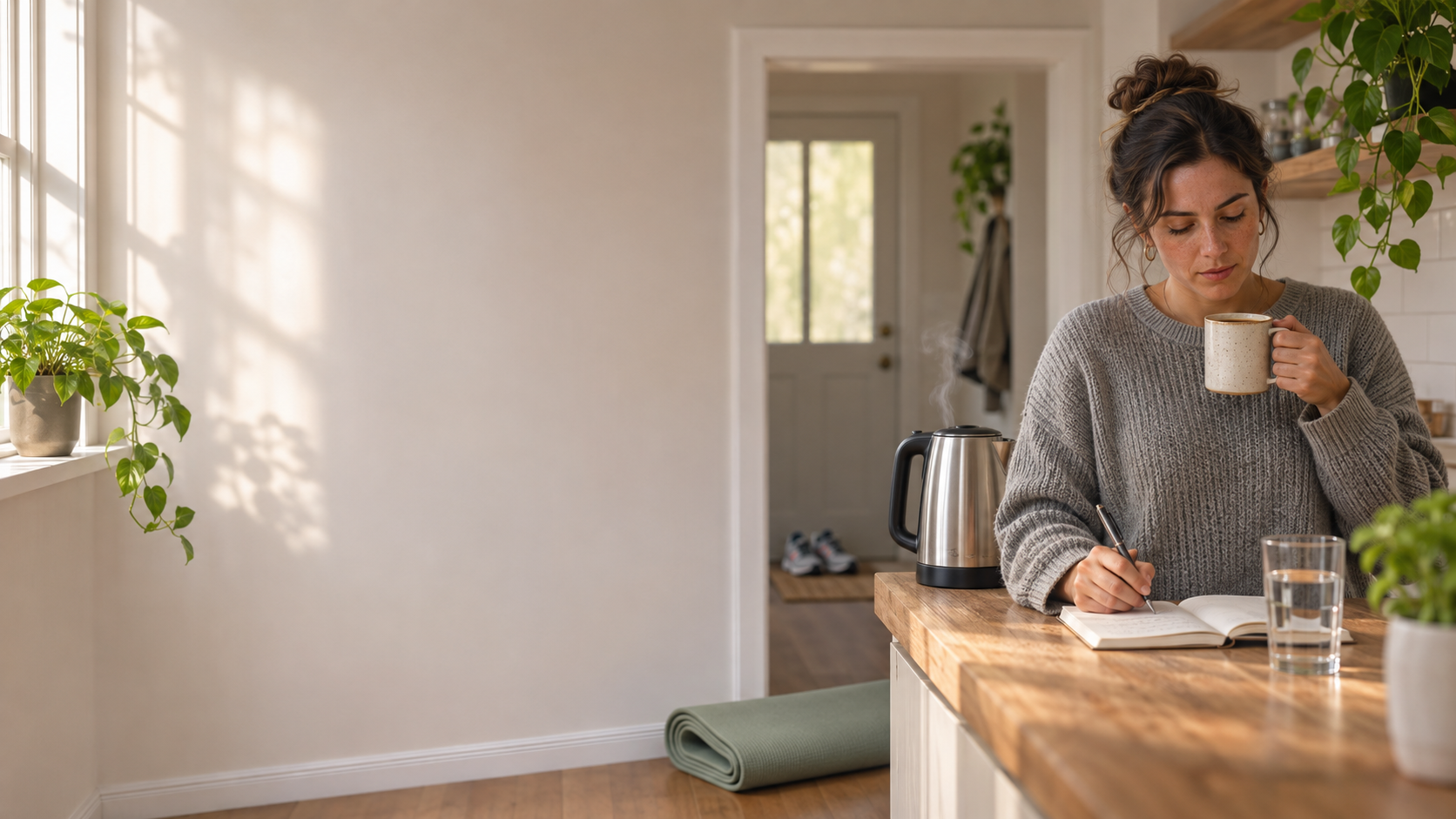
You already have dozens of habits. You brush your teeth without deciding to. You put the kettle on, lock the door, plug in your phone. None of it takes willpower, and that’s the whole point of habit stacking: you take something you already do on autopilot and hang a new behaviour on it.
The formula most people use comes from James Clear’s Atomic Habits: “After [current habit], I will [new habit].” The term itself goes back to S.J. Scott’s 2014 book on small daily changes. Simple enough. The harder part is choosing stacks that actually stick, which is what this list is for.
A word of honesty before we start. Katy Milkman, a behavioural scientist at the Wharton School, told The Washington Post in April 2026 that for all its popularity, habit stacking itself has hardly been studied. What has been studied is the machinery underneath it: cues, repetition, if-then planning and the behaviours you’d want to stack. So every example below is built on research about that machinery, or about the habit itself. Where the evidence is thin, I’ll say so.
One more thing to know. New habits take longer than the “21 days” you’ve probably heard. A 2024 systematic review by Ben Singh and colleagues in Healthcare pooled 20 studies with 2,601 adults and found median times of 59 to 66 days to reach automaticity, with individual times ranging from 4 to 335 days. Plan for months, not weeks. If you want a broader menu of what’s worth building first, our guide to good habits to have is a decent place to browse.
Here are 31 stacks, roughly in the order your day unfolds.
1. Floss one tooth after you brush
This is the example that comes up whenever experts discuss stacking, because it’s one of the very few direct tests of it. In a 2013 study in the British Journal of Health Psychology, Gaby Judah, Benjamin Gardner and Robert Aunger asked 50 people to start flossing. Half were told to floss before brushing, half after. Those who flossed after brushing built stronger habits, and at the eight-month follow-up they still flossed more often.
Fifty people is a small sample, and Milkman makes exactly that point: it’s encouraging, not conclusive. Still, the logic holds. Brushing is a rock-solid cue, and finishing it naturally hands off to the next step.
Start small: one tooth. Once the floss is in your hand, you’ll usually do the rest.
2. Stretch for one minute after you switch off your alarm
The American Heart Association lists this exact pairing in its habit-stacking guidance (reviewed September 2025): turn off the alarm, then stretch your arms, legs, ankles and feet. It’s cheap, it’s quick, and the cue fires every single morning.
There’s a hint that mornings help, too. Singh’s review describes a stretching study in which participants who stretched in the morning reached automaticity in a mean of 106 days, against 154 days for evening stretchers. That’s one study, so don’t treat it as a law. But if you’ve got a choice of slot, morning seems the safer bet.
Leave a yoga mat or a folded towel by the bed tonight so the first thing your feet touch is the reminder.
3. Write one line of gratitude with your first sip of coffee
Gratitude journaling sounds soft until you look at the size of the evidence base. In July 2025, Hyewon Choi and colleagues published a preregistered meta-analysis in PNAS covering 145 papers, 163 samples and 24,804 people in 28 countries. Gratitude practices raised well-being on average, mostly by lifting positive emotion rather than cutting negative feelings.
The country picture was messier. According to a Psychology Today summary of the paper, benefits showed up in the United States, China, Germany, Canada and Australia but not clearly in France, India, Japan, the Netherlands or the UK. The authors argue there’s no one-size-fits-all version.
Picture this: the kettle clicks off, you pour, and before the first sip you write a single line in a notebook that lives next to the mug. Nothing poetic. “The bus was on time.” That’s enough.
Give it a go: keep the notebook and pen physically touching your coffee things, so you can’t make coffee without seeing them.
4. Take your medication while the kettle boils
Here’s the mechanism. A habit forms when the same cue and the same action keep showing up together. Tie your pill to “sometime in the morning” and the cue is vague. The timing drifts. Tie it to the kettle and the cue becomes precise, so the timing stops wandering, and consistent timing is what habit looks like from the outside.
A 2025 study in the Interactive Journal of Medical Research by Antoine Pironet, L. Alison Phillips and Bernard Vrijens tested this with electronic pill-bottle data from 15,818 people in clinical studies. Lower day-to-day variability in when people took their medication was linked to better adherence. That’s correlation, not proof. And a separate 2025 experiment by Caitlin Liddelow and colleagues found that simply linking the contraceptive pill to a daily cue didn’t substantially improve adherence among women who already took it.
So this helps most when you’re starting a new medication or keep forgetting one. Check with your pharmacist or doctor before you shift the time you take anything.
5. Walk the first two minutes briskly after you lock the front door
You don’t need a gym to get vigorous activity. A 2024 study in the British Journal of Sports Medicine led by Emmanuel Stamatakis tracked 22,368 UK Biobank participants who said they did no structured exercise. Women who averaged just 3.4 minutes a day of short, intense bursts (think hurrying for a bus or carrying heavy shopping) had a 45% lower risk of major cardiovascular events, a 51% lower risk of heart attack and a 67% lower risk of heart failure than women who did none. Men saw smaller benefits.
It’s observational, so fitter people may simply move faster. Stamatakis himself suggested these bursts could be a stepping stone toward a regular exercise habit.
Next time, do this: turn the key, then walk as if you’re slightly late for the first two minutes, wherever you’re going.
6. Take the stairs every time you see them
Sophie Paddock, an interventional cardiologist at the University of East Anglia, kept her advice blunt when her team presented their findings to the European Society of Cardiology in April 2024: given a choice between the stairs and the lift, take the stairs. She added that even brief bursts of activity have health benefits, which makes stair climbing a realistic daily target.
Their analysis pooled nine studies with 480,479 people aged 35 to 84. Compared with not climbing stairs, regular stair climbing was associated with a 24% lower risk of dying from any cause and a 39% lower risk of dying from cardiovascular disease. A meta-analysis of the same nine-study dataset appeared in the American Journal of Cardiovascular Drugs in August 2026. These were observational studies, so the link isn’t proof of cause.
The cue here is the staircase itself. That makes it one of the easiest stacks on this list, because you don’t need to remember anything. For more ideas on weaving movement into ordinary days, see our piece on how to make exercise part of your daily routine.
7. Do five cyclic sighs before you get out of the car
Park, switch off the engine, and breathe. In a 2023 randomised trial in Cell Reports Medicine, Melis Yilmaz Balban, David Spiegel, Andrew Huberman and colleagues had 111 healthy volunteers practise one of four routines for five minutes a day over a month. Cyclic sighing, which stresses long exhales, produced greater improvements in mood than mindfulness meditation and lowered resting breathing rate.
The technique is simple. Inhale through your nose, take a second smaller inhale to top up your lungs, then breathe out slowly through your mouth. Spiegel suggests repeating it for about five minutes, though even a few rounds may help you walk into work or home calmer. It was a month-long study with healthy people, so it’s not a treatment for an anxiety disorder.
A quick experiment: try it in the car park for a week and rate your mood out of ten before and after. If a tough day has already started, our guide on how to turn a bad day around has more resets.
8. Write your one priority before you open email
Microsoft’s 2025 Work Trend Index, built on telemetry from its own workplace apps, found that during the nine-to-five, employees are interrupted every two minutes by meetings, emails or pings. Count the hours outside the core day and it adds up to 275 interruptions.
That’s the problem with opening your inbox first. You hand the agenda to whoever emailed last. Writing one priority before you click creates a small anchor of your own, so when the pings start, you have something to return to.
Your move: open the laptop, open a sticky note, type the single most important task, and only then open email. If your whole desk needs a rethink, try our tips on being more organized at work.
9. Turn the end of every meeting into an if-then next step
Meetings end, and the decisions evaporate. The fix is a plan written in if-then form, which psychologists call an implementation intention. A meta-analysis by Paschal Sheeran, Olivia Listrom and Peter Gollwitzer, published online in the European Review of Social Psychology in March 2024, analysed 642 independent tests and found these plans improved cognitive, emotional and behavioural outcomes, with effect sizes between d = .27 and .66.
The detail that matters for stacking: effects were bigger when plans used a genuine if-then format, when people were motivated, and when they rehearsed the plan. “If it’s Thursday at 10, then I’ll send Sam the draft” beats “I’ll get to it.”
Before you leave any meeting, type one line in that format into your notes. If you’re already wrestling with too many open tasks, time blocking pairs well with this.
10. Stand up and stretch after every focus block
Deep work drains you. Each stretch of concentration uses up some mental energy, and if you go straight from one task into the next, you start the second already tired. A short break gives that energy a chance to come back.
A 2022 meta-analysis in PLOS ONE by Patricia Albulescu and colleagues pooled 22 samples with 2,335 people and found that micro-breaks of ten minutes or less gave a small but real boost to vigour (d = .36) and reduced fatigue (d = .35). Performance was a different story: the effect wasn’t significant overall, and the authors suggest very demanding tasks may need breaks longer than ten minutes.
So treat this as an energy habit, not a productivity hack. Here’s a simple way in: when your timer ends, stand, stretch your arms overhead, look out of a window, then sit back down.
11. Stand up and walk whenever your phone rings
According to a WHO-led study in The Lancet Global Health in June 2024, 31% of adults worldwide, about 1.8 billion people, didn’t meet recommended activity levels in 2022. That share rose by about five percentage points between 2010 and 2022, and WHO projects it could reach 35% by 2030.
Phone calls are a sneaky solution. You’re already talking; your legs are free. And steps add up. A July 2025 meta-analysis in The Lancet Public Health led by Melody Ding found that, compared with 2,000 steps a day, 7,000 steps was linked to a 47% lower risk of death, with benefits for heart disease, dementia and depression too. Gains tapered beyond 7,000, and the data were observational.
Test it this week: every time the phone buzzes with a call, you stand before you answer.
12. Change into workout clothes as soon as you drop your work bag
How long does a gym habit really take? Anastasia Buyalskaya, Katherine Milkman, Colin Camerer and colleagues used machine learning on more than 12 million gym check-ins and 40 million hospital handwashing records. Published in PNAS in April 2023, the study found gym habits typically took months to form, about six on average, while handwashing habits formed in weeks.
Camerer pointed out that the “21 days” figure was never based on science. The study also found context mattered: for 76% of gym-goers, the time since their last visit helped predict whether they’d show up.
That’s why the bag drop works as an anchor. It happens every working day, at the same point, and putting on kit lowers the barrier to actually going. Lay the clothes on the bed in the morning so they’re waiting.
13. Text one friend while you wait for your coffee
Gallup’s survey of 5,426 U.S. adults (May 27 to June 4, 2025) found that 20.9% felt loneliness “a lot of the day yesterday”, the highest rate since March 2021. Among 18- to 29-year-olds, it was 28.8%.
Waiting in a queue is dead time you’d normally fill with scrolling. Swap one scroll for one message. It costs nothing and takes thirty seconds: a photo, a “this made me think of you”, a question about their week. Small contact keeps the door open for bigger contact later.
Start small: one name, one message, every time you’re waiting for a drink. Our guide on how to improve social skills has ideas if conversation feels rusty.
14. Give your workout a backup anchor
In 2015, Google ran a gym experiment with 2,508 of its employees, designed by John Beshears of Harvard Business School, Katherine Milkman and colleagues. Each person picked an ideal two-hour daily window. Some were paid only for workouts inside that window; others were paid whenever they went. During the four weeks of incentives, both groups exercised at similar rates. After the money stopped, the rigid-routine group’s chance of visiting at least weekly fell by 10 percentage points, about twice the drop for the flexible group.
The findings were published in Management Science in late 2020. The lesson for stacking isn’t “skip routines.” It’s that a single, fragile anchor can break, and when it does, the whole habit goes with it.
So give your exercise two cues: a main one (“after I drop my bag”) and a backup (“if I miss that, then after dinner”).
15. Call someone on your commute home
In June 2025, the WHO Commission on Social Connection reported that about one in six people worldwide experience loneliness, and estimated that loneliness was linked to about 871,000 deaths a year between 2014 and 2019, roughly 100 every hour. The report calls for social connection to be treated as a public health priority, not a private matter.
You can’t fix that alone, but you can protect your own connections with a fixed slot. The commute is ideal because it already has a start and an end, which gives the call a natural length.
Next time, do this: on your first stretch of walking or the first stop of your journey home, call someone you’d like to hear more from. If you drive, go hands-free or wait until you’ve parked.
16. Move older food to the front when you unpack the shopping
The UK is one of the better case studies here. According to UNEP, voluntary partnerships between government, retailers and charities helped cut household food waste per person by more than a quarter between 2007 and 2018. That’s a national result built on millions of ordinary kitchens changing what they did with food.
The global picture shows why it matters. UNEP’s Food Waste Index Report 2024, still the latest edition, estimated that households wasted 631 million tonnes of food in 2022, or 79 kg per person per year.
Your move: every time you unpack groceries, new items go to the back of the fridge and the older ones come forward. More ways to bin less are in our guide on how to minimize food waste at home.
17. Prep one vegetable right after you wash your hands to cook
Think of your existing routines as hooks on a wall. A coat hook works because it’s always in the same place and you pass it every day. “Wash hands before cooking” is that kind of hook.
Here’s the evidence that hooks like this work about as well as a clock. In a 2021 randomised trial in the British Journal of Health Psychology, Jan Keller, Phillippa Lally and colleagues had 192 adults aged 18 to 77 link a nutrition behaviour either to a daily routine or to a set time, then report daily for 84 days. Both approaches increased automaticity, with no difference between them. Among those who formed habits, peak automaticity came at a median of 59 days. The biggest predictor was simply repeating the plan.
The analogy breaks down in one way: a hook doesn’t care whether you use it, but a routine cue only gets stronger when you act on it. So wash, then chop one vegetable for the meal, every time.
18. Put phones in another room when you sit down to eat together
Ryan Dwyer of the University of British Columbia, who led the research, doesn’t think you need to ban phones from meals forever. His view is that the odd glance won’t wreck your social life, but frequent phone use during time with people you care about probably costs you something.
In the field experiment, published in the Journal of Experimental Social Psychology in 2018, more than 300 people shared a restaurant meal with friends or family, with phones either on the table or put away. With phones present, people felt more distracted and enjoyed the meal less.
The anchor is the moment everyone sits down. Phones go into a drawer or onto a shelf in another room, out of reach, before the first forkful. If meal times have become tense, our guide on how to avoid misunderstandings in a relationship is worth a look too.
19. Walk for ten minutes after dinner
A 2023 systematic review and meta-analysis in Sports Medicine compared exercise before and after meals in people with and without type 2 diabetes. Exercise after eating reduced blood sugar spikes compared with exercise before eating (standardised mean difference 0.47) and compared with staying inactive. Longer gaps between eating and moving weakened the effect.
The reason is timing. After a meal, sugar from your food is entering the bloodstream and has to be cleared into your tissues. Working muscles help pull it in, so moving while that’s happening blunts the peak. Leave it too long and the effect fades.
A quick experiment: put your shoes by the table before you eat. Last fork down, shoes on, out the door.
20. Thank your partner for one specific thing as you clear the table
Sara Algoe, a psychologist at the University of North Carolina at Chapel Hill and director of the Love Consortium, says gratitude has some of the strongest scientific evidence among the things couples do to strengthen their relationship.
How you say it matters. A 2026 study by Le and colleagues followed 214 couples through a 14-day daily diary, a lab session and a three-month follow-up. When people saw their partner’s gratitude as honest, they reported higher well-being, greater relationship satisfaction and felt more appreciated.
So skip the generic “thanks for everything.” Name one real thing from today: “Thanks for sorting the bins without being asked.” Clearing the table is the cue. For the bigger picture, see what are the most important things in a relationship.
21. Move for five minutes when an episode ends
The American Time Use Survey, released by the U.S. Bureau of Labor Statistics in June 2026, found that watching TV was the single biggest leisure activity in 2025, at 2.6 hours a day and half of all leisure time.
That’s a lot of sitting, and the end of an episode is a perfect cue. In a small 2023 trial led by Keith Diaz at Columbia University, 11 adults sat for eight hours on several occasions. Five minutes of walking every half hour cut their blood sugar spikes after meals by almost 60% and lowered blood pressure. Eleven people is a tiny sample, but the direction fits wider research on breaking up sitting.
Test it this week: before autoplay starts the next episode, walk around the house, climb the stairs or do some squats. Then sit back down.
22. Save your favourite podcast for the washing-up
Katy Milkman calls this temptation bundling: you only allow yourself something you love while doing something you’d rather avoid. Speaking to WeightWatchers in March 2026, she put it simply: “linking a temptation with the desired behavior changes the experience.” People stick with behaviours that feel rewarding in the moment, and dishes rarely do.
Strictly speaking, this is a pairing rather than a stack. But it uses the same principle, and it fixes the weakest part of many stacks, which is that the new habit is dull.
Pick one show or podcast you look forward to and give yourself a rule: it only plays when the sink is full. Don’t be surprised if the sink stops feeling like a chore.
23. Move a fixed amount to savings when payday lands
The Federal Reserve’s latest report on household finances, published in May 2026 from a survey of nearly 13,000 adults in October 2025, found that 63% would cover a $400 emergency expense entirely with cash or its equivalent. That figure hasn’t changed since 2024. The flip side: more than a third would have to find the money some other way, or couldn’t find it at all.
Saving fails when it depends on a fresh decision every month, because there’s always a reason to wait. Tie it to the payday notification and automate it, and the decision happens once.
Here’s a simple way in: set up a standing transfer for the day after payday, even if it’s small. Raise it when you get a raise.
24. Send one thank-you message on the first of every month
The first of the month is a calendar anchor you can’t miss. Use it for the most effective gratitude practice tested so far.
A multinational megastudy published in PNAS in May 2026 tested six brief gratitude practices against three control tasks with 10,696 people in 34 countries. All six improved mood compared with the controls, raising positive feelings (d = 0.37), lowering negative ones (d = -0.22) and lifting optimism (d = 0.24). According to a summary from Brazil’s research foundation FAPESP, whose researchers took part, the practice with the greatest effect was writing and actually sending a message to someone you’re grateful to. These were immediate effects, measured right after the task, so the long-term payoff is less clear.
Give it a go: on the 1st, send one message to someone who helped you, however long ago.
25. Do wall push-ups while the microwave runs
WHO’s physical activity guidance, updated in its June 2024 fact sheet, says any amount of activity is better than none, all activity counts, and muscle strengthening benefits everyone. That last point gets forgotten. Most people who move a bit still skip strength work entirely.
The microwave gives you a ready-made timer of one to three minutes, and the kitchen counter or wall is right there. Wall push-ups are gentle enough for most beginners, and as they get easy you can move to the counter edge, which is harder.
Start with as many as fit into one reheating. Count them, and try to beat the number next week.
26. Start your wind-down when a bedtime alarm goes off
A CDC data brief from April 2026, using the 2024 National Health Interview Survey, found that 30.5% of U.S. adults slept less than seven hours a day, and 15.4% had trouble falling asleep on most days or every day.
Most of us set an alarm to wake up and none to stop. That’s backwards if late nights are the issue. A wind-down alarm creates a cue in the evening, which gives every other sleep habit on this list somewhere to attach.
Set it for 45 minutes before you want to be asleep. When it rings, start the chain: phone on the charger, teeth, book. If you keep stealing late-night hours back for yourself, read our piece on revenge bedtime procrastination.
27. Charge your phone outside the bedroom once you’re in pyjamas
This one has solid, recent numbers behind it. In a 2025 study, Gunnhild Johnsen Hjetland of the Norwegian Institute of Public Health and colleagues analysed survey data from 45,202 Norwegian university students aged 18 to 28. Each extra hour of screen use after going to bed was linked to 59% higher odds of insomnia symptoms and about 24 minutes less sleep, according to the paper in Frontiers in Psychiatry.
What people did on screens mattered less than how long. The researchers suspect time displacement: screen time simply eats into time that would otherwise be sleep. The study was cross-sectional and self-reported, so it can’t prove the phone caused the poor sleep.
The fix is physical, not motivational. Pyjamas on, phone goes to a charger in the kitchen or hallway. Buy a cheap alarm clock if the phone is your alarm.
28. Pick up a book as soon as your phone is on the charger
In 2025, Americans aged 15 and over spent an average of 16 minutes a day reading for personal interest, compared with 2.6 hours watching TV, according to the Bureau of Labor Statistics in July 2026.
The longer trend is steeper. A 2025 study in iScience by Jessica Bone, Daisy Fancourt and colleagues analysed 20 years of the same survey (236,270 people) and found the share reading for pleasure on an average day fell from 28% in 2004 to 16% in 2023.
The charger handoff from the previous example is a gift here. The phone leaves your hand, and the book takes its place. Put the book physically on top of the charger so you have to move it to plug in. Bone’s team also notes earlier research linking reading to lower stress and slower cognitive decline in older adults. For more brain-friendly habits, see our guide on how to improve your memory.
29. Write tomorrow’s to-do list after you set your alarm
Unfinished tasks are a classic reason for lying awake. In a 2018 sleep-lab study in the Journal of Experimental Psychology: General, Michael Scullin and colleagues at Baylor University had 57 adults aged 18 to 30 spend five minutes before bed writing either a to-do list or a list of things they’d already done. The to-do group fell asleep about nine minutes faster, and the more specific their list, the faster they dropped off.
Scullin himself noted that a larger study would help, and it’s an older finding now. But it’s cheap to test.
Setting your alarm is the perfect hook because it’s already your last “planning” act of the day. Alarm set, notepad out, five minutes of very specific tasks. If those lists keep getting longer, our guide on how to stop procrastinating might help.
30. Book the next call before you hang up
You know how a dentist’s receptionist books your next check-up before you leave? That’s why people go back. Nobody has to remember to make the appointment, because it’s already made. Social calls work the same way, and most of us never do it.
The research behind this is about planning. In their 2025 Annual Review of Psychology article, Peter Gollwitzer and Paschal Sheeran describe if-then plans as most effective when they’re tailored to a person’s real circumstances. “We should catch up soon” fits nobody’s circumstances. “Same time next Sunday?” does.
The analogy has a limit: friends aren’t appointments, and a rigid schedule can feel cold. So keep it light. Before you say goodbye, suggest a rough day for the next call and put it in your calendar while you’re still on the line.
31. Review your stacks every Sunday with your first coffee
Katy Milkman once believed you could help people build a habit over a few months and then step away. In an American Scientist interview in 2026, she said her studies kept showing the opposite: “every time, the habit would slowly fizzle.” She now treats behaviour change as an ongoing job with no finish line.
That’s not a gloomy message. It just means stacks need maintenance. Anchors move when life changes: new job, new baby, new flat. A stack that worked in March can quietly die in June because the cue it depended on disappeared.
Your Sunday review takes five minutes. Which stacks fired this week? Which didn’t, and why? Was the cue missing, or was the new habit too big? If you like this kind of reflection, our guide on how to practice self-observation goes deeper.
What to do when you slip
You will miss a day. Probably several. That’s normal, and the research is reassuring about it.
In Phillippa Lally’s well-known 2010 study in the European Journal of Social Psychology, 96 volunteers repeated a chosen behaviour daily in the same context for 12 weeks. Missing one opportunity didn’t materially affect the habit-forming process. The catch was that people who were very inconsistent didn’t form habits at all. So one miss is fine. A pattern of misses is the thing to watch.
How you react to the miss matters, too. A 2023 study in Appetite, led by Charlotte Hagerman at Drexel University, followed people trying to lose weight and asked them, several times a day, about lapses. When people responded to a lapse with self-compassion rather than self-criticism, they reported better mood and more self-control over eating and exercise in the hours that followed.
So when a stack breaks, try this sequence:
- Notice it without the drama. “I didn’t floss last night” is information, not a verdict on your character.
- Do the habit at the very next anchor, even a tiny version of it. Don’t wait for Monday.
- Ask what broke. Did the cue disappear (you slept somewhere else, the routine changed)? Then pick a new anchor or use your backup.
- Shrink it if it keeps failing. One push-up still keeps the link alive.
If slipping up tends to set off a harsh inner voice, our guide on how to stop hating yourself has more on quieting it.
Start with three, not thirty-one
Don’t try all of these at once. That’s a tower that falls over in week one. Pick three stacks: one for the morning, one for work, one for the evening. Write each one down in the “After I…, I will…” format and stick it where the cue happens, on the mirror, the kettle, the laptop.
Give them two months before you judge them. Then add one more.
For more research-backed ways to build a better routine, explore our self-improvement guides.