You buy a bag of spinach with good intentions. Six days later it’s a dark, slippery mess at the back of the drawer, and into the bin it goes. Nobody plans that. It just happens, quietly, a few times a week.
Multiply that by every kitchen on the planet and the numbers get uncomfortable. The UN Environment Programme’s Food Waste Index Report 2024, still the latest edition, estimated that 1.05 billion tonnes of food was wasted in 2022, and that households were responsible for 60% of it. In the UK alone, WRAP’s July 2025 key facts put the edible part of household waste at 4.4 million tonnes a year, worth about £17 billion. For a family of four, that works out at roughly £1,030 of food a year that was bought, carried home and thrown away.
The good news is that home food waste responds well to small, boring changes. Not heroics. Not a pantry full of mason jars. Just better habits around shopping, storing, cooking and eating up. If you’ve already tried some simple zero waste habits, this guide zooms in on the food side, with research behind each step.
1. Stop assuming you’re a low waster
Most of us are sure the waste problem lives in someone else’s kitchen. WRAP’s UK Household Food Management Survey, published in March 2026 and based on 5,509 adults surveyed in summer 2025, found that 80% of people believe they waste less than the average household. After seeing photos of what typical UK food waste looks like, that figure went up, to 85%. The same survey found that 64% think some food waste is inevitable, and the share who feel comfortable not using all the food they buy rose from 11% to 18% in a year. You can read the details in WRAP’s 2026 Household Food Management Survey.
Here’s why that matters. If you believe your waste is already low, or unavoidable, there’s nothing to fix, so you never look closely. The belief protects the habit. It’s a classic blind spot, the kind of thing that sharper reasoning skills help you catch.
Start small: for one week, say out loud (or at least in your head) what you’re throwing away and why, every single time you scrape a plate or empty a container.
2. Track what you bin for two weeks
Once you suspect you waste more than you think, measure it. A Japanese study by Yasuko Seta and colleagues, published in the journal Detritus in 2026, gave 126 households either a gamified app for tracking their fridge habits or no app at all. A cloud-connected scale weighed the avoidable food waste. Average weekly waste per household dropped by 45% in the app group, compared with 13% in the control group. The detailed results are in the Detritus paper on gamified self-monitoring.
Even without an app, simply being measured seems to change behaviour. In a 2025 South African trial of 175 households by Nosipho Miti and colleagues at Durban University of Technology, the control group, which only had its bins audited, cut its waste about as much as the groups that got toolkits and cooking lessons. The authors suspect the audits themselves made people more careful. Paying attention, it turns out, is a form of situational awareness for your kitchen.
Test it this week: stick a sheet of paper on the fridge and write down every item you throw out, with a rough reason (forgot it, cooked too much, didn’t like it, past the date). Two weeks is enough to see your pattern.
3. Plan a few days ahead, not the whole month
Meal planning gets recommended everywhere, but the type of plan matters. In a model of the psychological drivers of household food waste, published in Appetite (online September 2025), Tapper and colleagues identified shorter-term, flexible meal planning as one of two key levers for cutting waste. The logic is fairly simple. A rigid month-long plan collides with real life: a late meeting, a dinner invitation, a sick kid. Each cancelled meal leaves a set of ingredients with no job, and those ingredients drift to the back of the fridge.
Ian Williams and Katie Houlihan of the University of Southampton agree. In a 2026 analysis in Waste Management, they argue that overly rigid planning can actually raise waste, and that planning a few days ahead, with a quick fridge check before shopping, works better.
So plan three or four dinners, leave one night open for leftovers or plans that fall through, and shop again when you need to. If you already do a weekly review on Sundays, add five minutes for the next few days of meals.
4. Shop your fridge before you shop the store
Before you write a list, open the fridge, the freezer and the cupboard. It sounds obvious, yet plenty of people skip it. A 2025 study in Foods by Yang and colleagues, including Nevin Cohen of the CUNY School of Public Health, surveyed about 1,000 US households and sorted them into three groups based on attitudes and shopping habits. The “Younger Wasters”, 13% of the sample, shopped casually and spontaneously with little planning. They reported wasting food about 6.7 times a week, compared with roughly 4.4 to 4.6 times in the two groups of more engaged planners. Cohen’s takeaway was that age and income matter mostly through the shopping and planning patterns that come with them.
It’s a survey. So it shows a link, not proof that checking the fridge causes less waste. Still, the link fits everything else on this list: you can’t use what you don’t know you have.
Next time, do this: take a quick photo of each fridge shelf before you leave for the shop. When you’re standing in the aisle wondering whether you have eggs, you’ll know. It’s a cheap way to give your short-term memory a break.
5. Choose the smaller pack, even when the big one looks like a bargain
The family-size bag feels like a smart buy. Often it isn’t, if half of it goes soft. In a nationally representative survey of 1,000 US households run by ReFED with YouGov in January 2026, choosing smaller quantities or packages was one of the behaviours most clearly linked to reporting less waste. Among households whose grocery bills had gone up, those who started buying smaller packs had an 11.3% higher probability of reporting that they wasted less.
The pull of the big pack is strong, though. WRAP’s 2026 survey found that 62% of UK shoppers pick smaller packs to suit their household size, yet 80% also buy larger packs because they seem better value. Both can be true in the same trolley. The ReFED data is self-reported and correlational, so treat it as a strong hint rather than a law.
A pack is only cheap if you eat it. Before grabbing the bigger bag of salad, ask yourself honestly how many meals in the next four days will include it, and buy for that number.
6. Buy loose produce whenever you can
Pre-packed fruit and veg decides the quantity for you. Loose produce lets you decide. WRAP’s Love Food Hate Waste campaign estimated in March 2025 that around 60,000 tonnes of food waste could be prevented if all apples, potatoes and bananas were sold loose in the UK. Jackie Baily, Senior Campaign Manager at Love Food Hate Waste, summed up the problem: with packaged produce, “we have to buy what we’re given not what we need.”
The same campaign called for smaller pack sizes at comparable prices and an end to multibuy offers on perishable food. You can’t change supermarket policy on your own. You can, however, choose the loose aisle, the market stall or the greengrocer where you pick up exactly three carrots.
Your move: on your next shop, buy at least one fruit and one vegetable loose, in the amount you’ll eat before your next trip.
7. Know the difference between “use by” and “best before”
Date labels cause an astonishing amount of perfectly good food to be binned. A November 2025 study commissioned by Too Good To Go and carried out by Dalhousie University’s Agri-Food Analytics Lab found that 30% of Canadians don’t know what a “best before” date means. Four in ten throw out food past its best before date even when it’s still edible, and households estimated that this confusion costs them about $246 a year. Because a food-waste company commissioned the survey, it’s worth reading as an industry poll rather than an independent study, but the pattern is consistent with other research on date labels.
The rule is short. “Use by” is about safety, so take it seriously. “Best before” is about quality, so the food is usually fine for a while after.
Picture this: you find a pack of crackers two weeks past its best before date. A use-by mindset says bin. A best-before mindset says open it, check it, and eat it if it’s still crisp. Same crackers, very different outcome.
8. Let your senses judge best-before food
Once you know which date is which, you can lean on your senses for the best-before kind. Current UK government guidance, last updated in September 2026, says that after a best before date you can use sight, taste or smell to decide whether to eat something, such as checking bread for mould or sniffing dairy for sourness. The same guidance is firm about use-by dates: don’t eat food past them unless it was cooked or frozen on or before that date.
Research on European shoppers shows both the promise and the limits of this approach. In a 2025 study in Food Quality and Preference, Danny Cliceri and colleagues surveyed 1,507 consumers across six countries. Correctly understanding that food can be eaten after its best before date was linked to about 30% less discarding of unused food, although understanding alone wasn’t enough. About 36% said they eat food past its date after a sensory check. The authors recommend combining sensory checks with date guidance rather than relying on either alone.
Give it a go: next time a best-before item reaches its date, look, smell and taste a small amount before deciding. Keep the use-by items for strict date rules.
9. Turn the fridge down to 5°C or below
A warm fridge quietly shortens the life of everything in it. The UK Food Standards Agency recommends keeping your fridge between 0°C and 5°C (32°F to 41°F). Yet in its Food and You 2 survey (Wave 10, fieldwork from late 2024 to early 2025), only 60% of respondents knew that range. Nineteen percent thought it should be above 5°C, and 16% didn’t know. Only 60% said they monitored their fridge temperature at all.
The mechanism is straightforward. Most spoilage microbes grow faster as temperature rises, so a fridge that drifts to 7 or 8°C gives milk, cooked meats and soft vegetables less time before they turn. A colder fridge doesn’t stop spoilage, but it buys you days.
A quick experiment: put a cheap fridge thermometer on the middle shelf overnight. If it reads above 5°C in the morning, turn the dial down a notch and check again the next day.
10. Rotate your food the way restaurants do
Professional kitchens run on a simple rule called first in, first out. New deliveries go to the back, older stock moves to the front, and the oldest gets used first. Your fridge is a tiny stockroom with no manager, which is exactly why things get lost. The analogy has limits, of course: a restaurant has daily deliveries and staff whose job is stock control, while you have a busy week and a door you open in a hurry.
Still, the idea holds up in homes. In a co-design project with households in Sweden’s Gothenburg region, researchers from the Stockholm Environment Institute (SEI) found that people valued clearly organised fridges and sticky notes on containers as memory aids. They also found that not every system suits every household, so the best one is the one you’ll actually keep up.
Unpacking groceries? Push the older yoghurt, cheese or veg to the front and put the new ones behind. It takes ten extra seconds, and it’s the kind of small system that also makes you more organized at work.
11. Keep ethylene producers away from sensitive produce
Some fruits release ethylene, a natural gas that speeds up ripening. Bananas, apples and peaches are among the big producers. Hong Qiao, a plant researcher at the University of Texas at Austin, explained in a 2023 university feature that ethylene builds up in the surrounding air, both on the counter and in the fridge, and can make sensitive produce go limp, wilted or overripe. Closeness matters: an apple next to a banana ripens faster than one further away.
Bags make it worse. Sealed bags trap the gas, Qiao noted, because “the bag makes it hard for the ethylene to leave.” In open air, the gas disperses and does much less harm. Her other tip: let climacteric fruit (the kind that keeps ripening after picking) ripen on the counter, then move it to the fridge once it’s how you like it, because cold slows the process down.
Here’s a simple way in: give your bananas and apples their own spot on the counter, away from the fruit bowl and the vegetables, and keep them out of closed bags.
12. Make an “eat me first” shelf
Forgetting is one of the biggest drivers of waste. In the same 2025 European study by Cliceri and colleagues, forgetting expiry dates was linked to 2.6 times more unused food being discarded. On the other hand, organising the pantry by expiry date was linked to less waste, for both unopened and partly used food. As with any survey, that shows a connection rather than cause, but it points clearly to the fix: make the food that needs eating impossible to miss.
A dedicated shelf or box does exactly that. It’s a visual cue that does the remembering for you, which is useful because memory is unreliable when you’re tired and hungry at 7pm.
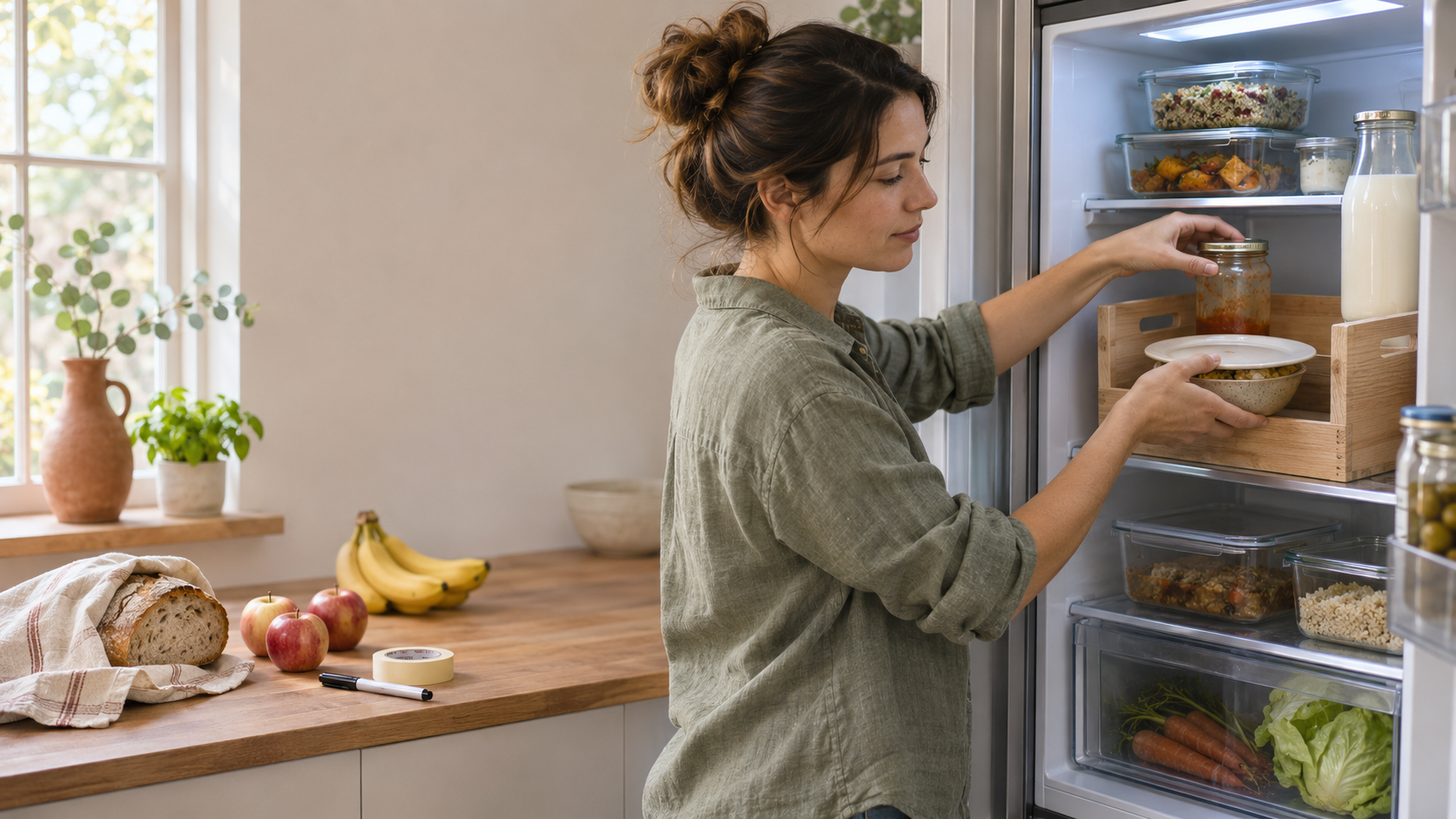
Start small: clear one shelf at eye level, label it “eat first” with a strip of tape, and put anything that’s close to its date, half-used or already open there. Check it before you cook anything new.
13. Give potatoes, bread and milk special attention
Some foods get wasted far more than others. WRAP’s July 2025 key facts, based on 2022 data, list fresh potatoes, meals, bread and milk as the UK’s most wasted edible items. Every day, UK homes throw away about 1,300 tonnes of potatoes, the equivalent of 8.2 million potatoes, including about 2.7 million that are binned whole. Bread waste equals around 24 million slices a day, and milk waste around 2.3 million glasses.
Those numbers suggest you’ll get the biggest return by focusing on a handful of staples rather than trying to perfect everything at once. Storage is part of it. UK government guidance points out that food stored badly can go off before its date, so it’s worth reading the storage line on the pack, not only the date.
Look at your own bin diary from step 2. If potatoes or bread show up again and again, buy less of them, store them as the pack suggests, and plan a specific meal for them before they start to sprout or go stale.
14. Freeze bread the day you buy it
Bread is a perfect candidate for the freezer, because you can toast slices straight from frozen. A 2025 Australian study in Future Foods by Jayanath Ananda, David Pearson and Sarah Hughes surveyed 2,033 households about their bread habits. People who froze bread wasted an average of 0.404 kg a week, compared with 0.534 kg for those who didn’t, a statistically significant difference. Around 27% froze bread straight after shopping almost every time.
The study is cross-sectional and based on self-reported waste, so it can’t prove freezing causes the drop. But the mechanism isn’t mysterious: frozen bread doesn’t go mouldy or stale.
Next time, do this: when you get a loaf home, leave out what you’ll eat in the next day or two, and freeze the rest in a bag. Pull out slices as you need them.
15. Treat your freezer as a pause button
Think of the freezer as a pause button for food. Whatever you can’t eat in time, you can stop the clock on and come back to later. Like any analogy, it’s imperfect: freezing changes the texture of some foods, and paused food can still be forgotten.
The research backs the basic idea. A study by Lei Xu, Ran Li and Brian Roe of Ohio State University, published in the British Food Journal and announced in December 2024, surveyed 1,067 US households. Discarded frozen items made up only about 6% of wasted household food, and frequent home freezing was linked to significantly less total waste. One interesting detail: about 30% more of the wasted frozen food was thrown out from the fridge than from the freezer, which suggests food often gets wasted after it’s thawed, not while it’s frozen. The study was partly funded by a gift from the Frozen Food Foundation, which is worth knowing, though public funders also backed it.
On the day you notice something won’t get eaten in time, freeze it, in portions, before it starts to turn. Thaw only what you’ll use.
16. Cook starchy staples by measure, not by eye
The most common reason food ends up in UK bins isn’t that it went off. According to WRAP’s 2025 key facts, 25% of household food waste by weight (about 1.1 million tonnes) was food that was cooked, prepared or served in excessive amounts. That’s more than any other single reason, including food that passed its date (17%).
Rice, pasta and potatoes are the usual suspects, because it’s hard to judge raw quantities by eye. A handful of dry pasta looks small. Cooked, it fills a bowl.
Give it a go: use a measuring cup or kitchen scale for rice and pasta for two weeks. Write the amount that feeds your household on a sticky note inside the cupboard door, so you don’t have to work it out again.
17. Schedule a leftovers night
Leftovers only help if somebody eats them. A randomised controlled trial with 230 Norwegian families with children, led by Kristine Myhrer Svartebekk at the food research institute Nofima and published in Cleaner Food Systems, asked one group to turn leftovers into new dinners using online resources. After seven weeks, that group had cut its dinner food waste by 39%, compared with 22% in a control group that only tracked its waste. One year later, both groups were at 29% less, and the difference between them had disappeared.
That long-term result is useful rather than disappointing. It suggests that tracking and attention keep paying off, and that a leftovers routine gives you an early boost. ReFED’s 2026 survey points the same way: using leftovers more often was the behaviour most strongly linked to reporting less waste, with a 19.6% higher probability among households facing higher grocery bills.
Test it this week: pick one night, say Thursday, and make it the night you cook nothing new. Everything that needs eating goes into a frittata, a fried rice, a soup or a “fridge buffet”.
18. Give your leftovers a deadline of their own
Leftovers vanish into containers, and nobody remembers when they were made. UK government guidance says that if you cook food on or before its use-by date, you should eat it within 48 hours or freeze it, and that once frozen food is defrosted it should be used within 24 hours. In the Food Standards Agency’s Food and You 2 survey (Wave 10), 63% of respondents said they would eat leftovers within two days, while 28% said three to five days.
Clear rules make decisions easier. Instead of standing at the open fridge wondering whether that curry is “probably fine”, you check a label and know.
Keep a marker pen and a roll of masking tape near the fridge. Every container of leftovers gets two dates: the day it was made and the day it needs to be eaten or frozen.
19. Eat the bits you usually bin
A good share of food waste is food we’ve decided not to eat. WRAP’s 2025 key facts attribute 22% of household food waste to personal preference, meaning parts people didn’t want or saw as inedible. Some of that really is inedible. Much of it is habit: broccoli stalks, crusts, herb stems, the outer leaves of a cabbage.
Here’s how the habit forms. You learn from recipes and from watching others to trim certain parts. Over time, those parts become “waste” in your head, so they go straight to the bin without a second thought. Changing the label changes the behaviour. Peeled and sliced, a broccoli stalk is just more broccoli.
A quick experiment: for one week, before you throw away any trimming, ask whether it could go into a soup, stir-fry, stock or pesto. Keep a bag in the freezer for veg trimmings, and turn it into stock when it’s full.
20. Revive limp vegetables before you write them off
Wilted doesn’t always mean finished. Leafy greens and stalky vegetables mostly go limp because they’ve lost water, and you can often put it back. America’s Test Kitchen recommends soaking leafy greens such as lettuce, spinach or rocket in ice water for about 30 minutes, then spinning them dry. For stalks like celery, broccoli, asparagus and spring onions, their testers suggest trimming the ends on a diagonal and standing them upright in cold water for about an hour, because these vegetables take up water fastest through the cut base.
This won’t rescue anything slimy, mouldy or smelling off. Those go. But a sad-looking head of lettuce or a bendy stick of celery is often a soak away from being useful again.
Say you open the crisper on a Friday and find half a bunch of celery that bends like rubber. Instead of putting it on the “deal with it later” list (a list that tends to grow, as anyone who has tried to stop procrastinating knows), trim it and stand it in a glass of cold water while you cook. By dinner, it’ll be crisp enough to chop.
21. Learn one preservation method properly
Pickling, jamming, fermenting and canning can turn a glut into weeks of meals. They can also go badly wrong if you improvise. The US Centers for Disease Control and Prevention (CDC) says that home-canned vegetables, which are low-acid foods, are the most common cause of botulism outbreaks in the United States, and that pressure canning is the only recommended method for canning low-acid foods. A boiling water bath is not enough for them.
The lesson isn’t “never preserve”. It’s “follow tested recipes”. The CDC points home cooks to the National Center for Home Food Preservation for research-based methods.
Here’s a simple way in: pick one method that suits what you waste most, such as quick fridge pickles for cucumbers and onions, or freezing fruit for smoothies. Learn it from a tested source before you branch out to canning.
22. Share what you won’t get to
Sometimes you simply have too much: a box of courgettes from a neighbour, a cake nobody finished, groceries before a holiday. Food-sharing apps like Olio exist for exactly this. You post a photo, a neighbour collects it, and the food gets eaten. In a February 2026 survey of 1,614 of its UK users, Olio found that 55% of people who share food on the app said it would probably have been thrown away otherwise.
That’s Olio’s own survey of an already engaged group, and the company itself notes that the sample leans toward people who care about food waste. Even so, it gives a sense of what sharing can rescue.
Your move: before your next trip away, list what’s left in the fridge and offer it to a neighbour, a colleague or a local sharing app. Being generous with food is also one of the easiest ways to be friendly with people you barely know.
23. Get the whole household on board
One careful person can’t stop a fridge full of half-eaten tubs if everyone else shops and cooks differently. The SEI researchers who ran the Gothenburg co-design project, Alexandra Fransson, Fiona Lambe and Silvija Marcinkevičiūtė, wrote in January 2025 that motivation was essential: without it, even well-designed interventions didn’t work. They also noticed something about families. Some sceptical participants said they’d accept a labelling system if their children were the ones proposing it.
So don’t impose a system. Invite people into it. Ask what annoys them about the fridge, which foods they always forget, and what would make leftovers more appealing. Kids often love being in charge of the “eat first” shelf.
If the conversation feels loaded (food can be surprisingly personal), it helps to approach it the way you’d talk to your partner about needs that aren’t being met: calmly, specifically, and without blame.
24. Stack small habits instead of chasing perfection
You don’t need all 23 steps above to see a difference. ReFED’s January 2026 survey found that each additional food-saving behaviour a household adopted was associated with about an 8% higher probability of reporting less waste, among households facing higher grocery bills. Three behaviours together were associated with at least a 24% higher probability. Again, this is self-reported and correlational, but the direction is encouraging: small habits add up.
The trick is to stack them, one at a time, until each feels automatic. That’s how most good habits stick.
Choose three steps from this list that fit your life right now. Practise them for a month before you add another.
What to do when you slip
You’ll have weeks when the bin fills up anyway. A party, a stomach bug, a run of late nights, and suddenly the eat-first shelf looks like a science project. That’s normal, and how you respond matters more than the slip itself.
Research on other habits points to self-compassion as the better response. In a 2023 study in Appetite, Charlotte Hagerman and colleagues at Drexel University tracked adults in a weight-loss programme through smartphone surveys several times a day. When people responded to a dietary lapse with more self-compassion, they reported better mood and more self-control in the hours that followed. Harsh self-criticism tends to do the opposite: it makes the slip feel like proof that the whole effort is pointless.
The Norwegian leftovers trial offers a food-waste version of the same lesson. A year after the study, the families who had received extra help and those who had only tracked their waste ended up at the same level, both about 29% lower than before. Progress wasn’t a straight line, but it stuck.
So when you slip, skip the guilt. Note what happened in your bin diary, pick the one habit that will get you back on track (often the fridge check before shopping), and restart the next day. If you notice you’re being hard on yourself more generally, these ideas on how to stop hating yourself and how to turn a bad day around are worth a read.
Conclusion
Food waste at home isn’t a character flaw. It’s the result of small gaps: a fridge that’s slightly too warm, a pack that’s slightly too big, a plan that didn’t survive Wednesday. Close a few of those gaps and the bin gets lighter, the grocery bill gets smaller, and you stop feeling that little pang every time you scrape a plate.
Pick one step for this week. The fridge thermometer, the eat-first shelf or the two-week bin diary are all good starting points. Then come back and add another. For more ideas on running a calmer, less wasteful household, browse the Home section.