
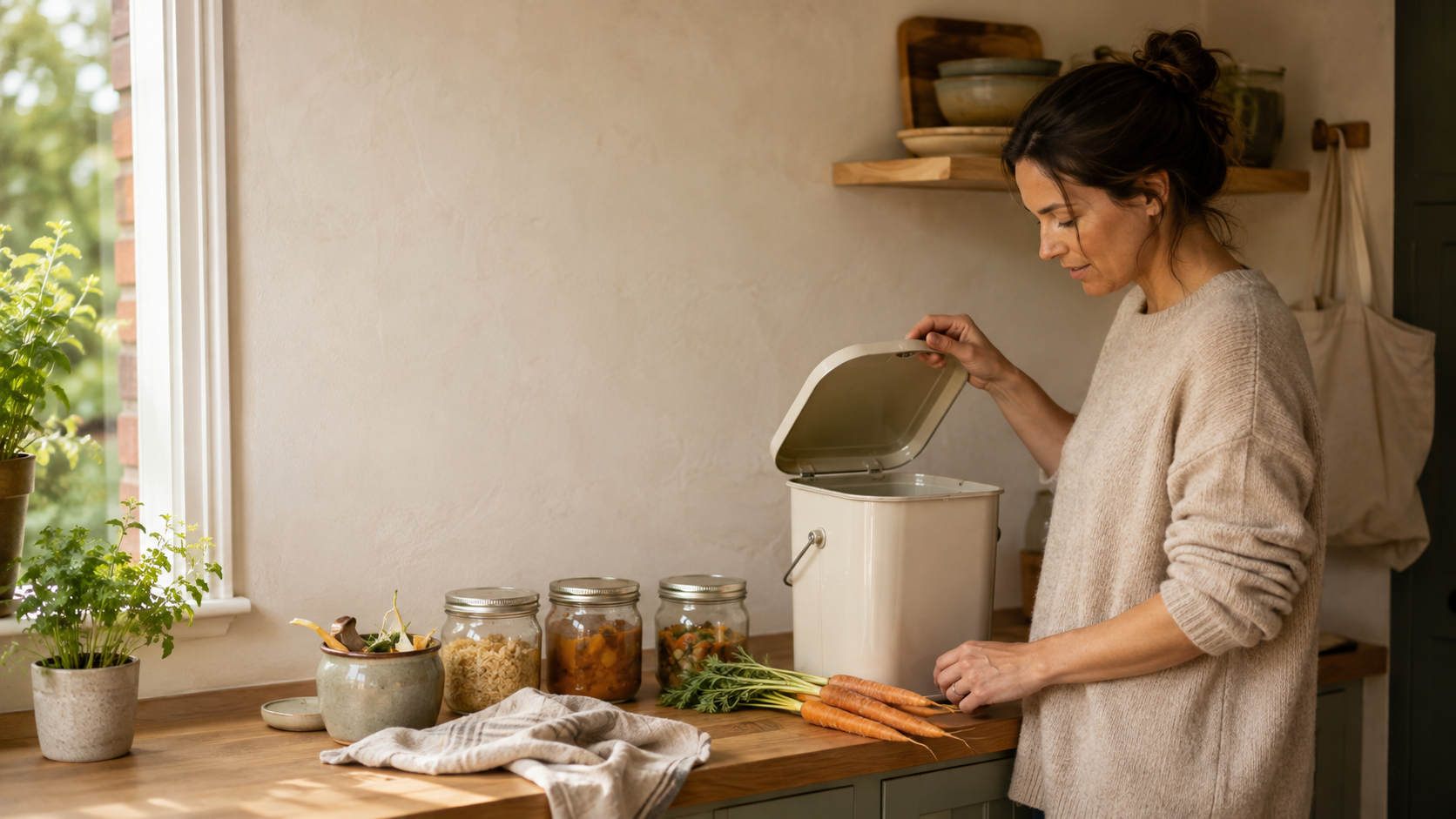
Take your kitchen bin out one more time this week and look at it. Really look. A torn bread bag, half a tub of yoghurt, a takeaway box, three pieces of junk mail, a jar you meant to rinse. None of it felt like a decision. That’s the problem.
The numbers behind that bag are big. The World Bank’s What a Waste 3.0 (2026) puts global municipal solid waste at 2.56 billion tonnes in 2022, a level its 2018 edition hadn’t expected until 2030. Closer to home for European readers, Eurostat reported in March 2026 that each person in the EU generated 517 kg of municipal waste in 2024, six kilos more than the year before and 38 kg more than in 2014.
You can’t fix a global system from your kitchen. You can, though, change what goes into your own bin, and most of the changes save money too. The trick is to stop thinking about recycling first. Recycling is what you do with trash that already exists. The bigger win sits further upstream: buying less of what you’ll throw out, using what you have, and keeping things in use for longer. If you like building small good habits that compound, this is a great place to practise.
Below are 16 ways to do it, each tied to real data or research, plus what to do when you slip.
1. Look in your bin before you change anything
Most of us are terrible judges of our own waste. In WRAP’s Household Food Management Survey (5,509 UK adults, fieldwork June–July 2025, reported March 2026), eight in ten people said they waste less food than the average household. When researchers showed them pictures of typical UK food waste, that share went up to 85%, not down. Mathematically, most of those people can’t be right.
That gap matters because you can’t cut what you can’t see. A short audit turns a vague guilty feeling into a list. Once you know that your bin is mostly yoghurt pots and bagged salad, the next steps pick themselves.
Here’s a simple way in: for seven days, jot down every item you throw away on a note stuck to the bin lid, or snap a photo before each bag goes out. At the end of the week, circle the three things that show up most. Those are your targets for the rest of this list. If you enjoy this kind of honest look in the mirror, self-observation works the same way for habits beyond the kitchen.
2. Buy the amount you’ll actually eat
You’d expect shopping lists and meal plans to be the magic bullet. The evidence is more interesting than that.
Gülbanu Kaptan, Tom Quested, Chuyao Kuang and Marcel Torode weighed the actual food waste of 1,783 UK households and published the results in Sustainable Production and Consumption in August 2025. Two behaviours stood out. People who rated themselves excellent at buying the right amount of food wasted 28.2% less than those who didn’t, and excellent leftover users wasted 36.6% less. Meal planning, list-making and checking the fridge, on their own, weren’t significantly linked to measured waste. The study is correlational and each home was measured for only one or two weeks, so treat it as a strong hint rather than a verdict.
A US survey of about 1,000 households, published in Foods in November 2025 by X. Yang, Nevin Cohen and colleagues, found something that fits: the group that planned least and shopped most casually reported throwing food away around seven times a week, against roughly 4.5 times for everyone else.
So the list still helps, but only if it changes quantities. Next time, do this: before you write the list, check what’s left from last week’s shop, then write amounts next to each item (“2 peppers”, not “peppers”). Block a fixed 15-minute slot for it in your week, the way you would with time blocking.
3. Read date labels like a food scientist
A lot of perfectly good food goes in the bin because of a misread date. ReFED’s July 2025 consumer food waste explainer, drawing on a 2025 survey run for Johns Hopkins University, Harvard Law School’s Food Law and Policy Clinic and ReFED, found that 43% of US adults “always or usually” throw food away near or past the date on the label. Some 44% wrongly believe the federal government regulates those labels. ReFED estimates nearly 1.5 million tons of food are discarded in US homes because of date-label worries, and puts the cost of uneaten food at almost $800 per person per year.
The distinction is simple. “Best before” or “best by” is about quality. “Use by” is about safety. A best-before yoghurt that looks, smells and tastes fine is usually fine. A use-by chicken breast is not something to gamble on.
Your move: tonight, pull out everything in your fridge with a date on it. Anything “best before” and close to the date goes to the front shelf to eat first. Anything “use by” that you won’t eat in time goes into the freezer today, which ReFED rather nicely describes as a pause button for food.
4. Give leftovers a fixed night of the week
Good intentions about leftovers rarely survive a busy Wednesday. A fixed slot does.
In two randomised field studies published in Resources, Conservation & Recycling in April 2023, A. Cooper, Erica van Herpen and colleagues asked families in Canada (1,205 households) and the US (1,047 households) to cook one “use-up” meal a week from food already in the house. They used a loose formula: a base like rice or potatoes, a vegetable or fruit, a protein, plus a herb or sauce. Over five weeks, waste fell 33% from baseline in Canada and 46% in the US, about 27% and 33% below control groups. The caveats are real. Waste was self-reported, many US families dropped out, the program was funded by Unilever, and eight weeks later the groups no longer differed significantly. The effect needs maintaining.
Picture this: it’s Thursday, the fridge has two eggs, half an onion, cooked rice from Monday and a sad handful of spinach. With the formula, that’s fried rice in twelve minutes. Without it, it’s a takeaway and a bin bag.
Test it this week: pick one evening and name it (“Fridge Night” works). Attach it to something you already do on that day, a trick known as habit stacking, so it doesn’t depend on willpower.
5. Compost what you can’t eat
Peels, cores, coffee grounds and eggshells are going to exist however careful you are. The question is where they end up.
Follow the chain. Food scraps in a sealed landfill break down without much oxygen. That kind of decay produces methane, a greenhouse gas far stronger than carbon dioxide over the short term. In a compost heap or a council food caddy, the same scraps break down with air and end up as soil improver or biogas instead. UNEP’s Food Waste Index Report 2024, the latest edition, estimates that food loss and waste generate up to 10% of global greenhouse gas emissions, and that households account for 60% of the 1.05 billion tonnes of food wasted in 2022.
One more data point, with a big asterisk. In the Kaptan study from step 2, homes that composted had about 553 g less edible food in their bins each week. Part of that is simply bookkeeping: food that goes on a home heap never reaches the bin the researchers weighed. So read it as “composters bin less”, not as proof that composting makes you waste less.
Start small: if your council collects food waste, use the caddy, even for a week. If not, a small bokashi bin works in a flat, and a simple heap works in a garden.
6. Keep a bag on you, always
Small charges change behaviour more than lectures do. England’s single-use carrier bag charge is one of the cleanest real-world tests of that idea.
According to Defra’s data for 2025 to 2026, published in July 2026, the seven main retailers sold 126 million single-use plastic bags that year. That’s down 23% on the year before and 90% since 2016 to 2017, or about two bags per person. WRAP had reported roughly 7.6 billion bags from the main retailers in 2014, before the charge, though Defra notes that figure didn’t cover exactly the same set of shops.
Bags are a small slice of household waste. The lesson is bigger: when the easy option costs even a little, people find another way. You can give yourself that nudge without waiting for a law.
A quick experiment: fold one reusable bag into every coat, backpack and car door you own. If you keep forgetting, the trouble is recall, not motivation, and a few memory tricks like a note on the front door genuinely help.
7. Swap disposables for reusables, then actually use them
Reusable isn’t automatically greener. It only wins once you’ve used it enough times.
A 2025 life cycle study in Acta Periodica Technologica by Sharanappagouda Kadabinakatti and Amar Shinde compared single-use plastic and foil takeaway containers with reusable plastic and stainless steel ones. The reusables had to be used at least three to five times to beat the throwaways on climate impact. Use a reusable container once and its footprint was around three times higher. Most of that comes from making the thing in the first place, which is why every extra use pays down the debt.
Think of it like a gym membership. The card in your wallet does nothing for your fitness. The visits do. The analogy holds for the payback logic. It breaks down in one way: unlike a gym, a reusable that sits in a cupboard can still be passed on to someone who’ll use it.
Here’s the practical version. Don’t buy a new set of bamboo everything. Use what you already own: old jars for leftovers, a mug for office coffee, tea towels instead of kitchen roll. If you want colleagues to join you, a shared mug shelf does more than a memo, and the ideas in how to influence people at work apply nicely here.
8. Choose loose, refill and bigger packs
Packaging is the part of the bin that arrives uninvited. Eurostat’s figures, released in October 2025, show the EU generated 177.8 kg of packaging waste per person in 2023. That was 8.7 kg less than in 2022 but still 21.2 kg more than in 2013. Paper and cardboard made up 40.4% of it and plastic 19.8%, about 35.3 kg of plastic packaging per person, of which 14.8 kg was recycled.
| Packaging waste per EU resident, 2023 (Eurostat) | kg per person |
|---|---|
| All packaging generated | 177.8 |
| All packaging recycled | 120.0 |
| Plastic packaging generated | 35.3 |
| Plastic packaging recycled | 14.8 |
Look at the gap in that last pair. Well under half of plastic packaging gets recycled, so not buying it in the first place does more than sorting it well afterwards.
Give it a go: on your next shop, pick three items you usually buy wrapped (apples, carrots, rice, say) and buy them loose or in the largest pack you’ll genuinely finish. Watch that “genuinely”: a giant bag of spinach that turns to slime is worse than a small one you eat.
9. Drink tap water from a bottle you refill
Bottled water creates a steady stream of plastic, and it may not be doing your body any favours either.
Sarah Sajedi, Chunjiang An and Zhi Chen of Concordia University reviewed more than 140 studies on single-use plastic water bottles in the Journal of Hazardous Materials (June 2025). They estimate people ingest 39,000 to 52,000 microplastic particles a year on average, and that regular bottled-water drinkers take in about 90,000 more particles than people who mainly drink tap water. The particles shed during manufacturing, storage, transport and handling, and when bottles are exposed to heat or sunlight. This is a review, the long-term health effects are still poorly understood, and measurement methods aren’t standardised, so the numbers are estimates rather than settled facts. Even so, Sajedi’s own advice is that bottled water makes sense in emergencies, not as an everyday habit.
Your move: keep one refillable bottle by the door and one at work. If you don’t like the taste of your tap water, a jug filter is a smaller waste stream than a weekly case of bottles.
10. Repair before you replace
Broken things are where a lot of avoidable waste comes from, and the rules are slowly shifting in your favour. The European Commission estimates that throwing away consumer goods that could have been fixed produces 35 million tonnes of waste a year in the EU, plus 261 million tonnes of greenhouse gas emissions. The EU’s Right to Repair Directive, adopted by Parliament in April 2024, was due to apply from summer 2026. When a product breaks within the legal guarantee and you choose repair, the guarantee is extended by 12 months. For certain products, manufacturers must also offer repair after the guarantee runs out, and independent repairers get more room to work.
Euronews reported in September 2026 that only about 5 million of roughly 28 million household breakdowns a year end with a technician fixing the device, and that only 10 member states had met the deadline to write the rules into national law. KU Leuven researcher Alex Bunodiere told Euronews the main obstacle is price, not access. So check, and don’t assume repair is pointless.
Next time something breaks, ask for a quote before you shop for a replacement, and look for a local repair café. If you have a “I’ll fix it eventually” pile, that’s procrastination wearing an eco badge. Pick one item and book it in this month.
11. Look secondhand first
Buying used keeps an object in circulation instead of creating demand for a new one, and it’s going mainstream fast. ThredUp’s 2026 Resale Report (April 2026), a commercial report produced with research firm GlobalData and based on a survey of 3,268 US adults in January–February 2026, says the US secondhand clothing market grew nearly four times faster than the wider clothing market in 2025. It projects the global secondhand apparel market will reach $393 billion by 2030. Bear in mind that ThredUp sells secondhand clothes, so it has every reason to talk the market up.
One honest caveat: secondhand only shrinks waste if it replaces a new purchase. A drawer full of thrifted bargains you never wear is still a drawer full of clothes you never wear.
A quick experiment: before buying anything non-perishable this month (a lamp, a jacket, a kids’ bike), spend five minutes checking local resale apps, charity shops or community groups first. Note how often you find it.
12. Buy fewer, better clothes
Clothing is the slow leak in most households. The European Environment Agency reported in March 2025 that the average EU resident bought 19 kg of clothing, footwear and household textiles in 2022, up from 17 kg in 2019. That’s roughly a large suitcase of new textiles per person per year. The EEA ranks textiles among the top five household consumption categories for pressure on the environment and climate. Its separate data shows only about 1.7 kg of textiles per person were reused in 2021.
The EEA’s conclusion is that the most direct fix is longevity: making, buying and keeping clothes that last. That means fewer, sturdier pieces that work with what’s already in your wardrobe, and looking after them so they survive.
Test it this week: before you buy any piece of clothing, name three things you already own that you’d wear it with. Can’t name three? Leave it in the basket for 48 hours. Most impulse buys don’t survive two days.
13. Borrow the things you use twice a year
Drills, carpet cleaners, tents, pasta machines: a lot of what we own spends its life in a cupboard. London’s Library of Things, which rents household items from neighbourhood lockers, is a good case study in what happens when people can borrow instead.
Its 2024/25 impact report says more than 34,000 people have joined, members have saved £8.6 million, and 423 tonnes of electricals have been reused, with more than 60,400 items shared. Among members who responded to its survey, 48.8% said they now buy fewer things overall and are more likely to rent or buy secondhand. These are the organisation’s own figures and partly self-reported, so read them as an encouraging case, not an independent evaluation. Still, the shift in buying habits is the interesting part: borrowing seems to change how people think about ownership, not just which drill they use.
Start small: if there’s no library of things near you, ask one neighbour whether they’d swap tools. It’s an easy opener, and the advice on how to be friendly helps if that feels awkward.
14. Refuse what you never asked for
Every freebie is future trash with a delay. The pen at the conference, the flyer on the doorstep, the plastic cutlery in the delivery bag, the receipt you’ll never look at. Each one enters your home without a decision and leaves it as waste.
The logic runs straight up the waste hierarchy. Recycling deals with waste after it exists; refusing stops it existing in your house at all. UNEP’s Global Waste Management Outlook 2024 shows why prevention matters at scale: the direct global cost of managing municipal waste was about $252 billion in 2020 and could nearly double to $640.3 billion a year by 2050 without urgent action. With prevention and better management, the report’s modelling holds the net cost to $270.2 billion. Most of that is beyond your control, but the starting point is the same: less coming in.
Here’s a simple way in: practise one polite line (“No thanks, I’m fine”) and use it for a week. Tick “no cutlery” on delivery apps, opt out of paper statements, and put a no-junk-mail sticker on your letterbox. If saying no to people feels uncomfortable, it gets easier with practice, and feeling at ease around people helps.
15. Recycle properly, as the last step
Recycling isn’t the hero of this story, but it’s still part of it. Eurostat’s March 2026 figures show the EU recycled 248 kg of municipal waste per person in 2024, or 48.1% of everything generated. That’s barely up from 48.0% in 2023 and 43.0% in 2014. Progress is real but slow, which is one more reason the earlier steps carry most of the weight.
| EU municipal waste per person (Eurostat, 2026) | Generated (kg) | Recycled (kg) | Recycling rate |
|---|---|---|---|
| 2014 | 479 | 208 | 43.0% |
| 2023 | 511 | 246 | 48.0% |
| 2024 | 517 | 248 | 48.1% |
What you can do is make sure the things you do recycle actually get recycled. Rules differ by council, so the right answer for your street might be different from your friend’s across town.
Give it a go: print your local recycling guide and stick it inside a cupboard door near the bins. Then agree on the system with whoever you live with. Bin arguments are a classic household flashpoint, and a few tips on avoiding misunderstandings can save you a cold war over the yoghurt pots.
16. Plan holidays and parties for real appetites
Celebrations are when waste spikes. Food, wrapping, decorations, single-use plates. With December coming, this one is timely.
Alexandra Geddes, Acting Chief Executive of the NSW Environment Protection Authority, said in a December 2025 statement that Christmas is one of the biggest food waste periods of the year, and that the fixes are simple. Her advice was practical: plan ahead, clear out the pantry, fridge and freezer before the big day so nothing gets forgotten, and keep food sealed, cool and dry, since moisture and temperature drive early spoiling. “The holidays should be a time for joy, not waste,” she said. The NSW EPA puts the cost of food waste at around A$2,100 per household per year.
Why does this work? Most party waste comes from over-catering out of fear of running short. Clearing space first means leftovers can actually be stored, and a plan based on headcount means less goes uneaten in the first place.
Next time you host, plan portions per guest instead of guessing, make room in the fridge and freezer a few days before, and have containers ready so guests can take leftovers home. For wrapping, reuse gift bags and boxes, or skip wrap entirely for adults.
What to do when you slip
You will slip. You’ll forget the bag, buy the giant spinach, order the takeaway that comes in four plastic boxes. That isn’t failure. It’s what building a habit looks like in the middle.
A December 2024 systematic review in Healthcare by Ben Singh and colleagues at the University of South Australia pooled 20 studies with 2,601 participants. Where studies measured it, healthy habits took a median of 59 to 66 days to form, and individual times ranged from four days to almost a year. The popular “21 days” figure doesn’t hold up. The review covered health behaviours rather than waste, but the lesson carries over: early wobbles are normal, and repetition in a consistent context is what makes a behaviour automatic.
The Cooper study from step 4 shows the flip side. Families cut their food waste sharply during the program, then drifted back toward the control group once the weekly structure stopped. The habit wasn’t locked in yet. So when you slip, don’t drop the whole system. Ask what got in the way (no bag in the car? no plan for Thursday?) and fix that one piece.
Go easy on yourself, too. Beating yourself up over a pizza box is how small lapses turn into quitting. If you tend to be your own harshest critic, how to stop hating yourself has some useful ideas, and if a slip ruins your mood for the day, here’s how to turn a bad day around. Then pick up the next step tomorrow.
Conclusion
Producing less trash doesn’t take a jar-of-a-year lifestyle. Most of the gains come from a few unglamorous moves: knowing what’s in your bin, buying amounts you’ll really use, treating the freezer as a pause button, and keeping things in use longer through reuse, repair, borrowing and buying secondhand. Recycling sits at the end, catching what’s left.
Pick two steps from this list, the two that match whatever filled your bin this week, and run them for a month before adding more. Your bin will tell you how it’s going. For more practical ideas on running a calmer, cheaper household, browse the Home section.